Aa
  • Read, Watch, Listen
  • TJI Series
  • Community Action
  • Events
  • Zedi
Follow us and continue the conversation
  • LinkedIn
  • Instagram
  • FaceBook
  • X
  • YouTube
Test yourself with the TJI Quiz!

Adjust size of text

Aa

Follow us and continue the conversation

  • LinkedIn
  • Instagram
  • FaceBook
  • X
  • YouTube

Your saved articles

You haven't saved any articles

What are you looking for?

Original reporting, insightful analysis and diverse views, delivered straight to your inbox

  • LinkedIn
  • Instagram
  • FaceBook
  • X
  • YouTube
Your support fuels our mission to inform, entertain and inspire.

The Jewish Independent is bound by the Standards of Practice of the Australian Press Council. If you believe the Standards may have been breached, you may approach The Jewish Independent or make a complaint to the Australian Press Council in writing at www.presscouncil.org.au. The Council may also be contacted on 1800 025 712.

  • Our Story
  • Contact us
  • Our Team
  • Support us
  • Guidelines
  • Pitch your idea
  • Republishing us
  • Community Action
  • Our Awards
  • LinkedIn
  • Instagram
  • FaceBook
  • X
  • YouTube
Aboriginal FlagTorres Strait Islanders Flag

The Jewish Independent acknowledges Aboriginal and Torres Strait Islander peoples as the Traditional Owners and Custodians of Country throughout Australia. We pay our respects to Elders past and present, and strive to honour their rich history of storytelling in our work and mission.

© The Jewish Independent 2026All Rights Reserved
Website design and development by Your Creative, MelbourneTerms & ConditionsPrivacy Policy
HomeRead, Watch, ListenArts & Culture
OpinionArts & CultureAustralia

Funding doxer is a stain on Creative Australia

Matt Chun's history of intimidating the Jewish and pro-Zionist creative community predates last year's infamous campaign.
Michael Visontay
Print this
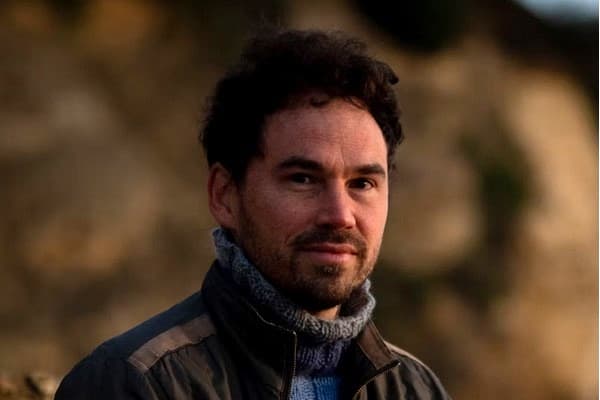
Matt Chun

Australian illustrator Matt Chun (4A Centre for Contemporary Asian Art)

Published: 6 January 2025

Last updated: 7 January 2025

One of the most troubling schisms that occurred in the aftermath of October 7 was the response of the creative communities. Weeks of silence from many arts organisations and muted condemnation of Hamas at best. Jewish artists, writers and others felt a cold shoulder from their communities and many joined a Whatsapp support group.

The hostility reached a nadir early last year with death threats against Jewish artists, loss of livelihood and the doxing of some 600 members of the Whatsapp group, which became an international news story.

Although government arts agencies were not directly involved in any of the above, the main funding body, Creative Australia (CA), has played a role in supporting one of the most virulent public campaigners against Israel and Jews within the Australian arts community.

His name is Matt Chun, real name Matthew Jones. Chun is a NSW-based illustrator and author of children’s books. He was also one of the leaders of the doxing campaign and has a prominent history of anti-Zionist advocacy. Of course, he is entitled to hold these views in a country such as ours. But should he be rewarded with public funding of his arts projects?

In May 2023, Jones and his artistic collaborator Amy McQuire received a grant of $42,452 from Creative Australia (formerly the Australia Council for the Arts) to produce a picture book titled Policing In Australia, to be published by August this year.

Last month the Australian disclosed the awarding of the grant by Creative Australia (CA) in response to a question on notice in a Senate estimates hearing. The project description provided by CA said the book “will deepen Matt and Amy’s proven collaborative partnership, which led to the creation of the successful, 2022 Australian Book Industry Awards shortlisted children’s picture book Day Break,” the Australian reported.

Zionists are thoroughly racist, thoroughly anti-Indigenous and thoroughly committed to colonialism.

Matt Chun, 2024

Day Break bills itself as a picture book that “refocuses the narratives around Australia Day on Indigenous survival and resistance” and one that would “open up a conversation on truth-telling for the next generation”, the report added.

Chun had also received another Australia Council grant in 2017 for a residency in Taiwan. So he has been on the public arts radar for a while, and his artistic concerns well-known.

But so, too, are his views on Israel and Jews. “Having now read the entire transcript, I’ll research and publish a number of posts about specific individuals from this leaked group chat, and the organisations with which they intersect,” he wrote on Instagram at the time of the doxing, the Australian reported.

“The group chat confirms what we already know: Zionists are thoroughly racist, thoroughly anti-Indigenous and thoroughly committed to colonialism.”

Now, it needs to be made clear at this point that Chun was awarded his grant in May 2023, before October 7, before his involvement in the doxing campaign - something the Australian failed to point out in its report.

However, his poisonous advocacy against Israel and Jewish causes was publicly known well before this year.

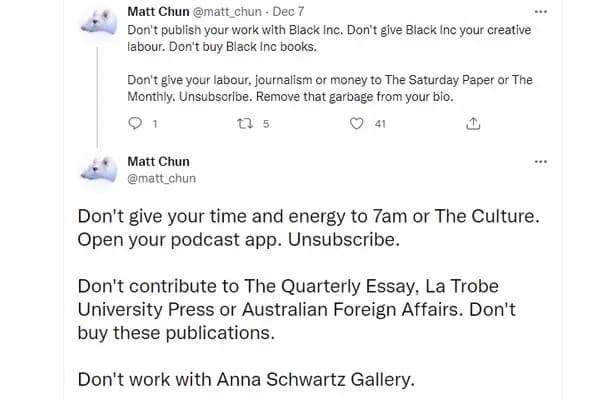
Matt Chun Twitter Post, December 2021

In December 2021, Chun initiated an online campaign against Schwartz Media, which publishes The Monthly, The Saturday Paper, Black Inc books and a raft of other publications.

The campaign appeared to have been inspired by a book published by ABC journalist John Lyons, Dateline Jerusalem: Journalism’s Toughest Assignment (Monash). In his book Lyons claimed Australian pro-Israel advocates had bullied Australian media into self-censoring over stories that were critical of Israel.

Within the book, Lyons claimed Schwartz Media, which is owned by Melbourne Jewish businessman Morry Schwartz, has deliberately ignored the Israeli-Palestinian conflict in its publications. Matt Chun, citing Lyon’s book, created a publication titled The Sunday Paper, which had a list of pro-Palestinian content as a corrective to The Saturday Paper’s alleged omissions.

Chun called for a boycott of all Schwartz Media publications, and went further, calling for a boycott of the prominent Melbourne art gallery owned by Schwartz’s wife, Anna.

“Don’t give your labour, journalism or money to The Saturday Paper or The Monthly. Unsubscribe. Remove that garbage from your bio,” he wrote on Twitter at the time.

Again, Chun is entitled hold these views and to publicly advocate them, offensive as they are.

But Creative Australia has a responsibility not to swallow them uncritically. It knew of them, or should have known of them, as part of its background research into assessing his grant application.

The criteria for receiving public funding go beyond narrow technical skill and projects. Government grants are designed to support an artist, not just their project, in the interests of enriching society. The applicant’s character and broader background form a crucial part of their fitness for being approved.

Even before 2023, Chun had been aggressively advocating censorship, ghosting and harassment – behaviours in diametric opposition to the flourishing of artistic expression that public funding is designed to promote. His activism should have disqualified him from receiving a grant.

Creative Australia was derelict in approving the grant to him and his collaborator. But it goes beyond that. When Chun’s involvement in the doxing campaign became known in February – a campaign so infamous that it prompted the Albanese government to tighten its anti-doxing legislation – Creative Australia could have decided to rescind the grant to Chun and McGuire.

It did not. It should have. The grant funds a project, which benefits a person. Chun is not a fit and proper person to receive government funding. 

The most benign interpretation of this affair is an ignorance of Chun’s anti-Zionist and anti-Jewish activism, which is hard to believe given the coverage it received. To be blunt, the ongoing funding reflects a tacit tolerance of his offensive activism. It is a stain on Creative Australia.

You might also like
  • Rachel Moshel: Creating a space for Jewish art and joy
    Gideon Cohen
  • Prime minister’s absence exposes weakness in Royal Commission hearings
    Michael Visontay
  • What ‘Zionism’ means in Israel:  it’s not what you think
    Ittay Flescher
logomark.67a07ee3
We believe in the free flow of information

Republish our articles for free, online or in print, by using our Creative Commons licence

You might also like

    Royal Commission final
    Royal CommissionNewsAustralia

    Strategies for cohesion final focus of Royal Commission hearings

    Peter Kohn 1
    vandalism car woollahra fuk israel farhat
    Australia

    Court decision fails to understand when ‘Fuk Israel’ becomes antisemitic

    Jeremie Bracka 6
    Tame
    Australia

    Tame apologises – but with little grace

    Deborah Stone

About the author

Michael Visontay

More from the author

NewsAustralia

Matt Chun’s hate speech prompts change in arts funding policy

AnalysisAustralia

Mishandled antisemitism education is not just ineffective, it’s dangerous

FeatureLifestyle

Where Shtisel meets The Jetsons

ReviewIsrael

Beinart’s utopian vision ignores awkward truths

Comments3

  • Avatar of Mihali Dellaportas

    Mihali Dellaportas14 February at 04:25 am

    This person, Matt Chun may be a skilled graphic artist or whatever he is, and he is entitled to a point of view, within reason. But his disturbing and bizarre views on the Bondi terrorist attack in which 15 innocent people were murdered, are simply morally repugnant and reprehensible! How could anyone think that they deserved to die! No, Chun should immediately at the very least, apologize. And to think I almost purchased one of his books! Congrats to Dymocks for refusing to continue stocking his material.

  • Avatar of Martin Munz

    Martin Munz9 January at 09:56 pm

    Would you please replace my original comment that had a couple of typos in its final paragraph with the corrected version below. Thanks. Martin.

    I write as a former staff member of the predecessor organisation to Creative Australia (the Australia Council).
    Although Creative Australia has changed in the years since I left the Australia Council, I assume its process for assessing applications does not extend, nor should it, to assessing an artist’s views on matters unrelated to the published assessment criteria for receiving a grant. This is fundamental to grant assessing otherwise neither the applicant nor grant assessors know the criteria against which competitive grant decisions are to be made.
    To suggest that Creative Australia should be aware of an applicant’s views on matters unrelated to an application “as part of its background research into assessing his grant application” mistakes how grant assessment is done. Grant assessment is based on what applicants submit in their applications against the assessment criteria, not amorphous and unknowable “background research.” In the context of the wider article this suggestion seems to foreshadows a sort of political correctness as an undisclosed criterion in the assessment process. A criterion that would not meet widely accepted notions of equity and fairness.
    Public art funding mainly assists artists to make specific works of art, save where awards are made that acknowledge life achievements of artists who have made exceptional contributions to the arts. However, most grants are to support specific art projects. They are not designed to provide artist with a living “in the interests of enriching society.” It would be good if there were schemes to do so, but unfortunately a general scheme of support for artists is not available in Australia. Even if it were, that support would need to be assessed against artistic criteria best judged by artist peers to avoid the creation of a politically approved cohort of artists that met undefined “character and broader background” checks. After all art is not a security business. Art, amongst other things, is made by artists to help us think about received ideas and expressive conventions.
    As offensive as some might find Mr. Chun’s activism, is it not disingenuous on the one hand to defend his right to his opinions and advocacy, and on the other to condemn Creative Australia for making a grant for a project apparently unrelated to that advocacy? To further suggest that it should rescind its grant because the artist has persisted with his unrelated advocacy, even if by dubious means, after the grant was made, assumes Creative Australia has the novel power to so. I doubt that it does.

  • Avatar of Martin Munz

    Martin Munz9 January at 10:15 am

    I write as a former staff member of the predecessor organisation to Creative Australia (the Australia Council).
    Although Creative Australia has changed in the years since I left the Australia Council, I assume its process for assessing applications does not extend, nor should it, to assessing an artist’s views on matters unrelated to the published assessment criteria for receiving a grant. This is fundamental to grant assessing otherwise neither the applicant nor grant assessors know the criteria against which competitive grant decisions are to be made.
    To suggest that Creative Australia should be aware of an applicant’s views on matters unrelated to an application “as part of its background research into assessing his grant application” mistakes how grant assessment is done. Grant assessment is based on what applicants submit in their applications against the assessment criteria, not amorphous and unknowable “background research.” In the context of the wider article this suggestion seems to foreshadows a sort of political correctness as an undisclosed criterion in the assessment process. A criterion that would not meet widely accepted notions of equity and fairness.
    Public art funding mainly assists artists to make specific works of art, save where awards are made that acknowledge life achievements of artists who have made exceptional contributions to the arts. However, most grants are to support specific art projects. They are not designed to provide artist with a living “in the interests of enriching society.” It would be good if there were schemes to do so, but unfortunately a general scheme of support for artists is not available in Australia. Even if it were, that support would need to be assessed against artistic criteria best judged by artist peers to avoid the creation of a politically approved cohort of artists that met undefined “character and broader background” checks. After all art is not a security business. Art, amongst other things, is made by artists to help us think about received ideas and expressive conventions.
    As offensive as some might find Mr. Chun’s activism, is not it disingenuous on the one hand to defend his right to his opinions and advocacy, and on the other to condemn Creative Australia for making a grant for a project apparently unrelated to that advocacy. To further suggest that it should have rescinded its grant because the artist has persisted with his unrelated advocacy, even if by dubious means, after the grant was made, assumes it has that novel power to so. I doubt that it does.