Aa
  • Read, Watch, Listen
  • TJI Series
  • Community Action
  • Events
  • Zedi
Follow us and continue the conversation
  • LinkedIn
  • Instagram
  • FaceBook
  • X
  • YouTube
Test yourself with the TJI Quiz!

Adjust size of text

Aa

Follow us and continue the conversation

  • LinkedIn
  • Instagram
  • FaceBook
  • X
  • YouTube

Your saved articles

You haven't saved any articles

What are you looking for?

Original reporting, insightful analysis and diverse views, delivered straight to your inbox

  • LinkedIn
  • Instagram
  • FaceBook
  • X
  • YouTube
Your support fuels our mission to inform, entertain and inspire.

The Jewish Independent is bound by the Standards of Practice of the Australian Press Council. If you believe the Standards may have been breached, you may approach The Jewish Independent or make a complaint to the Australian Press Council in writing at www.presscouncil.org.au. The Council may also be contacted on 1800 025 712.

  • Our Story
  • Contact us
  • Our Team
  • Support us
  • Guidelines
  • Pitch your idea
  • Republishing us
  • Community Action
  • Our Awards
  • LinkedIn
  • Instagram
  • FaceBook
  • X
  • YouTube
Aboriginal FlagTorres Strait Islanders Flag

The Jewish Independent acknowledges Aboriginal and Torres Strait Islander peoples as the Traditional Owners and Custodians of Country throughout Australia. We pay our respects to Elders past and present, and strive to honour their rich history of storytelling in our work and mission.

© The Jewish Independent 2026All Rights Reserved
Website design and development by Your Creative, MelbourneTerms & ConditionsPrivacy Policy
HomeRead, Watch, ListenIsrael
FeatureIsrael

‘It’s like whack-a-mole’: Volunteers document West Bank violence

Sam Stein
Print this

Published: 23 June 2023

Last updated: 5 March 2024

SAM STEIN: Jewish advocates are staying in Palestinian villages to report settler violence and military activity to Israeli police.

A group of Israeli and Diaspora Jews are living in West Bank Palestinian villages to document violence and support shepherds and farmers.

The Center for Jewish Non-Violence’s (CJNV) Hineinu project brings Jewish activists to live in Palestinian villages in Masafer Yatta and engage in full-time solidarity activism.

Masafer Yatta is a region in the southern end of the West Bank that faces rampant settler violence from notorious settler outposts such as Havat Maon, Mitzpe Yair, and Havat Talia. Many residents of Masafer Yatta also face expulsion from an area the Israeli military has declared “Firing Zone 918.”

While on Hineinu, which is Hebrew for “we are here,” participants spend three months living in Masafer Yatta. According to CJNV, they learn Arabic and “accompany local residents while they are shepherding, farming, commuting, and engaging in a variety of activities in which they may face military or settler violence.”
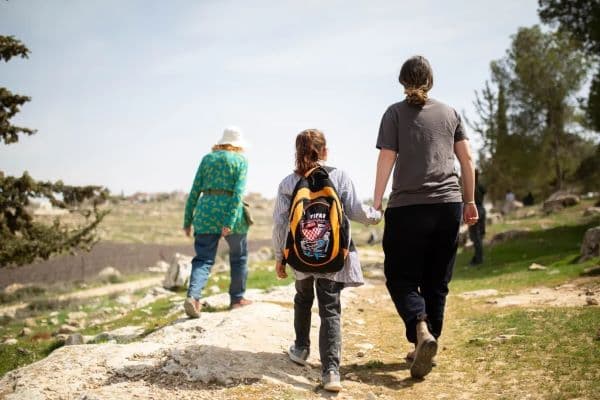
A Hineinu volunteer accompanies a child to school in Tuba (Emily Glick)

Being on-site means they are well-placed to document settler violence or military activity, help file police reports, or pick up arrested Palestinians from the police station.
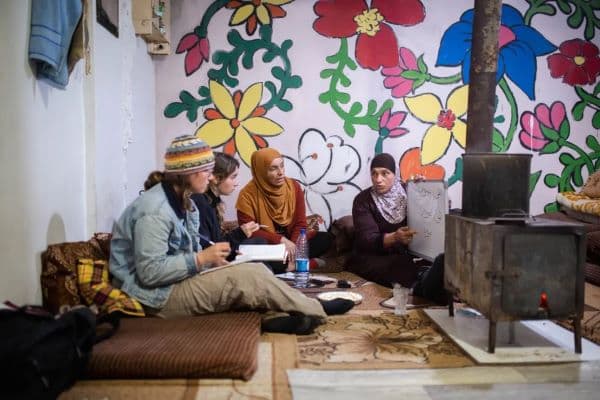
Palestinian activist Hamdan Balal said the presence of Hineinu protects and supports Palestinian life in Masafer Yatta.

“There are many fields that the shepherds couldn’t reach before Hineinu … but when [the Jewish activists] are there filming what the settlers do and protecting the shepherds, the shepherds feel safer, and they start to be able to access these fields.”

Balal said Hebrew-speaking Jewish activists were able to have an impact when Palestinians cannot.

“The police don’t care what Palestinians say, but when the people from Hineinu speak to them, it’s different. They can’t say ‘You’re liars.’ The activists have pictures and videos of when the settlers attacked.”

Hineinu is the first activist program to bring Israeli citizens to stay in the West Bank. Other programs have brought activists from overseas, some of them Jewish, but Hineinu is a specifically Jewish program to help Palestinians.

The breakthrough happened in 2020 when Covid meant other international activists could not travel to the West Bank.

CJNV co-director Oriel Eisner explained, “When Covid hit, we went to our partners and asked what we should do … and they said, ‘All the internationals are gone, so bring people in.’” 

Hineinu volunteers learn Arabic (Emily Glick)

Hineinu began to fill a gap but has become integrated into the life of the small villages where it works. Hineinu participant Gaby Vides said when she first thought about joining the program and living in a Palestinian village it felt crazy.

But the experience of living among Palestinian people has humanised her hosts. 

During the first two weeks of Vides’ time in Masafer Yatta, her host gave birth to a baby boy, and this newborn baby’s grandfather passed away.  “You’re with people for really painful moments, but also really precious moments,” she said.

From the high of joining a dance party in one of the local villages to the low of contending with settler violence, Vides learned what it was to live as a Palestinian.

Another Hineinu participant, Devorah Klionsky, said the program was important both as a learning experience and because it demonstrated solidarity.

 “I don’t learn well about things that are far away … and also – even if it’s futile – it’s important that there are people here doing this work and joining this resistance. Let it not be said that all Jews were complicit.” 

She said documenting the rampant settler violence and military activity in the region was a constant challenge.

“It’s like whack-a-mole,” she said, referring to the game where players have to strike a constantly moving target.

Klionsky also reflected on the physical stress of life in Masafer Yatta. Just three months in the conditions Palestinians are forced to endure for their entire lives is enough to affect anyone’s mental health, she said.

RELATED STORIES

Israel's Christians horrified by hate crimes in Jerusalem (Al Monitor)
Verbal and physical attacks are rising against Christians and Christian sites in Jerusalem.

Israel soccer games may be moved from Jerusalem venue after racism toward Arab player (Times of Israel)
Association chief says “all option”’ will be considered after Mohammed Abu Fani is jeered, called “terrorist” during international match at Beitar Jerusalem’s home stadium.

Top photo: A Hineinu volunteer films a military encounter with a Palestinian villager (Emily Glick)

You might also like
  • Israel is cementing its control over the West Bank and East Jerusalem while the world is distracted
    Martin Kear
  • Abuse by IDF soldiers humiliates Muslim Palestinians
    Ben Lynfield
  • Palestinians disillusioned with Hamas and armed struggle: new survey
    Shahar Burla
logomark.67a07ee3
We believe in the free flow of information

Republish our articles for free, online or in print, by using our Creative Commons licence

You might also like

    Activists attempt to deliver supplies to Palestinian families near Nablus
    OpinionIsrael

    Qusra siege exposes shared agenda of IDF and settler extremists

    Ben Lynfield
    Erdogan Turkey
    AnalysisIsrael

    Turkey emerges as military threat to Israel

    Dror Doron
    ISRAEL-TRANSPORT-AVIATION-STRIKE
    Israel Votes 2026AnalysisIsrael

    Bennett’s balancing act: can he win over the right without losing the centre?

    Shahar Burla 1

About the author

Sam Stein

Sam Stein

Sam Stein was born and raised in Lawrence, New York. He moved to Tel Aviv in late 2019 and then Jerusalem in 2020 to become an anti-occupation activist. For more, follow him on Instagram and Twitter @sam_avraham.

More from the author

OpinionIsrael

‘We are not the Israelites in the current reality’

Israel

Unhappy holidays: Jewish celebrations spark fear for many Palestinians

FeatureIsrael

For this yeshiva graduate teaching Palestinian kids to wrestle is a political act