Aa
  • Read, Watch, Listen
  • TJI Series
  • Community Action
  • Events
  • Zedi
Follow us and continue the conversation
  • LinkedIn
  • Instagram
  • FaceBook
  • X
  • YouTube
Test yourself with the TJI Quiz!

Adjust size of text

Aa

Follow us and continue the conversation

  • LinkedIn
  • Instagram
  • FaceBook
  • X
  • YouTube

Your saved articles

You haven't saved any articles

What are you looking for?

Original reporting, insightful analysis and diverse views, delivered straight to your inbox

  • LinkedIn
  • Instagram
  • FaceBook
  • X
  • YouTube
Your support fuels our mission to inform, entertain and inspire.

The Jewish Independent is bound by the Standards of Practice of the Australian Press Council. If you believe the Standards may have been breached, you may approach The Jewish Independent or make a complaint to the Australian Press Council in writing at www.presscouncil.org.au. The Council may also be contacted on 1800 025 712.

  • Our Story
  • Contact us
  • Our Team
  • Support us
  • Guidelines
  • Pitch your idea
  • Republishing us
  • Community Action
  • Our Awards
  • LinkedIn
  • Instagram
  • FaceBook
  • X
  • YouTube
Aboriginal FlagTorres Strait Islanders Flag

The Jewish Independent acknowledges Aboriginal and Torres Strait Islander peoples as the Traditional Owners and Custodians of Country throughout Australia. We pay our respects to Elders past and present, and strive to honour their rich history of storytelling in our work and mission.

© The Jewish Independent 2026All Rights Reserved
Website design and development by Your Creative, MelbourneTerms & ConditionsPrivacy Policy
HomeRead, Watch, ListenArts & Culture
FeatureArts & CultureIsrael

New Netflix film ‘Farha’ is a Palestinian answer to Paul Newman in ‘Exodus’

Ittay Flescher
Print this

Published: 13 December 2022

Last updated: 5 March 2024

ITTAY FLESCHER discusses the controversy surrounding a new Netflix film dramatising the story of a Palestinian teenager in the conflict leading up to the event Israelis call Independence and Palestinians call The Nakba.

From Fauda to Munich and The Girl from Oslo, Netflix has many films in its catalogue about the Israeli-Palestinian conflict. The latest is Farha, by Jordanian Director Darin J. Sallam, the child of Palestinians who fled to Syria during the 1948 War.

The first quarter of the film is almost a mirror image of Beauty Queen of Jerusalem, an Israeli series also on Netflix. Both are set in pre-1948 Palestine and centre around the lives of strong-willed female teenagers whose desire for education and friendship clashes with their communities’ conservative values.

This is where the similarities end. In Beauty Queen of Jerusalem, the struggle for Israeli Independence is told through Jewish narratives; Farha gives us the Palestinian narratives of the same war.

In Farha, we meet those who want to fight the British and Zionist forces, and those who don’t, and even those who collaborate with the latter. The heart of the film, however, surrounds the life of Farha.

To ensure her survival, her father makes the difficult decision to lock her in an annex of their house so that she will be spared the fate of her loved ones.

The film includes a horrific scene that occurs shortly after the Haganah warns the residents of her village to flee, presumably because there were weapons in the village and shooting at IDF soldiers. The one family that remains - because the mother has just given birth - is murdered by a young soldier wearing a kippah, who carries out an order to execute the unarmed Palestinians lined up against a wall. He is also ordered to shoot a baby, but can’t do it.
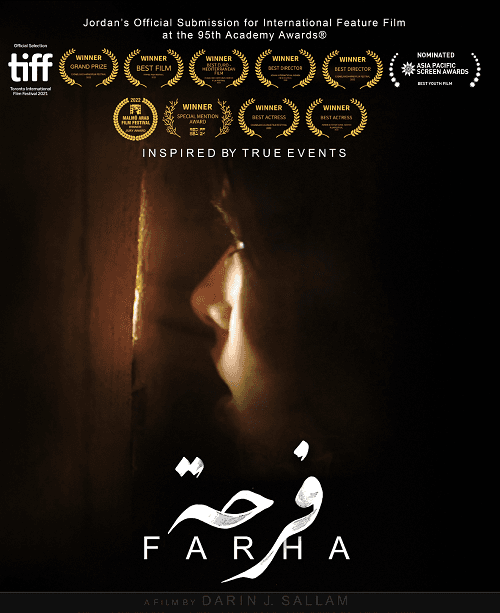
Poster for Farha, claiming it is based on true events.

The film claims to be “inspired by true events,” with Sallam, whose name means peace in Arabic, saying she was moved to make her debut film after being told the story by her father at a young age, and says it was based on real incidents.

 "I'm not afraid to tell the truth,” she said in a media interview in 2021, when the film premiered at the Red Sea International Film Festival.

However, in a Zoom interview revealed by the Zionist advocacy group Stand With Us, Sallam admitted she had been unable to find the main subject of the movie before making the film.

“When I couldn’t find the girl, who is now an old woman, I decided this was a good thing, because I needed some distance and space to create some fiction,” she said.

A petition claiming the film is “antisemitic” and calling for it to be removed from Netflix has so far garnered over 9000 signatures.

According to Israeli historian Benny Morris, there were 24 massacres carried out by the IDF during the 1948 war. “In some cases, four or five people were executed, in others the numbers were 70, 80, 100. There was also a great deal of arbitrary killing. There are cases such as the village of Dawayima [in the Hebron region], in which a column entered the village with all guns blazing and killed anything that moved,” Morris said in an interview with Israeli journalist and writer Ari Shavit in 2004.

Morris added that "The worst cases were Saliha (70-80 killed), Deir Yassin (100-110), Lod (250), Dawayima (hundreds) and perhaps Abu Shusha (70).  About half of the acts of massacre were part of Operation Hiram [in the north, in October 1948]: at Safsaf, Saliha, Jish, Eilaboun, Arab al Muwasi, Deir al Asad, Majdal Krum, Sasa. In Operation Hiram there was an unusually high concentration of executions of people against a wall or next to a well in an orderly fashion.”

Morris justifies Israel's actions at the time, asserting that “there are circumstances in history that justify ethnic cleansing. I know that this term is completely negative in the discourse of the 21st century, but when the choice is between ethnic cleansing and genocide - the annihilation of your people - I prefer ethnic cleansing. A Jewish State would not have come into being without the uprooting of 700,000 Palestinians.”

While the film affirms much of this history, at no point does it show Israelis as victims, or highlight the massacres of Jews during the same war such as the Hadassah Convoy Massacre in Sheikh Jarrah or the killing of the Lamed heh detachment in Gush Etzion.

In a sense, Farha is a reverse version of the 1960 film Exodus, which starred Paul Newman and was enormously influential in stimulating Zionism and support for Israel among diaspora Jews for generations, an idealised and peace-loving image of Zionism which at no point showed Arabs having any religious attachment to Palestine or any modern feelings of national identity.

Perhaps the lesson from this is that if one wants to learn history from the screen, it’s better to rely on documentaries such as Tangled Roots, made by  Israeli and Palestinian historians, rather than dramatised personal narratives such as He Walked in the Fields in Hebrew or Farha in Arabic.

During the 1948 war, 6000 Israelis and 13,000 Palestinians were killed, with 11 Jewish villages and 601 Arab villages destroyed, causing 60,000 Jews and 700,000 Palestinians to flee their homes, an event they call the Nakba (Arabic for catastrophe). While most of the Jews were resettled in what became Israel, many Palestinians remain refugees, leading them to view the Nakba as an ongoing event, furthered by the events of 1967 and continuing attempts to remove Arab populations from contested areas including Masafer Yatta, Sheikh Jarrah and Silwan that continue to this day.

For Israeli Jews, the lack of peace and constant sense of fear and alertness that permeates life in the Jewish state due to terror attacks and wars with Hamas leads them to feel that the struggle to realise the final sentences of the Israeli anthem, “to be a free people in our land,” is still more hope than reality.

In a time when there is peace, watching films that increase understanding and build empathy with the suffering of the other would be as uncontroversial as Australians watching films about Turkish perspectives on Gallipoli.

Yet in the current reality for Palestinians and Israelis, the conflict is too raw and present for the majority on either side to do anything other than negate and shun the stories that should break down the emotional barriers between us.

Photo: Karam Taher plays Farha in the new Netflix drama (promotional shot)

You might also like
  • Fighting for a better Israel 
    Peter Kohn
  • Where are the women in this election campaign?
    Eetta Prince-Gibson
  • Your Israel election cheat sheet
    Deborah Stone
logomark.67a07ee3
We believe in the free flow of information

Republish our articles for free, online or in print, by using our Creative Commons licence

You might also like

    Protest against settler violence in Jerusalem
    Israel

    Record spike in settler violence ahead of election

    Ben Lynfield
    Boycott Israel sign
    Israel Hamas WarAnalysisIsrael

    Israel now faces 138 sanctions across 63 countries

    Shahar Burla 2
    Adelaide Hermann magicianHarvard_Theatre_Collection_-_Hermann_TCS_28
    FeatureArts & Culture

    Legendary magicians who made their Jewish identities disappear

    Nina Siegal

About the author

Ittay Flescher

Ittay Flescher

Ittay Flescher is the Jerusalem Correspondent for The Jewish Independent. For over twenty years, he has worked as an educator, journalist, and peacebuilder in Melbourne and Jerusalem. His book, The Holy and the Broken: A Cry for Israeli-Palestinian Peace from a Land that Must Be Shared, was longlisted for the 2025 Walkley Book Awards.

More from the author

OpinionIsrael

Even on October 7, we are not united

AnalysisArts & Culture

Fauda and the illusion of vengeance

AnalysisIsrael

What ‘Zionism’ means in Israel:  it’s not what you think

AnalysisIsrael

From haven to hotbed: how Israel’s perception of Australia has changed