Aa
  • Read, Watch, Listen
  • TJI Series
  • Community Action
  • Events
  • Zedi
Follow us and continue the conversation
  • LinkedIn
  • Instagram
  • FaceBook
  • X
  • YouTube
Test yourself with the TJI Quiz!

Adjust size of text

Aa

Follow us and continue the conversation

  • LinkedIn
  • Instagram
  • FaceBook
  • X
  • YouTube

Your saved articles

You haven't saved any articles

What are you looking for?

Original reporting, insightful analysis and diverse views, delivered straight to your inbox

  • LinkedIn
  • Instagram
  • FaceBook
  • X
  • YouTube
Your support fuels our mission to inform, entertain and inspire.

The Jewish Independent is bound by the Standards of Practice of the Australian Press Council. If you believe the Standards may have been breached, you may approach The Jewish Independent or make a complaint to the Australian Press Council in writing at www.presscouncil.org.au. The Council may also be contacted on 1800 025 712.

  • Our Story
  • Contact us
  • Our Team
  • Support us
  • Guidelines
  • Pitch your idea
  • Republishing us
  • Community Action
  • Our Awards
  • LinkedIn
  • Instagram
  • FaceBook
  • X
  • YouTube
Aboriginal FlagTorres Strait Islanders Flag

The Jewish Independent acknowledges Aboriginal and Torres Strait Islander peoples as the Traditional Owners and Custodians of Country throughout Australia. We pay our respects to Elders past and present, and strive to honour their rich history of storytelling in our work and mission.

© The Jewish Independent 2026All Rights Reserved
Website design and development by Your Creative, MelbourneTerms & ConditionsPrivacy Policy
HomeRead, Watch, ListenArts & Culture
FeatureArts & Culture

‘The birds were hungry too’:  Olga Horak’s private passion

Olga Horak is one of Australia’s most prominent Holocaust survivors, whose words inspire politicians and students alike. But few know about her other life as an artist.
Jana Vytrhlik
Print this
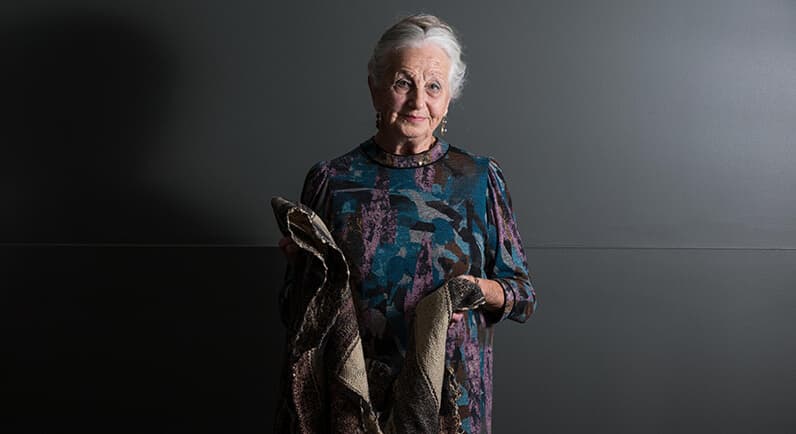
White haired woman holding a blanket

Olga Horak, photographed for the Sydney Jewish Museum’s Survivor Portrait series (Katherine Griffiths, Sydney Jewish Museum)

Published: 3 March 2024

Last updated: 21 March 2024

Olga Horak is one of Australia’s most prominent Holocaust survivors, whose words inspire politicians and students alike. But few know about her other life as an artist.

“I was always creative, as a small girl, I loved colours and was always making things. My parents encouraged me to draw and make models. In my teens I was enrolled in Professor Rosenthal’s art school in Bratislava. But that soon finished. I pinned the yellow Star of David to my clothing and everything changed.”

Olga Rosenberger was 17 when the Nazis occupied Slovakia and the persecution of Jews began. Jewish children were excluded from schools, their homes were looted and parents attacked on the streets. After a short-lived hiding, the family was denounced and deported to Auschwitz-Birkenau in August 1944.

Olga endured a gruelling death march to Bergen-Belsen, where she was eventually liberated in April 1945. She was the sole survivor of her family. Her physical and emotional recuperation was slow, but two years later in Bratislava, Olga met her future husband, Jan (John) Horak, also a Holocaust survivor. The young couple emigrated to Australia in 1949 and started new life with admirable force and determination, a trait seen in the generation of survivors around the world.

Soon, their two little daughters were born and by 1960, the Horak family settled into a busy routine between their Dover Heights home, school and their flourishing textile factory in Woolloomooloo. Olga designed blouses and fashionable garments and was eager to return to her passion for art. Encouraged by her husband, the young mother and businesswoman set up a small studio in the laundry of her home, and started painting... but it was far from easy.  
Did the memories of the Holocaust impact your art?

“I didn’t want my art to be about the horrors of the Holocaust. I wanted to express myself with happy colours and shapes. But the colours turned black and my flowers turned into dark skulls. It was not intentional, it happened. My inner feelings were affected by my tragic memories which in turn were reflected in my art.

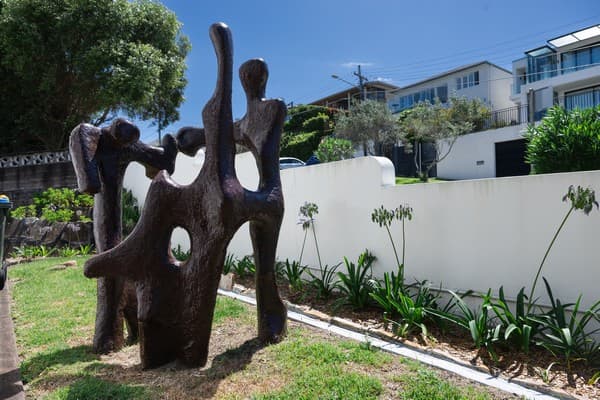
“And it was the same with my sculpting. I carved in timber and the shapes turned into the skinny skeleton-like figures. They were reflection of the walking skeletons I used to see in Auschwitz ... and I was one of them. And the birds were hungry too, and instead of modelling Bondi seagulls, the skinny bird begging for food came out.”(Fig 1).

The Bird (1960)
The Bird (1960)
<em>Fear, Fire and Death</em> (1967)
Fear, Fire and Death (1967)

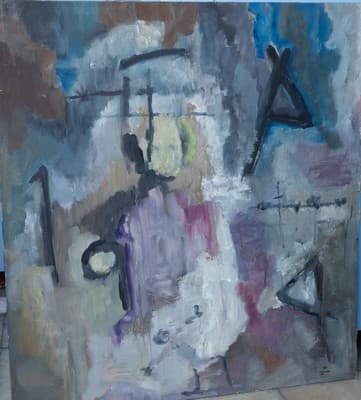
In the painting from 1967 (Fig 2) the black and disfigured lines emerge as scattered symbols:  barbed wire, a prison-cell window, a fallen figure and finally 1944, the year when the entire Rosenberger family was deported to Auschwitz. Yet, the black contrasts with bright and pastel tones.

Was there a hope to escape the past?

To shift her memory from anguish and loss, Olga decided to enrol in evening art classes in the East Sydney Technical College.

“I met two wonderful Australian artists, my teachers. John Ogburn opened his painting studio in 1963 and I was one of his first enthusiastic students. Ogburn emphasised the importance of techniques in drawing and painting. He taught us art theory and history and we studied the works of old masters. I painted in oils and he encouraged me to create my compositions from the centre out, or from one corner to another.

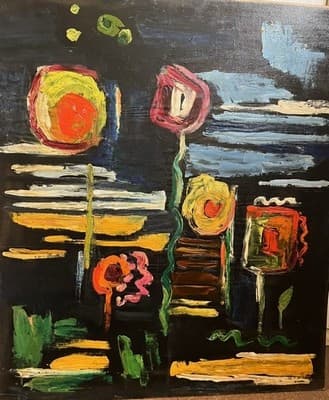
“I was never bogged down with  detail. Instead, my composition grew organically and in harmony with colours. My colours returned in my first paintings with Ogburn. In ‘William Street at night’ (Fig 3) I discovered that a dark night can be colourful and happy, and my flowers and shapes blossomed bright again. (Fig 4 and 5).

“In sculpting classes, my teacher was Lyndon Dadswell, the first Australian sculptor appointed as a war artist. He understood my memories and encouraged me to see and model a human figure for its forms, not for the past trauma. Dadswell admired the British sculptor Henry Moore and taught us  respect for material and forms.”

<em>William Street at Night</em> (c 1963)
William Street at Night (c 1963)
<em>Flowers Grow Again</em> (c 1963)
Flowers Grow Again (c 1963)
<em>Nude (</em>c 1964)
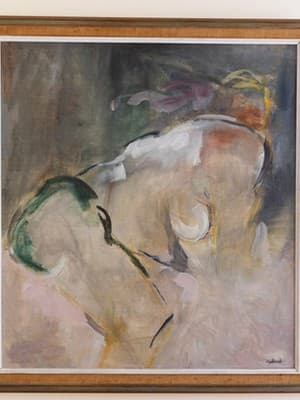
Nude (c 1964)

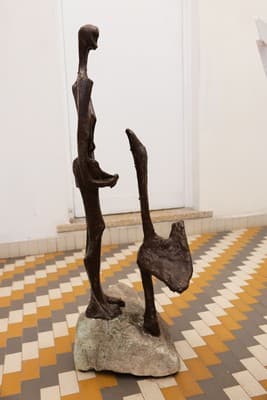
Indeed, some of the Horak’s figures, created in resin or patinated plaster, are reminiscent of the most celebrated sculptor of the twentieth century.

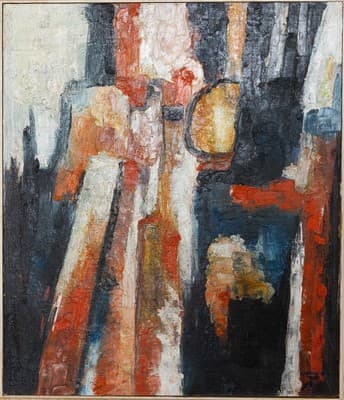
After five years of evening art classes, Olga Horak’s style and technique matured. The paintings stand out for their confident lines, impeccable compositions and bold colour palette. Her feel for human forms and spatial volume resulted in monumentality regardless of the artwork size. The past did not go away but was channelled through the symbolism of Horak’s artistic expressions. 

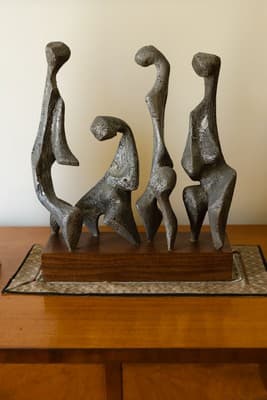
In her first and only large sculpture, ‘The Family’ (Fig 6), Olga experimented with a bold Moore-inspired figurative composition. The figures stand motionlessly, as if in a frozen moment of the past and expectation of the next move.  

In 2008, Olga Horak’s sculpture ‘Exodus’ (Fig 7) was selected for a representative exhibition at the National Museum of Australia. The artist’s rare work in bronze was praised for modern expression and emotional depth.

The Family (1966)
The Family (1966)

Can Olga Horak ever escape the ghosts of the past?

“I don’t live in the past, the past lives in me and the art was healing, whether I saw it that way or not. Art brought me back to the times when I first discovered the joy of creating. I didn’t need anybody’s opinion. My paintings and sculptures were not for public eyes. They were my diary when the words failed me. Over and over again, my art brought me the happiness that is hard to find in other aspects of one’s life”.

Olga Horak donated several sculptural reliefs from the 1980s to the Sydney Jewish Museum. Their titles, ‘Mother and Child’ and ‘Mother Protecting Child’, reflect the Holocaust theme of Olga’s painful memories of a child losing her mother. True to her style, the figures are long and stylised, depicted in a sombre and contemplative composition.

Together with the family memorabilia, old photographs and Holocaust-era objects which she also generously donated over the years to the Sydney Jewish Museum, her art complements the account of her life.

<em>Exodus</em> (1965)
Exodus (1965)
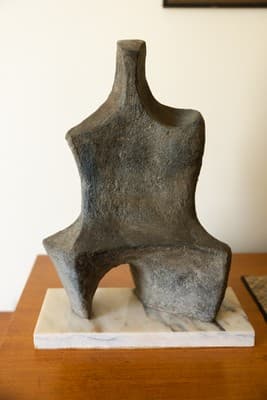
<em>Torso</em> (1969)
Torso (1969)
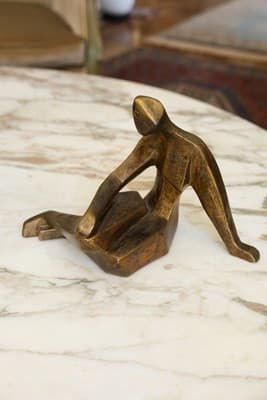
<em>Siesta</em> (1960)
Siesta (1960)

In Olga Horak’s own words, her art “shows a world that was ending but was at the same time beginning, and – most importantly - was one in which she too took part and survived. A wisdom”, she adds, “that only art can articulate”.

Olga’s art represents a rare genre in post-war Australia, and is possibly amongst the first of its kind worldwide. It is the work of a Holocaust survivor who understands the importance of preserving the memory of the Shoah victims. Olga was instrumental in the establishment of the Sydney Jewish Museum in 1992. At the same time, she has been motivated by her genuine love of art and creativity that provided an outlet for expressing her personal trauma and resilience.

Although Olga sees herself as "an amateur who loves colours", her art, created between 1960 and the 1980s, might be unjustly dismissed and her artistic creativity hidden from the public view. It is hoped that one day Olga’s art comes to the spotlight it deserves. Olga Horak OAM remains unfailingly positive about life. Two years shy of celebrating 100, she is courageous, creative and immensely inspirational. 

All photos of artwork by Giselle Haber

You might also like
  • When the state faltered, civil society and Diaspora Jewry stepped up
    Shahar Burla
  • The case for leaving graffiti up for a while
    Adam Slonim
  • New ‘spoken word’ festival in Sydney offers stories directly from creators
    Miriam Hechtman
logomark.67a07ee3
We believe in the free flow of information

Republish our articles for free, online or in print, by using our Creative Commons licence

You might also like

    Generation Change: Rachel Moshel
    Generation ChangeInterviewArts & Culture

    Rachel Moshel: Creating a space for Jewish art and joy

    Gideon Cohen
    Heinz portrait
    FeatureArts & Culture

    ‘To bring joy where there is no joy’: the show goes on for a lost composer

    Zeddy Lawrence
    Simon Brodkin on stage – Photo – David Monteith-Hodge Photographise please credit (1)
    InterviewArts & Culture

    Simon Brodkin’s cutting comedy finds love in the dark

    Peter Kohn

About the author

Jana Vytrhlik

Jana Vytrhlik

Prague-born Dr Jana Vytrhlik is is an art and architecture historian and Judaica specialist. She is presently leading the curatorial review of the AM Rosenblum Jewish Museum at The Great Synagogue in Sydney. Her book Treasures of Old Jewish Sydney was published in May 2024

More from the author

FeatureArts & Culture

Teary eyed on Bondi: a young artist’s response to tragedy    

FeatureAustralia

Vale Olga Horak, survivor icon

OpinionWorld

From Prague to Sydney: A refugee’s fondness for the language she hated

Comments

No comments on this article yet. Be the first to add your thoughts.