Aa
  • Read, Watch, Listen
  • TJI Series
  • Community Action
  • Events
  • Zedi
Follow us and continue the conversation
  • LinkedIn
  • Instagram
  • FaceBook
  • X
  • YouTube
Test yourself with the TJI Quiz!

Adjust size of text

Aa

Follow us and continue the conversation

  • LinkedIn
  • Instagram
  • FaceBook
  • X
  • YouTube

Your saved articles

You haven't saved any articles

What are you looking for?

Original reporting, insightful analysis and diverse views, delivered straight to your inbox

  • LinkedIn
  • Instagram
  • FaceBook
  • X
  • YouTube
Your support fuels our mission to inform, entertain and inspire.

The Jewish Independent is bound by the Standards of Practice of the Australian Press Council. If you believe the Standards may have been breached, you may approach The Jewish Independent or make a complaint to the Australian Press Council in writing at www.presscouncil.org.au. The Council may also be contacted on 1800 025 712.

  • Our Story
  • Contact us
  • Our Team
  • Support us
  • Guidelines
  • Pitch your idea
  • Republishing us
  • Community Action
  • Our Awards
  • LinkedIn
  • Instagram
  • FaceBook
  • X
  • YouTube
Aboriginal FlagTorres Strait Islanders Flag

The Jewish Independent acknowledges Aboriginal and Torres Strait Islander peoples as the Traditional Owners and Custodians of Country throughout Australia. We pay our respects to Elders past and present, and strive to honour their rich history of storytelling in our work and mission.

© The Jewish Independent 2026All Rights Reserved
Website design and development by Your Creative, MelbourneTerms & ConditionsPrivacy Policy
HomeRead, Watch, ListenAustralia
OpinionAustralia

AUJS: “The days of trusting universities to ensure student safety are behind us”

As Pro-Palestinian encampments and rallies continue to rise on campuses across the country, peak body AUJS is rethinking its strategy to better protect the wellbeing and safety of Jewish university students.
Tobias Siegal
Print this
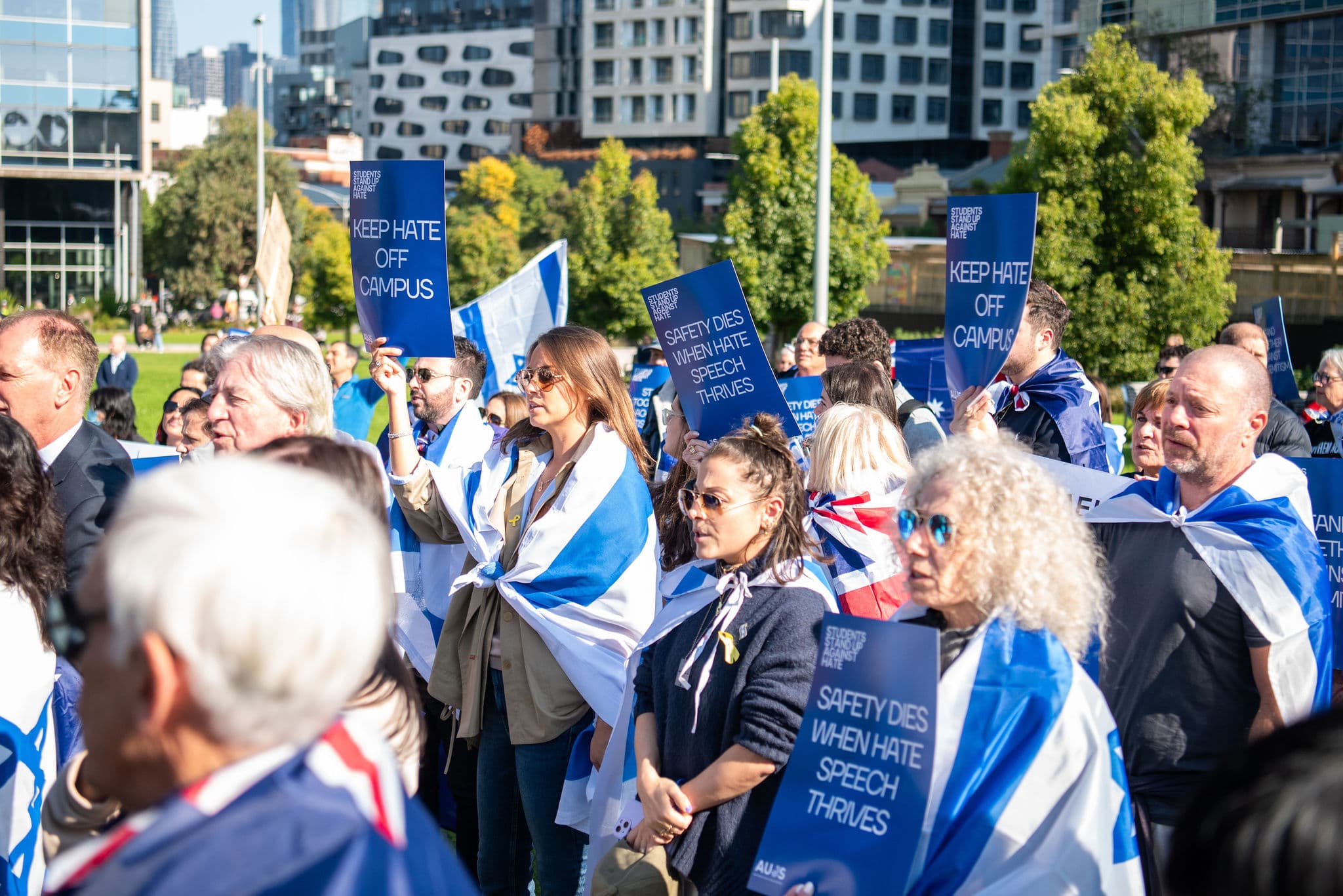
Rally against antisemitism at Melbourne University

Antisemitism is being felt across all educational levels, including most recently on tertiary campuses (Image: James McPherson).

Published: 7 May 2024

Last updated: 9 May 2024

The arrival of the US pro-Palestinian encampment phenomenon to Australia’s shores, and the inability of many universities to effectively tackle the issue, has caused Jewish students to feel evermore isolated – leading the Australasian Union of Jewish Students (AUJS) to rethink many of its programs and advocacy strategies for the upcoming year.

The pro-Palestinian protests over Israel’s ongoing war against Hamas have stepped up in recent weeks, with so-called “Gaza solidarity” encampments occupying often large areas on campuses across the United States, Europe and more recently, Australia.

Pro-Palestinian encampments have been set up on at least six campuses across Melbourne, Sydney, Canberra, Perth and Adelaide, restricting students’ access to public spaces and creating a hostile environment for Jewish and non-involved students alike.
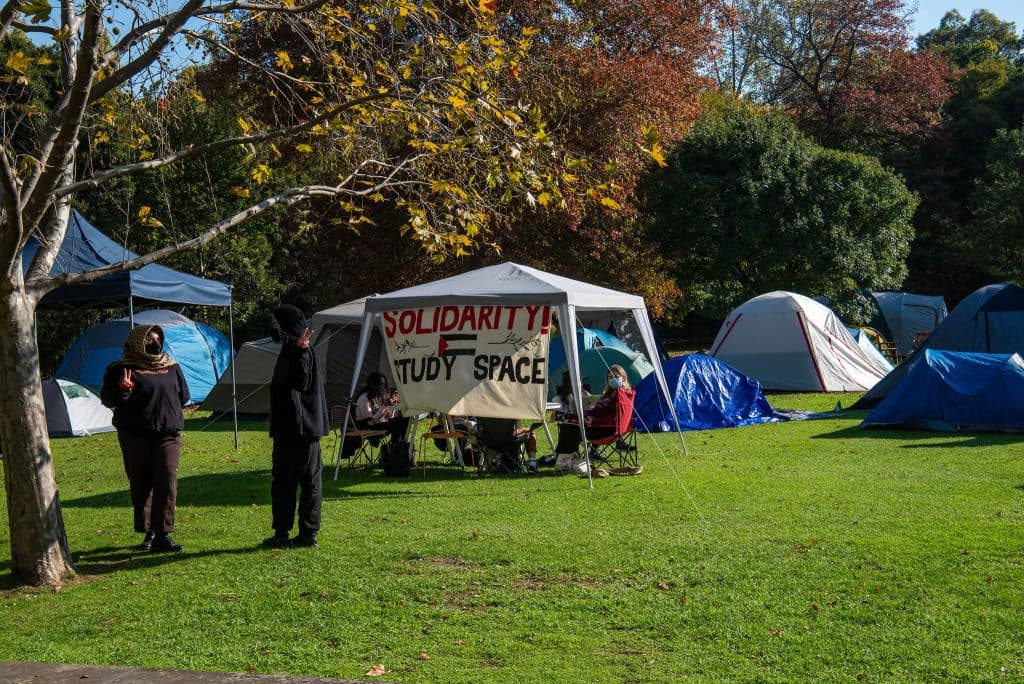
A pro-Palestinian encampment at Melbourne University (Image: James McPherson).

Perhaps the most concerning when it comes to issues of student safety is the growing understanding that many of the most vocal and active players at these campus encampments are not actually students. In New York, almost half of the 282 pro-Palestinian protesters who were arrested last week by police on two campuses in the city were found to be external agitators unaffiliated with either university.

While pro-Palestinian activity on Australian campuses has posed challenges for Jewish students since October 7, and long before then, the current situation seems to have thrown out the window all guidelines, expectations and procedures around protests on campus.
Even worse is the growing understanding for many that the universities are either unwilling or unable to stop this from progressing further. This lack of action by universities, lawmakers and other student groups have caused many Jewish students to avoid campus altogether.

The encampments have changed everything and no one, including universities, knows how to deal with them. AUJS must rearrange its focus accordingly.

Recognising the unprecedented challenges that the encampments pose, AUJS – the peak body that represents Jewish students in Australia and New Zealand – will be pivoting much of its plans for the upcoming year. It will place a greater focus on campus-oriented advocacy events, holding independent safety training programs for its members and working to directly combat antisemitism on campus.

This shift, which could potentially come at the expense of other programs planned throughout the year, was not taken lightly. Rather, it was the painful realisation that seeking partners and building relationships with non-Jewish student groups, university faculty and government officials has its limits under the current circumstances.

According to AUJS general manager Joey Wilkinson, ensuring student safety on campus and promoting Israel advocacy by forming meaningful relationships was effective in the past but no longer hold merit. The encampments have changed everything and no one, including universities, knows how to deal with them. AUJS must rearrange its focus accordingly, says Wilkinson and several student leaders I’ve spoken with in recent days.

Universities’ failure to prevent the encampments is the result of allowing the situation to reach this far. Trusting that the universities would take note and eventually action, AUJS held countless meetings with lawmakers and vice chancellors of Australian universities in recent months, warning of the hostile atmosphere towards Jewish students in and outside classrooms; pointing to the fact that many of the involved agitators were not students; and directing their attention to inciting material on campus that targeted Jewish and Israeli students.

The days of trusting the universities, the accepted guidelines around protesting and the government’s assistance to ensure student safety are behind us.

While some universities seem more receptive than others, the vast majority have failed to ensure real safety for Jewish students amid the pro-Palestinian protests since October 7. They failed to remove inciting posters, to prevent Hamas-supporting events on campus and to take action against students openly calling for violence against Jewish and Israeli students.

Most recently, the University of Sydney went as far as defending the use of the word “intifada,” which literally means “violent uprising”, and for many Jewish students and most Israelis, brings up memories of suicide bombings.

It has thus become clear to many in AUJS that the organisation is in need of a much more hands-on approach. The days of trusting the universities, the accepted guidelines around protesting and the government’s assistance to ensure student safety are behind us. This is not to say that AUJS has neglected its commitment to dialogue and bridge-building, but these will need to be put on the back burner until there is a reliable partner to work with.

While the way in which these changes will take place is still being discussed, AUJS has already begun increasing its on-campus activities to let Jewish students know they are not alone.

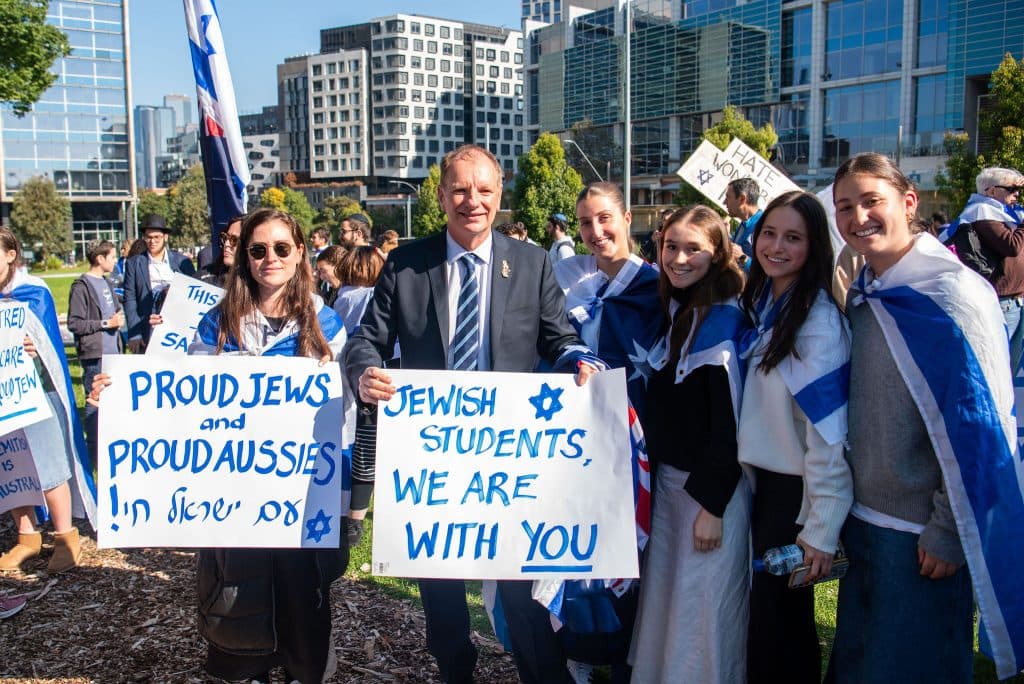
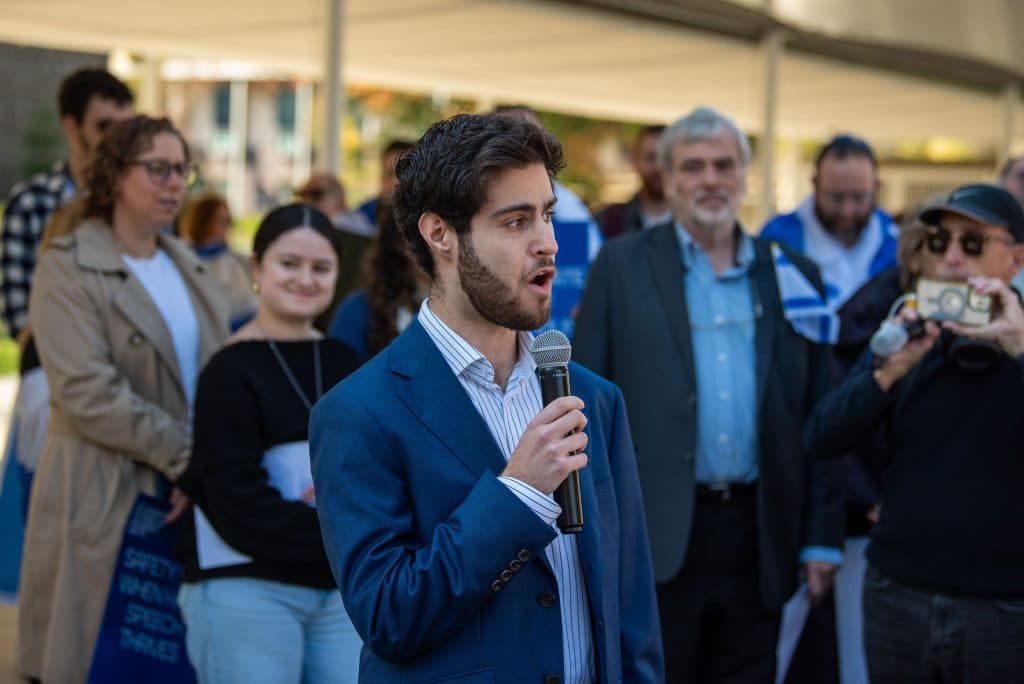
On Thursday, a solidarity rally organised by AUJS at Melbourne University under the banner “Keep Hate Off Campus” saw approximately 300 students and community members coming together to show their support and say “enough is enough”.

Deputy Leader of the Victorian Liberal Party David Southwick joined AUJS's rally against antisemitism on campus in Melbourne last week (Image: James McPherson).

While the event was meant as a sign of solidarity with Jewish students at Melbourne University and as a wake-up call for universities to take action against rising antisemitism, there were reports of a small group of participants who tried to confront a nearby pro-Palestinian crowd.

AUJS President Noah Loven, who spoke at the event, denounced the actions of what he described as “a rogue group that went against AUJS’s wishes and undermined the important work we’re trying to do”.

The speakers, who included student and community leaders, actively called on participants to avoid engaging with the encampment and the rally itself was held on the other side of campus to ensure zero friction between the groups.

AUJS President Noah Loven spoke at the Melbourne University rally, urging tertiary institutions to better protect Jewish students (Image: James McPherson).

These actions do not reflect the spirit in which AUJS has been and will continue to operate under. If anything, it highlights the importance of drawing red lines by the universities and taking action when these are crossed.

Free speech is important, and worth fighting for, but not at the expense of ensuring a safe space for students. Universities must do more to regain the trust of their Jewish students. A good start would be taking reports of harassment and violence more seriously and checking identification cards to avoid non-student agitators from entering campus grounds in the first place.

I will conclude by reiterating a sentiment communicated by CEO of the Zionist Federation of Australia Alon Cassuto during Thursday’s rally: “We’re here to say that the past seven months are not something we’re prepared to tolerate any longer. Our campuses have to be free of hate”.

RELATED STORIES

Australian universities reject 'not safe' label (ABC Listen)
As protests continue, university leaders in Australia are trying to calm tensions, while emphasising they have "zero tolerance" for racism or harassment.

Fine unis that fail to crack down on ‘racist’ pro-Palestine encampments: Coalition (SMH)
The federal opposition is calling for the forcible break-up of pro-Palestine university tent protests and new laws to fine universities that do not sanction misbehaving protesters.

Amid reports Jewish students in Sydney ‘afraid to go to class’ minister urged to condemn university encampments (Guardian)
Jason Clare says the community, including politicians, must ‘lower the temperature’.

‘Good Jews oppose Zionism’: French Jewish students say campus no longer a safe space (Times of Israel)
Post-October 7 anti-Israel agitation and the antisemitism it unleashed are pushing promising candidates away from French schools. Last week’s protests may be the tipping point.

How pervasive is antisemitism on US campuses? A look at the language of the protests (Guardian)
The movement to press for an end to Israel’s war on Gaza has now found itself overshadowed by its loudest voices.

University chiefs seek federal advice on ‘intifada’ calls (SMH)
The nation’s biggest universities are seeking legal advice from federal authorities on how to respond to protesters who call for an “intifada” against Israel amid a political row over public chants that back the use of violence.

You might also like
  • Three years after Oct 7: an anniversary of reckoning
    The Jewish Independent
  • Sydney Uni commissions independent review after ‘Globalise the Intifada’ campaign
    Deborah Stone
  • New evidence points to Iranian responsibility for Diaspora antisemitic attacks
    Colin Shindler
logomark.67a07ee3
We believe in the free flow of information

Republish our articles for free, online or in print, by using our Creative Commons licence

You might also like

    Generation change Template
    Generation ChangeInterviewAustralia

    Ash Densham: Building community through Humanistic Judaism

    Gideon Cohen 1
    jiff26-cancelled.jpg
    ReflectionArts & Culture

    On despair: A reflection after watching ‘Cancelled’

    Deborah Stone 2
    antisemitism online
    NewsAustralia

    Proposed digital care law to offer protection against online antisemitism

    Deborah Stone

About the author

Tobias Siegal

Tobias Siegal

Tobias Siegal is the Jewish Agency’s emissary (shaliach) to AUJS. Before that, he worked as a Jerusalem-based journalist covering various topics, namely education and politics. His work has appeared in The Jerusalem Post, The Times of Israel and Ynet.

More from the author

Israel

‘Nature knows no borders’: An Oslo initiative that survived

Israel

Arabic education builds peace one word at a time

Comments

No comments on this article yet. Be the first to add your thoughts.