Published: 15 July 2022
Last updated: 5 March 2024
Australian Israelis, aka Ausraelis, are developing a distinctive and vibrant ethnolinguistic identity, writes RAN PORAT
Ethnolinguistic vitality refers to a group's ability to maintain and protect its existence in time as a collective entity with a distinctive identity and language.
It involves continuing intergenerational transmission of the group's language and cultural practices, sustainable demography and active social institutions, social cohesion, and emotional attachment to its collective identity.”
A few decades ago, the ethnolinguistic vitality of Hebrew in Australia was in doubt. In his ground-breaking 1987 study of Hebrew speakers in Australia, Tim McNamara concluded that Hebrew was a low status language in Australia, even within the Jewish community.
Recently released initial 2021 Australian Census data about Hebrew speakers in Australia shows a complete turnaround in the vitality of Hebrew.
While still one of the least spoken languages in the country, the number of Australians reporting in the census that Hebrew is spoken at home has jumped by a whopping 52 percent, from 7568 in 2006 to 11,504 in 2021.
Almost all Hebrew-speakers are Jewish by background: 80-85 % describe themselves as Jewish under religion and 14% say they have no religion, which presumably includes secular Israeli Jews.
Unsurprisingly most Hebrew speakers reside in and around the Jewish neighbourhoods of the eastern suburbs of Melbourne and eastern parts of Sydney. More Australians speak Hebrew in Victoria (5580) than in NSW (3805), and the largest cluster of Hebrew speakers is found in Melbourne’s Glen Eira municipality.
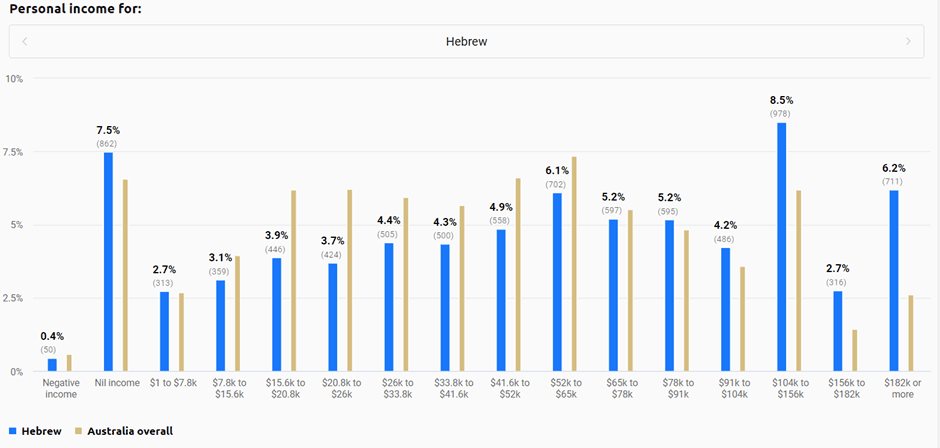
There are several indicators pointing at the socio-economic strength of Hebrew-speaking Australians. The 2021 census data shows that this group outperforms the rest of Australians with regards to annual income – a trend that has been slowly increasing since 2011.