The first Crossroads survey was a landmark attempt to measure Australia attitudes to Jews, Israel and antisemitism in a statistically reliable survey.
The survey found a low level of antisemitism with a large majority of respondents indicating a positive attitude to Jewish Australians. In the strongest result, 91% of respondents agreed or definitely agreed with the statement “I am just as open to having Jewish friends as I am to having friends from other sections of Australian society.”
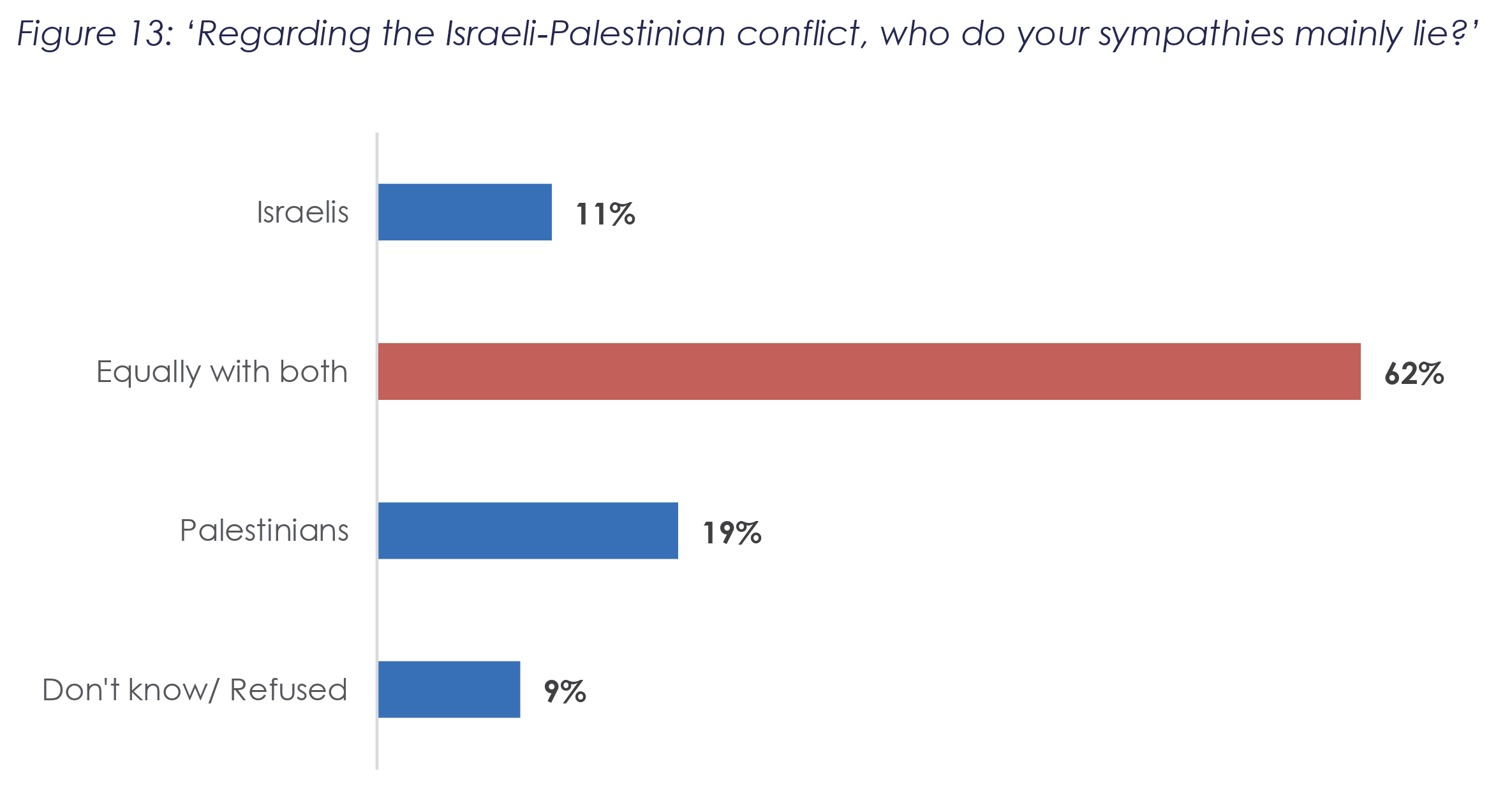
On Israel-Palestine, the largest proportion (62%) indicated their sympathies lie ‘equally with both’, while 19% indicated that they support Palestinians and 11% support Israelis. A relatively high 9% indicated that they did not know or declined to answer.
The Crossroads21 survey was conducted between 18 January and 1 February 2021 by the Social Research Centre on its probability-based Life in Australia™ panel. The survey was completed by 3,459 respondents. The survey comprised 17 substantive questions covering three thematic areas: questions dealing with antisemitism, the Israeli-Palestinian conflict, and the knowledge base on which opinions were based. The large sample enabled statistically reliable disaggregation of responses by a range of demographic and attitudinal variables.
The survey questionnaire comprised 17 substantive questions. Four contextual questions tested factual knowledge with reference to the substantive questions asked in the survey. This attention to context adds a level of precision unusual in surveying. The contextual questions were:
- What proportion of the Australian population is Jewish?
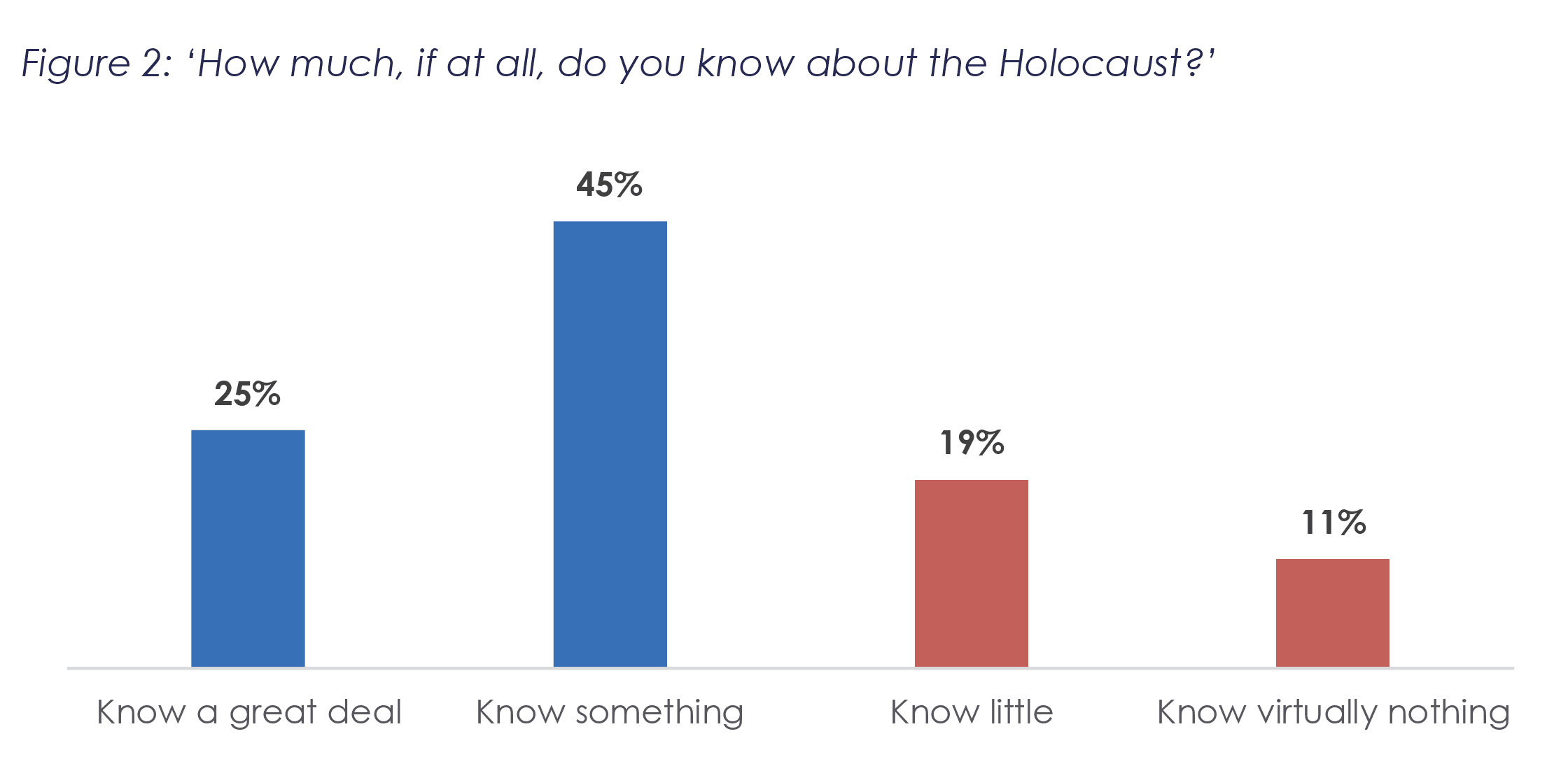
- How much, if at all, do you know about the Holocaust?
- How interested are you in the Middle East and the Israeli-Palestinian conflict?
- How much do you know about Australia’s policy towards Israel and Palestine?
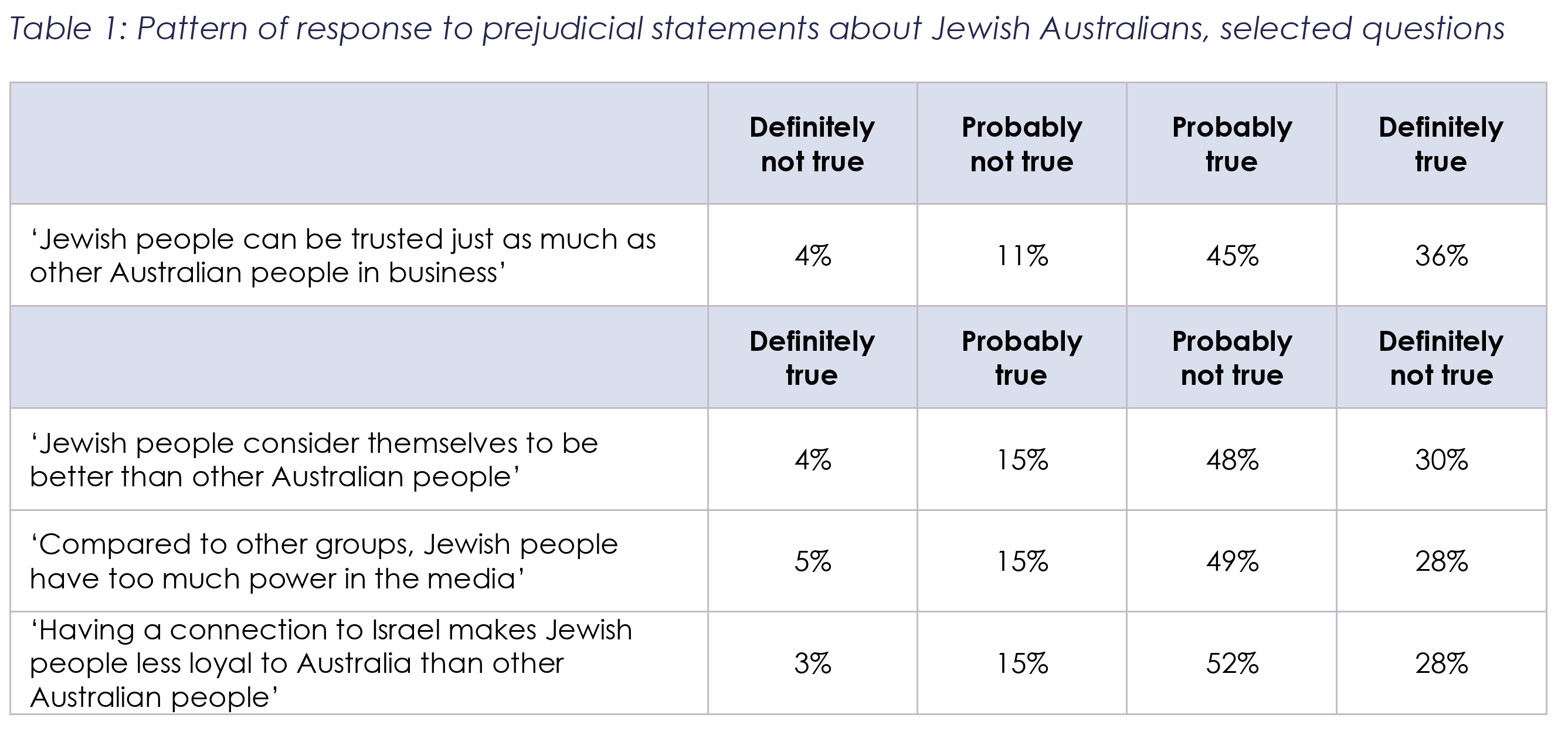
To gauge the level of antisemitism in Australian society, respondents were presented with six stereotypical statements about Jewish behaviour and a question about openness to friendship with Jewish people.
The findings indicate a low level of antisemitism in Australian society. A large majority of respondents indicate a positive attitude to Jewish Australians. This is most evident in response to the proposition that ‘I am just as open to having Jewish friends as I am to having friends from other sections of Australian society’; 64% of respondents indicated that they ‘definitely’ agreed, 27% agreed, a total of 91%, while only 8% disagreed.
For six of the questions in the survey, the proportion indicating a strongly negative attitude was in the range 2%-5%, the next (lower) level of negative attitude in the range 6%-15%, when combined in the range of 8%-20%. The outlier in terms of agreement with a prejudicial statement was the response to the proposition that ‘Australian Jewish people chase money more than other Australian people’; 5% indicated that the proposition was ‘definitely true, 22% that it was ‘probably true’, a combined 27%, while a large majority of 71% indicated that it was ‘probably not true’ or ‘definitely not true.’
A majority indicated support for action against antisemitism in response to the statement that ‘To protect Jewish people from antisemitism, the Nazi symbol should be banned in Australia’; just 12% disagreed, 25% indicated that they neither agreed not disagreed, while a substantial majority, 62% agreed.
Balanced sympathies with Israelis and Palestinians
With regard to the Israeli-Palestinian conflict, in response to a question that asked, ‘who do your sympathies mainly lie?’, the largest proportion (62%) indicated ‘equally with both’, while 19% indicated Palestinians and 11% Israelis. A relatively high 9% indicated that they did not know or declined to answer.
In response to a question that asked if their views on the Israeli-Palestinian conflict had changed over the past five years, by far the largest proportion, 79%, indicated that their views had not changed. Of the small minority who indicated that their views had changed, a net 5% indicated decreased support of Israel and a net 5% indicated increased support of Palestinians.
The small minority of respondents, 15% of the sample (533 respondents out of the total of 3,459), who indicated that they ‘knew something’ or ‘knew a great deal’ about Australian foreign policy towards Israel were asked for their views on aspects of that policy: 47% indicated agreement with the proposition that ‘the Australian government was not critical enough of Israel’, 22% disagreed, while 31% neither agreed nor disagreed. In a similar distribution of attitudes, when asked if the ‘Australian government should do more to support Israel’, 43% disagreed, 19% agreed, while 39% ‘neither agreed nor disagreed.’
Age, gender and political alignment results differ
A final section of the report disaggregates findings by five variables: gender, age, level of education, location, and political alignment, indicated by response to a question that asked respondents who they had voted for at the last federal election. The variable that obtained the largest differentiation was political alignment. With regard to the Israeli-Palestinian conflict, support for Israel was highest among supporters of the Liberal/ National coalition, lower among Labor and Greens voters.
The majority of respondents (in the range 54%-65%) indicated that in the context of the Israeli-Palestinian conflict their sympathies were ‘equally with both,’ but among those favouring one side, 19% of Liberal/ National voters favoured Israel, also favoured by 6% Labor, 6% Greens, while support for Palestinians was indicated by 34% Greens, 25% Labor, and 8% Liberal/National.
However, with regard to level of antisemitism, the strongest rejection of stereotypical statements was by Greens voters. For example, the statement ‘Jewish people talk about the Holocaust just to further their political agenda’ was indicated to be ‘definitely not true’ by 37% of Liberal/ National voters, 45% Labor, and 66% Greens.
Support powerful, 
independent journalism.
Since 2015, TJI has provided an independent voice on Australia, Israel and the Jewish World at zero cost to our readers.
Your contribution — big or small — is critical in helping us create a platform for diverse content, fresh voices and regular coverage on issues that matter to you.