Published: 2 September 2015
Last updated: 4 March 2024
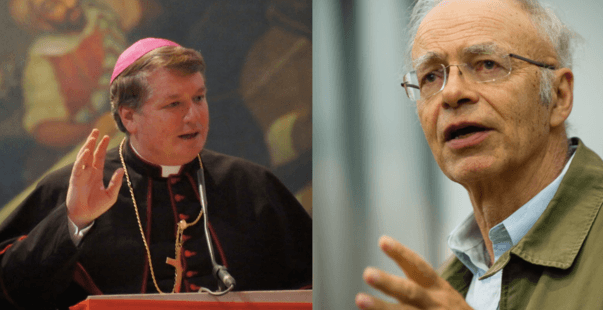
One might perhaps have anticipated that a debate on voluntary euthanasia between a sometimes controversial philosopher, who has even supported infanticide under certain conditions, and a Roman Catholic theologian, well known as a staunch defender of the sanctity of life, would involve an irresistible force meeting an immovable object. And so it proved to be. As one journalist said of the recent debate between moral philosopher Professor Peter Singer and former lawyer and bioethicist Archbishop Anthony Fisher,”arguments flew in both directions and never met.” But both protagonists at least put their arguments forward with civility, which allowed listeners to review and consider the issues as seen by each side.
Professor Singer tried to limit the discussion to his definition of voluntary euthanasia: the ending of the life of a competent person, at his/her request, if suffering from a terminal illness with unrelievable pain as diagnosed by at least two medical specialists. Singer did not distinguish between medically-assisted suicide, where physicians provide the drug but does not administer it themselves, and the provision of a lethal injection by a physician. Archbishop Fisher, on the other hand, saw any legalisation of voluntary euthanasia as a violation of the sanctity of life. Despite any attempted legal drafting, he felt such legislation would invariably lead to “bracket creep” and the involuntary death of unwanted infants, the aged, the frail, the mentally ill and the physically handicapped.
Each debater used precedents and statistics in an attempt to bolster his position. Professor Singer discussed the judgment of the Canadian Supreme court in overturning an appeal against the legalisation of voluntary euthanasia. The court found there was no evidence of a slippery slope in those countries or states where voluntary euthanasia was practised. He observed also that in the USA state of Oregon there had been no increase in the number of patients who had availed themselves of medically-assisted suicide since the relevant legislation was enacted almost 14 years ago. Fisher countered by referring to the Netherlands, which legalised voluntary euthanasia in 2002, and where the law has been extended beyond cases involving people with a debilitating, terminal illness. Singer argued that while there had been an increase in absolute numbers of people seeking voluntary euthanasia in the Netherlands, this still only accounted for three percent of all deaths in that country. He agreed however, that this was considerably higher than the percentage in Oregon.
Each protagonist claimed that his position more truly respected the autonomy of the individual. Singer argued that when competent terminally ill persons are denied their wish for voluntary euthanasia on the grounds of diminished quality of life, their autonomy is severely compromised. Fisher was concerned that legalisation of voluntary euthanasia would lead to reduction in autonomy of the most helpless members of society, and that depression or fear, for example, might further reduce their ability to stand up for their right to life.
There was also disagreement about the difficulties that the medical profession could face in the event of voluntary euthanasia legislation. Singer felt that clear guidelines would benefit doctors who in effect currently practise voluntary euthanasia through the principle of double effect - the prescribing of additional morphine for ostensible pain relief, knowing it will lead to death. Fisher believed that legalising voluntary euthanasia would make the profession of medicine, which has always been committed to the preservation of life, morally much more difficult for its practitioners.
Both Professor Singer and Archbishop Fisher treated the topic and each other’s views with civility, respect and compassion. The issue of passive euthanasia - the withdrawal of treatment when it is judged to be medically unsustainable or too burdensome for the patient - was mentioned tangentially and appeared to be acceptable to both debaters. During question time, Professor Singer was the recipient of more hostile questioning than Archbishop Fisher, which probably reflected the composition of the audience.
Jewish Australians wanting to know Jewish religious views on this topic would have to consider the attitudes of the Orthodox, Conservative and Reform streams of Judaism (Baeke, Wils & Broeckaert, 2011 – see References in end note). While it has often been said that where there are three Jews, there will be four opinions, in the case of euthanasia there is general consensus among the adherents of Orthodox and Conservative Jewry, as well as most Reform rabbis, that the practice of euthanasia is contrary to the teachings of Judaism.
Orthodox Jewish doctrine takes the same view of the sanctity of life as did Archbishop Fisher in his debate with Professor Singer. The Orthodox position, as enunciated by Bleich (1981,1993), is “that in Jewish law every positive act, no matter how laudable the intentions of the person performing the act, which hastens death, is equated with murder. No matter how hopeless or meaningless continued existence may appear to be in the eyes of the mortal perceiver, the life of a human being may be reclaimed only by the Author of life and death.” For Orthodox Jews, this would automatically exclude both the practice of voluntary euthanasia and physician-assisted suicide. There does seem to be some ambiguity, however, concerning the withdrawal of life-support among Orthodox rabbis who believe that, on the one hand, action need not necessarily be taken to prolong the life of a dying person, and on the other, that only God can take away life.
The view on voluntary euthanasia of the Conservative movement, which takes an intermediate position between Orthodox and Reform Jewry, is probably more similar to the one put forward by Archbishop Fisher than to that of Professor Singer. The Conservative rabbinate interprets the holy texts in the same manner as the Orthodox rabbinate: nothing must be done to hasten the death of a person who has a terminal illness. Thus there is a prohibition on both voluntary euthanasia and physician-assisted suicide. A distinction is made, however, between euthanasia and the withholding or withdrawing of life support. While there is an obligation to prolong life, there seems to be less obligation to prolong death (Dorff 1998). The wisdom of “there is a time to be born and a time to die” (Ecclesiastes 3:2a) must be respected. Thus, while the Conservative movement would forbid the practice of voluntary euthanasia and physician-assisted suicide, it would tolerate the practice of discontinuing aggressive treatment when there is no reasonable hope of success.
There is also a minority view that voluntary euthanasia is permissible under certain circumstances, which has been expressed, for example, by Conservative Rabbi Byron Sherwin (z”l), formerly Distinguished Service Professor of Jewish Philosophy and Mysticism at the Spertus Institute. In 2000, Rabbi Sherwin expressed the following opinion (quoted in Baeke et al, 2011):
“In view of contemporary realities, I have felt it necessary to defend a position within the framework of classical Jewish sources that would justify active euthanasia in at least certain circumstances. I believe that patients whose last days are overwhelmed with unbearable agony, who have no hope of recovery, who have irreparable organ damage, and who have exhausted all medical remedies should be able to advocate and to practise active euthanasia without feeling they are criminals. To be sure, Judaism instructs us to ‘choose life’ (Deut. 30:19), but Judaism also recognizes that ‘there is a time to die’ (Eccles. 3:2).“
This pro-euthanasia view has been echoed by Reform Rabbi Kravitz, Emeritus Professor of Midrash and Homiletics at HUC-JIR/New York, despite the official Reform Rabbinate position that the practice of voluntary euthanasia is not permissible. He argues (quoted in Baeke et al, 2011) that “where pain trumps life, where suffering cannot be controlled and recovery cannot be achieved, then if the patient feels that life is no longer worth living, and ‘the game not worth the candle’, there is no need to extend life, and indeed, there may be a need to shorten it” (2006, 93).
Arguably, legalisation of voluntary euthanasia has been an even more contentious issue in Australia than abortion or same sex marriage. The Northern Territory Rights of the Terminally Ill Act 1995 which came into force in 1996, allowed terminally ill patients to commit medically assisted suicide, either by the direct involvement of a physician or by procurement of drugs, and under stringent guidelines. But that legislation was overturned by the Federal Government in 1997, after only four terminally ill individuals had made use of the new provisions. The closest euthanasia has come to being legalised by a state was in Tasmania in 2013, when a Greens' voluntary euthanasia bill was narrowly defeated in the Tasmanian House of Assembly by a vote of 13-12. Although both major parties allowed a conscience vote, all ten Liberals voted against the legislation, with Labor splitting seven in favour and three against, and all five Greens voting in favour. Despite the overwhelming support of the Australian public for the legaliation of voluntary euthanasia, it is likely we still have a long way to go in considering this important issue.
.
References
Baeke, G., Wils, J-P and Broeckaert. Jewish Perspectives on Euthanasia: J Relig Health. 2011 Dec; 50(4): 778–795.
Published online 2011 Jan 21. doi: 10.1007/s10943-011-9465-9
PMCID: PMC3230754
Bleich JD. Judaism and healing: Halakhic perspectives. New York: KTAV; 1981.
Bleich JD. Life as an intrinsic rather than instrumental good. The ‘spiritual’ case against euthanasia. Issues in Law and Medicine. 1993;9(2):139–150. [PubMed]
Dorff EN. Matters of life and death. A Jewish approach to modern medical ethics. Philadelphia/Jerusalem: The Jewish Publication Society; 1998.
Kravitz L. ‘Some’ Jewish reflections on Jewish tradition and the end-of-life patient. In: Hurwitz PJ, Picard J, Steinberg A, editors. Jewish ethics and the care of end-of-life patients. A collection of rabbinical, bioethical, philosophical and juristic opinions. Jersey City: KTAV Publishing House; 2006. pp. 75–97.
Sherwin BL. Jewish ethics for the twenty-first century. Living in the image of god. Syracuse, NY: Syracuse University Press; 2000.
This +61J article may be republished if acknowledged thus: “This article first appeared on www.plus61j.com.au and is reprinted with permission."