Published: 12 July 2016
Last updated: 4 March 2024
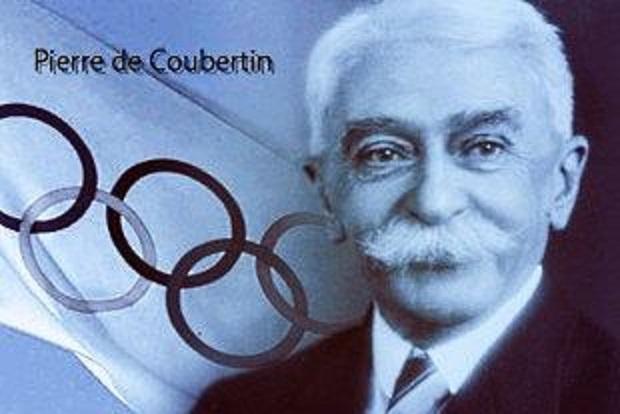
Not out of a love of sport did Baron Pierre de Coubertin resurrect the ancient Olympics: rather, he wanted to restore the spirit of French militarism among those much dispirited by their shattering defeat in the Franco–Prussian War in 1871. Illogically, he didn't want a Games between individuals but one between nationalistic nations. Yet, he declared, the competition had to be free of politics, racism, antisemitism, belligerence — whereupon he banned women from competing (until 1900).
The Baron was president of the International Olympic Committee (IOC) from 1896 to 1925. He died in 1937, having seen the Berlin Games fulfil his dream of a right-wing militaristic Olympic internationalism. The next head was a dedicated Belgian antisemite and Nazi sympathiser, Comte Henri de Baillet-Latour, in office from 1925 to 1942. He said not one word about Hitler's attempts to exclude Jews from the German team. But when he toured the summer and winter Olympic villages in 1936 (both Games were held in the same year), he reacted sharply. At the Winter site he saw 'no Jews allowed' signs and demanded that Hitler remove them. He won the argument only because for the fortnight of the competitions 'Olympic law' deemed the two domains of the Games, Garmisch and Berlin, to be places called 'Olympia' and not German territory.
International pressure compelled the Germans to include two Jews, ice-hockey player Rudi Ball (exiled in France, a bronze winner in 1932) and fencer Helene Meyer (exiled in America, world champion 1929–1931, Olympic gold medallist in 1928 and much else besides). Defying and denying the historical records, the American IOC representative, Avery Brundage and the secretary of the American Olympic Committee, Frederick Rubienn, were frenetic in their support for the German stance, insisting that non-selection of Jews was because there had never been any Jewish athletes of world calibre. These American officials were only too eager to drop two Jewish track sprinters, Sam Stoller and Marty Glickman, from their 4 x 100m relay team rather than have Hitler endure having to award them medals. An all-African American team was deemed less offensive (Colin Tatz, Sporting Traditions, 1(1), 1984).
Thirteen of Berlin's medals were won by Jews, seven of them Hungarian. Two were in fencing, mortifying Reinhard Heydrich, the 'Blond Beast' and the butcher to be, the SS security head who had had a hand in creating Dachau, the man who became a leading member of the International Fencing Federation.
The next IOC president was Swedish industrialist Sigfrid Edström, yet another with a 'Jewish problem'. Jews, he told his good friend Avery Brundage, 'led Germany' and soon would lead the United States and 'the day may come when you will have to stop the activities of the Jews'. He wasn't 'against them but they must be kept within certain limits' (Leif Yttergren, Olympika XV!, 2007: 77).
Brundage — a man with an avowed Jewish and Black problem — was to follow. When African Americans threatened to boycott the 1968 Mexico Games (because of their ill-treatment in the United States), he declared that 'they won't be missed' (Richard Lapchik, The Politics of Race and International Sport, 1975). He presided over the fateful (and fatal) Munich Games in 1972. The terrorist group Black September appeared in 1971, following not Israeli but Jordanian expulsion of Palestinians. Armed members raided the Israeli team in the Munich village. What followed was the killing of Jews amid the very Games that were meant to be an expiation and atonement for the Nazi version of 1936. Chancellor Willy Brandt's dream of a new Germany was shattered.
Unfazed, Brundage pursued the illusion of Olympism with his infamous phrase 'the Games must go on', most reluctantly agreeing to a one day postponement to allow for mourning (Allen Guttman, The Games Must Go On, 1983) That American swimmer Mark Spitz won seven gold medals out of a Jewish medal tally of 21 couldn't mitigate the reality that Jews were killed because they were Jews — in that place and on that nation's soil.
Juan Antonio Samaranch, a disciple of Spain's dictator General Francisco Franco, followed as president. Like similar international organisations — the International Commission of the Red Cross, FIFA, the Boy Scout movement — the IOC is a law unto itself, accountable to no one, voted in by no constituents, making 'laws', issuing edicts, exerting undue pressure, behaving like an autonomous (untouchable) nation state, threatening dire punishment to anyone appropriating its precious rings, and providing a haven for extreme right-wing ideologues. The only impediment to its immense global power is its own inner corruption.
In 2004, Paul Taylor, a Sydney philosopher, wrote Jews and the Olympic Games (Sussex Academic Press). An excellent account and a key work in this field, the book tells many stories of individual athletes, their efforts to combat prejudice, and of those who perished in the Holocaust. This is poignant and pertinent material about the twentieth century Jewish experience.
Speaking at a Zionist congress in 1901, the Hungarian physician and Zionist leader Max Nordau called for the development of 'muscular Judaism', as both a complement to the vigorous muscular Christianity movement of the time, and as an antidote to what he called human Degeneration (William Heinemann, 1892). Another context was the exclusion of young Jews from universities, social and sporting bodies, in several European societies. Jews had to establish their own social clubs, their own gymnasia and turnhalles (specialising in gymnastics, boxing, wrestling, fencing and athletics). Many a sepia photograph survives of posed groups of die Starken, the strong guys, the living contradictions to Otto Weininger (discussed in the first of this essay series).
Turnhalle history is reflected in the Olympic medal tallies. Of the 360 Jewish Olympic medals to date, nearly 21 per cent have come from fencing (72 medals), nearly 18 per cent (62) from swimming, 16 per cent (57) from gymnastics, nearly 13 per cent (44) from athletics, and 12 per cent (42) from a combination of boxing, wrestling, judo, and weightlifting. Jews in boats — the yachting set, the canoeists and the kayakers — were to come much later.
At first glance, a mere 10 boxing medals is surprising. But exclusion from major sporting bodies — the likes of the New York Athletic Club, among others — and, of course, the Great Depression, pushed Jews to box for money. The story of that era of domination is told in the next essay.
This The Jewish Independent article may be republished if acknowledged thus: ‘This article is reprinted with permission from www.thejewishindependent.com.au’