Aa
  • Read, Watch, Listen
  • TJI Series
  • Community Action
  • Events
  • Zedi
Follow us and continue the conversation
  • LinkedIn
  • Instagram
  • FaceBook
  • X
  • YouTube
Test yourself with the TJI Quiz!

Adjust size of text

Aa

Follow us and continue the conversation

  • LinkedIn
  • Instagram
  • FaceBook
  • X
  • YouTube

Your saved articles

You haven't saved any articles

What are you looking for?

Original reporting, insightful analysis and diverse views, delivered straight to your inbox

  • LinkedIn
  • Instagram
  • FaceBook
  • X
  • YouTube
Your support fuels our mission to inform, entertain and inspire.

The Jewish Independent is bound by the Standards of Practice of the Australian Press Council. If you believe the Standards may have been breached, you may approach The Jewish Independent or make a complaint to the Australian Press Council in writing at www.presscouncil.org.au. The Council may also be contacted on 1800 025 712.

  • Our Story
  • Contact us
  • Our Team
  • Support us
  • Guidelines
  • Pitch your idea
  • Republishing us
  • Community Action
  • Our Awards
  • LinkedIn
  • Instagram
  • FaceBook
  • X
  • YouTube
Aboriginal FlagTorres Strait Islanders Flag

The Jewish Independent acknowledges Aboriginal and Torres Strait Islander peoples as the Traditional Owners and Custodians of Country throughout Australia. We pay our respects to Elders past and present, and strive to honour their rich history of storytelling in our work and mission.

© The Jewish Independent 2026All Rights Reserved
Website design and development by Your Creative, MelbourneTerms & ConditionsPrivacy Policy
HomeRead, Watch, ListenWorld
World

‘Knowing Baczyński’s Jewish roots can help us better understand his writings’

Mati Shemoelof
Print this
Mati cemetery main

Published: 22 June 2021

Last updated: 4 March 2024

MATI SHEMOELOF talks to the non-Jewish Pole trying to shine a light on the little-known Jewish background life of a Polish poet who was killed in the Holocaust

THE POLISH PARLIAMENT declared last year that 2021 would be the year of the Jewish poet Kashistof Kamil Baczyński.

The 23-year-old Baczyński and members of his family perished in the Holocaust. Dr Michał Laszczkowski, the non-Jewish president of Poland’s Cultural Heritage Foundation, has discovered the tombstones of Baczyński’s relatives.

Laszczkowski has teamed with the Foundation for the Preservation of Jewish Heritage in Poland and was a driving force behind the Polish government’s decision in 2017 to launch a $US28 million investment fund devoted to restoring and maintaining the Jewish Cemetery in Okopowa Street, Warsaw. Poles regard Baczyński as a Polish (Christian) poet; Laszczkowski is working to shine a public spotlight on his Jewish identity.
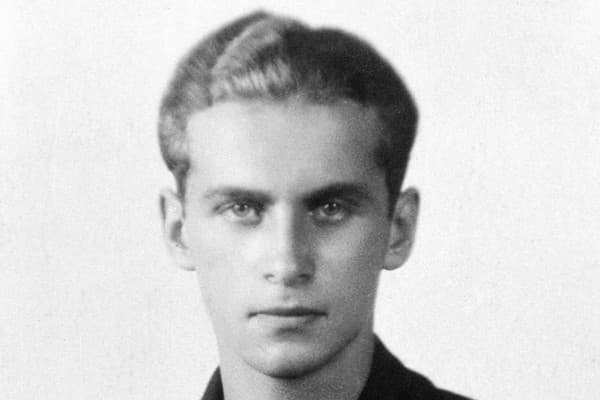
Kashistof Kamil Baczyński.

Why did you go looking for Baczyński 's Jewish relatives?

Baczyński’s Jewish side is not hidden but is little known.  Last year, when the parliament declared 2021 the year of Baczyński, I decided to check if the graves of his ancestors still exist. I checked the name of his Jewish mother, who had converted to Christianity.

I discovered that his grandparents, who were murdered by the Nazis, are buried in our Warsaw Jewish cemetery. I was lucky that the tombstones exist because many were destroyed during the war or afterwards. I shared this information on my social media and with colleagues.
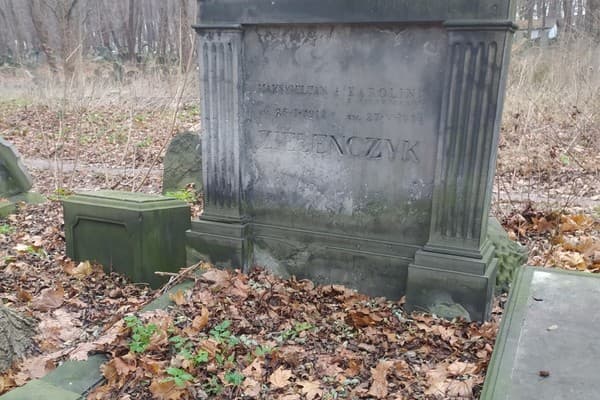
On Baczyński’s birthday, I was interviewed by Polish newspapers about the Jewish connections in Polish culture and I mentioned finding the graves. This interview was interesting for many people because they didn’t know of Baczyński’s Jewish background.

MS: Does the Jewish side of Baczyński help us understand better Polish culture?

ML: Baczyński’s poetry is very big in Polish culture. But few know it has a Jewish root. Knowing this can help us understand the depth of this writings. For example, in the 1980s, the lyrics of a famous song were adapted from a Baczyński poem.

Most Poles thought the song was about the Warsaw Uprising in 1944. But Baczyński had already been shot by the Nazis when this uprising began. His poem was about the Warsaw Ghetto Uprising in 1943.

The tombstone of one of Baczyński's relatives

Tell me more about your activism.

I visited the Jewish cemetery in Warsaw during a high school trip; fifteen-years later, I went there for a walk and saw it was overgrown, the biggest jungle in Europe. So, my friends and I started an association that organises volunteers to uncover the history of the cemetery.

We learned about the different societies that were buried there. For example, , Orthodox Jews with Hebrew names on their tombstones. We learned about Jews who were 100 per cent Polish, through what was the written on their tombstones – inscriptions that, for instance, said someone died in 1918 like a respectable Polish citizen.  If anyone writes such a thing on a tombstone, the person buried was sure to be Polish.

We started working more professionally in the cemetery to help it survive. We understood that this is our heritage, and we are responsible for protecting it.

So where was Baczyński buried?

Warsaw is full of cemeteries. There is a Jewish cemetery with famous figures such as the Yiddish writers Ansky, Yaakov Dinzon and YL Peretz all buried there. On the other side of the wall is a Catholic cemetery. And there is also civil cemetery which was previously a military cemetery. Baczyński is buried in the civil cemetery. His mother and wife are also buried there. 

What else did you find out about his family?

Baczyński grew up with his mother’s Jewish family. When the Nazis occupied Warsaw, he stayed with his mother - who had converted to Christianity - in the “German” side of the city.  In August 1943, Baczyński's uncle (from this mother’s side), Professor Adam Zielczyk, was shot dead by the Gestapo.

Baczyński must have had emotional scars, nightmares etc. We also assume he went to the funeral of his grandmother from his mother’s side who died in 1938 and was buried on the Warsaw Jewish cemetery. His grandfather died when he was three years old. He must have visited the Jewish cemetery to commemorate them. So, not only did he have Jewish roots, he was close to Jewish culture.

What is the role of the surviving Jewish cemetery in Warsaw?

In Warsaw nothing survived World War II, the city was destroyed. The Jewish cemetery is a kind of museum that stands under the sky. In a paradoxical way, it shows the life that once existed.

Our association tries to create a network of people who help us preserve the cemeteries in their towns. And I am surprised at how many institutions and people have joined the initiative.

We have signed documents of cooperation with at least 40 institutions. And soon 20 more will join. Discoveries such as Baczyński’s Jewish roots help people understand why Poland’s Jewish cemeteries should be protected.

Photo: Dr Michal Laszczkowski

You might also like
  • Facing a new year with the knowledge life can be better
    The Jewish Independent
  • Was the barmi a shemozzle? How Australians use Jewish words 
    Caroline Hendy & Emma Breslow
  • Being seen with all our differences
    Tal Slome
logomark.67a07ee3
We believe in the free flow of information

Republish our articles for free, online or in print, by using our Creative Commons licence

You might also like

    Protest
    AnalysisIsrael

    Western ‘Palestinianism’ colonises everything – and hurts Palestinians

    Andres Spokoiny 5
    interfaith war
    FeatureWorld

    The illusion of Just War: Conflict ethics in Judaism, Christianity and Islam

    Dave Moskovitz
    Erdogan Turkey
    AnalysisIsrael

    Turkey emerges as military threat to Israel

    Dror Doron

About the author

Mati Shemoelof

Mati Shemoelof

Mati Shemoelof is a poet and an author. His writing includes seven poetry books, plays, articles and fiction, which have won significant recognition and prizes. He has written a radio play for German radio WDR. A German edition of his bi-lingual poems was published by AphorismA Verlag.

More from the author

ReflectionIsrael

An Israeli abroad: grieving, alienated, ashamed

OpinionWorld

Israeli expats are becoming Diaspora Jews

OpinionWorld

The surprising trend among anxious Jewish parents in Berlin

OpinionWorld

How do Germans views Israelis who live among them?