Aa
  • Read, Watch, Listen
  • TJI Series
  • Community Action
  • Events
  • Zedi
Follow us and continue the conversation
  • LinkedIn
  • Instagram
  • FaceBook
  • X
  • YouTube
Test yourself with the TJI Quiz!

Adjust size of text

Aa

Follow us and continue the conversation

  • LinkedIn
  • Instagram
  • FaceBook
  • X
  • YouTube

Your saved articles

You haven't saved any articles

What are you looking for?

Original reporting, insightful analysis and diverse views, delivered straight to your inbox

  • LinkedIn
  • Instagram
  • FaceBook
  • X
  • YouTube
Your support fuels our mission to inform, entertain and inspire.

The Jewish Independent is bound by the Standards of Practice of the Australian Press Council. If you believe the Standards may have been breached, you may approach The Jewish Independent or make a complaint to the Australian Press Council in writing at www.presscouncil.org.au. The Council may also be contacted on 1800 025 712.

  • Our Story
  • Contact us
  • Our Team
  • Support us
  • Guidelines
  • Pitch your idea
  • Republishing us
  • Community Action
  • Our Awards
  • LinkedIn
  • Instagram
  • FaceBook
  • X
  • YouTube
Aboriginal FlagTorres Strait Islanders Flag

The Jewish Independent acknowledges Aboriginal and Torres Strait Islander peoples as the Traditional Owners and Custodians of Country throughout Australia. We pay our respects to Elders past and present, and strive to honour their rich history of storytelling in our work and mission.

© The Jewish Independent 2026All Rights Reserved
Website design and development by Your Creative, MelbourneTerms & ConditionsPrivacy Policy
HomeRead, Watch, ListenAustralia
InterviewAustralia

Peter Khalil: The government’s official tightrope walker

As Envoy for Social Cohesion, Peter Khalil is painfully aware of the uncertainties of Australia's antisemitism crisis and the limits of the government's ability to fight it.
Michael Visontay
Print this
Khalil AAP Joel Carrett 2019

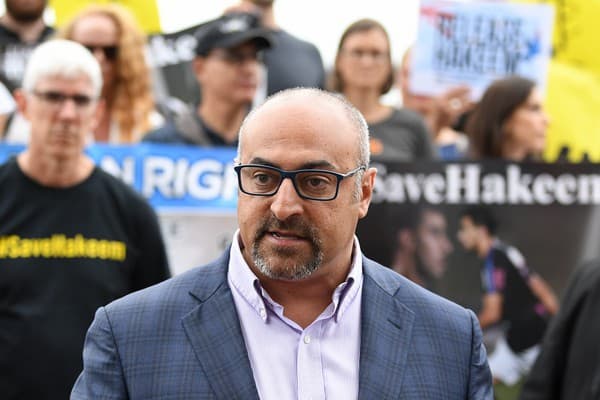
Peter Khalil addressing a human rights rally. (Joel Carrett/AAP)

Published: 29 January 2025

Last updated: 31 January 2025

Peter Khalil isn’t sure whether the outbreak of antisemitic attacks reflects a broadly-felt sentiment in Australian society, or is the work of a handful of extremists.

“That's a tough one,” says the government’s Envoy for Social Cohesion. “It's a tough one because antisemitism is an ancient hatred that has existed in Western society for a long time. It is part of that kind of historical reality that Jewish communities have faced in many, many countries.

“Has it always been there under the surface, and what we're seeing is an unleashing of what is already there, or is it a case of a very loud minority who are using violence to express hatred or an ideological position, which is not reflective of the wider society?"

Khalil pauses to consider his answer during our interview in his Melbourne office. “I don't know. I really don’t know. But I’d like to think it's the latter – that the broader Australian society doesn't have the same levels of prejudice that existed 30 years ago.”

He stresses that whether the spate of recent attacks in Melbourne and Sydney were by fringe extremists or, as the AFP has suggested, by criminals paid to commit those crimes by foreign actors, does not change their gravity or significance. What matters is that the attacks are occurring, he says, and they must be brought to an end.

Khalil, 51, the federal Labor member for Wills in northern Melbourne, was appointed to the newly-created role of Special Envoy for Social Cohesion in July, a few weeks after Jillian Segal was appointed antisemitism envoy, as the Albanese government stepped up its response to the escalation of targeting of Jewish and other religious institutions in response to the October 7 massacre and Israel’s war against Hamas.
Government can sanction illegal behaviour...but social cohesion requires a degree of basic decency amongst every individual

The Melbourne-born son of Coptic Egyptians, Khalil knows his way around sensitive territory and the Middle-East. He was Chair of Parliament’s key Intelligence and Security Committee, served on its Human Rights Committee, and spent time in Iraq. Even so, when he started in the job last August, he felt thrown in at the deep end.

“I felt like every problem in the country came my way, like the government is supposed to solve everything. Government can sanction illegal behaviour and there has been a legislative response to that behaviour. But social cohesion requires a degree of basic decency amongst every individual. There is a responsibility of every citizen, and every organisation to engage respectfully, even if we do disagree.”

Khalil believes his biggest impact can come from working with community leaders. “I've zoomed in on where I think I can do the most positive work, which is engagement with stakeholders.”

The mantra about the role of leadership in sending the right signals to communities has been hammered home across the political spectrum since October 7. Yet the spread of public vitriol and division seems to defy the messages from those at the top. It raises a question about whether members of faith and other community groups are actually swayed by what their leaders say.

Khalil is adamant that they do. “Absolutely. I still think people listen to their leaders. We're talking about long historical grievances, deep religious, ethnic and political differences. But that's when it counts. Everyone else sees that, and they take their cues from their words and actions.

“Those messages strengthen the social framework. It’s like the strength of a material. Every message adds threads to it, strengthening it each time you demonstrate an ability to engage with someone that you disagree with.”

Khalil is critical of some public and political leaders who he says “abrogated their responsibility to show that leadership” by exacerbating division for short-term political gain. Specifically, he singles out the Greens. “Some leader will say we're standing up for a great cause, and look at us. We’ve seen that with the Greens political party. In many respects, the way they have fuelled division has bene quite shocking.”

Faith leaders here have to show the courage, and some have the courage and bravery to make the clear distinction and say Hamas is not the Palestinian cause

The cues that leaders send to their followers can have major repercussions, Khalil emphasises. When they respond meekly to denigration of particular communities, or graffiti and the public display of other symbols, it gives people permission to continue, where it can progress  to more violent behaviours.  

For the Jewish community, one of the most distressing  examples of flawed leadership has been the response by Muslim and pro-Palestinian groups to the actions of Hamas, which openly desires to  destroy the Israeli state.

Khalil says while some have stood up and made clear distinctions between Hamas and the Palestinian people, others need to do more. “There should be absolute disavowal of Hamas. The idea that Hamas is somehow a legitimate resistance movement is a complete misunderstanding, or deliberately wilful ignorance, about who they really are, what they represent and what they stand for. Everyone needs to be really clear about this.

“Faith leaders here have to show the courage, and some have the courage and bravery to make the clear distinction and say Hamas is not the Palestinian cause. They've set it back terribly."

If more faith leaders had publicly disavowed Hamas in the immediate aftermath of October 7, and made a clearer distinction between it and the Palestinian cause, that messaging would have made a difference, he said. “You can’t change history now, but I think it would have had an impact.”

But the Palestinian death toll from the war has caused so much distress within the Australian Palestinian and Muslim communities that this distinction has often been buried by pain. “It's a deeply difficult and distressing time, particularly for Palestinian Australians, but right across the board, for Muslim Australians. A lot have lost so many family members in the bombings and the fighting and so on. There's a lot of pain being felt by those people, just as we’ve seen the pain felt by Jewish Australians who have had family members killed or taken hostage.”

This trauma has created competing grievances that have seen the federal government become wedged between communities on both sides of the Gaza war conflict. Much of the anger has been directed at the government for not doing enough, but the communities are angry about different things.

Jewish leaders are angry at the government for not doing enough to address antisemitism, and for its tougher foreign policy positions  about Israel, while leaders on the other side are angry at the government for not going in harder to pressure Israel about its conduct of the war and the huge loss of civilian life.

The common denominator is intense public expression of anger and fraying of social cohesion over grievances that are impossible for the government to reconcile.

Khalil admits it’s a thorny challenge. “Broadly speaking, these communities are upset with the government for not doing enough of this, or not doing enough of that. It's a really difficult one to navigate. But that's part of the legitimate engagement with communities who have the right to protest or to articulate policy positions and points of view to their government or whatever the issue is, and that's, I think, perfectly OK.”

While the passions and anger run deep, Khalil does not believe they will have much impact on voting decisions in the upcoming election.

“Of course, many Australians are concerned about what's happening on the other side of the world when there is pain and suffering and loss of innocent civilian life. People care about that. But does it change their vote?

“They may make a judgment about what the Australian government has done or hasn't done with respect to its international diplomacy or its international efforts. But I would hope most people would see what the Australian government's done with respect to our efforts in the international community to end the fighting, to increase humanitarian aid, to call on Israel to adhere to international law, to condemn Hamas.

“But it might not be the issue that changes votes. People will certainly be looking at cost of living, and housing, which is a huge issue. They'll be looking at things like education and healthcare, as they always do, this is what matters to Australians every day.  I don't know exactly, but I think when people go to the voting booth, that's what really matters to them.”

You might also like
  • Strategies for cohesion final focus of Royal Commission hearings
    Peter Kohn
  • Evidence of declining social cohesion and the efforts to turn it around
    Peter Kohn
  • When the state faltered, civil society and Diaspora Jewry stepped up
    Shahar Burla
logomark.67a07ee3
We believe in the free flow of information

Republish our articles for free, online or in print, by using our Creative Commons licence

You might also like

    Jewish-diversity copy
    FeatureAustralia

    Why you should take part in the Gen26 community survey 

    Adina Bankier Karp & David Graham
    Jewish word map
    FeatureArts & Culture

    Was the barmi a shemozzle? How Australians use Jewish words 

    Caroline Hendy & Emma Breslow 1
    Commissioner Virginia Bell
    Royal CommissionAnalysisAustralia

    Now is the time for the Royal Commission to deliver, not be politicised

    Dean Sherr 1

About the author

Michael Visontay

More from the author

NewsAustralia

Matt Chun’s hate speech prompts change in arts funding policy

AnalysisAustralia

Mishandled antisemitism education is not just ineffective, it’s dangerous

FeatureLifestyle

Where Shtisel meets The Jetsons

ReviewIsrael

Beinart’s utopian vision ignores awkward truths

Comments

No comments on this article yet. Be the first to add your thoughts.