Aa
  • Read, Watch, Listen
  • TJI Series
  • Community Action
  • Events
  • Zedi
Follow us and continue the conversation
  • LinkedIn
  • Instagram
  • FaceBook
  • X
  • YouTube
Test yourself with the TJI Quiz!

Adjust size of text

Aa

Follow us and continue the conversation

  • LinkedIn
  • Instagram
  • FaceBook
  • X
  • YouTube

Your saved articles

You haven't saved any articles

What are you looking for?

Original reporting, insightful analysis and diverse views, delivered straight to your inbox

  • LinkedIn
  • Instagram
  • FaceBook
  • X
  • YouTube
Your support fuels our mission to inform, entertain and inspire.

The Jewish Independent is bound by the Standards of Practice of the Australian Press Council. If you believe the Standards may have been breached, you may approach The Jewish Independent or make a complaint to the Australian Press Council in writing at www.presscouncil.org.au. The Council may also be contacted on 1800 025 712.

  • Our Story
  • Contact us
  • Our Team
  • Support us
  • Guidelines
  • Pitch your idea
  • Republishing us
  • Community Action
  • Our Awards
  • LinkedIn
  • Instagram
  • FaceBook
  • X
  • YouTube
Aboriginal FlagTorres Strait Islanders Flag

The Jewish Independent acknowledges Aboriginal and Torres Strait Islander peoples as the Traditional Owners and Custodians of Country throughout Australia. We pay our respects to Elders past and present, and strive to honour their rich history of storytelling in our work and mission.

© The Jewish Independent 2026All Rights Reserved
Website design and development by Your Creative, MelbourneTerms & ConditionsPrivacy Policy
HomeRead, Watch, ListenArts & Culture
FeatureArts & CultureLifestyle

Ten ways to make Seder 2024 relevant

In every generation, we live the liberation from Egypt anew, but for contemporary Jews this year will be different from all other years.
Deborah Stone
Print this
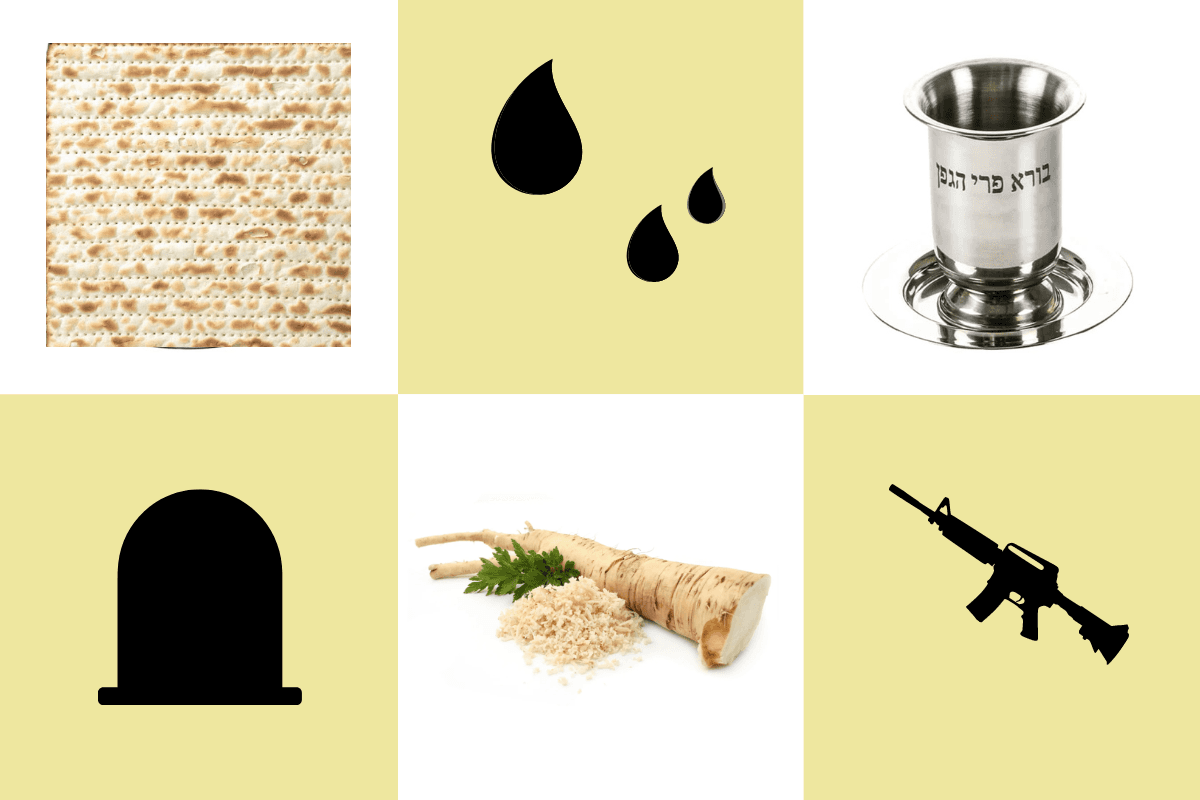
Matzah, horseradish, kiddush cup, tombstone, blood, gun

Published: 17 April 2024

Last updated: 1 April 2025

1. Remember the hostages

“This year we are slaves, next year may we be free,” has never been so poignant, at least not in the lifetime of most of us. Jews around the world will link this year’s celebration of liberation to the captivity of those kidnapped by Hamas.  

Some ideas include: Provide each participant at the seder with a piece of yellow ribbon to tie around their wrist or their kiddush cup as a symbol of waiting for the hostages to come home. Add an empty chair to symbolise the absent, whether killed or kidnapped on October 7. Or give each participant the details of a single hostage to read and perhaps share during the Seder.

2. Rethink the four children

The division of children into wise, wicked, simple and the one who does not know how to ask has had many reworkings over the years. For this year, Rabbi Rachel Barenblat, who blogs as the Velveteen Rabbi, has written a powerful version that breaks down the divisions within the Jewish people and visualises unity.

All Four (Are One)

Today the Four Children are a Zionist,
a Palestinian solidarity activist, a peacenik, and
one who doesn’t know what to even dream.

The Zionist, what does she say? Two thousand years
we dreamed of return. “Next year in Jerusalem”
is now, and hope is the beacon we steer by.

The solidarity activist, what do they say?
We know the heart of the stranger. To be oppressors
is unbearable. Uplift the downtrodden.

The peacenik, what does he say? We both love this land
and neither is leaving. We’re in this together.
Between the river and the sea two peoples must be free.

And the one who doesn’t know what to even dream:
feed that one sweet haroset, a reminder that
building a just future has always been our call.

All of us are wise. None of us is wicked.
(Even the yetzer ha-ra is holy—without it
no art would be made, no future imagined.)

We are one people, one family. Not only
because history’s flames never asked what kind
of Jew one might be, but because

the dream of collective liberation is our legacy.
We need each other in this wilderness.
Only together can we build redemption.

3. Add to the Ten Plagues

In addition to spilling a drop of wine for each of the traditional Ten Plagues, spill a drop for the modern evils that afflict us. You could ask each participant at the Seder to nominate one, or use this list of the modern Ten Plagues from the New Israel Fund Seder supplement: Crime, Disease, Abuse, Neglect, Poverty, Destruction of the environment, Discrimination, Indifference to the suffering of others, Hunger and War.

4. Sing Dayenu with awareness

The accessibility of the chorus – and perhaps the fact that it means we are approaching dinner – makes Dayenu one of the most popular moments of the Seder. But the meaning of “Enough for us” is problematic this year.  

“As long as people are trapped in Gaza, that’s not enough. As long as our soldiers are still risking their lives, it’s not enough. We can’t say ‘Dayenu.’ It can’t be, you know, ‘Praise God for this situation.’ So we have to find new texts,” American-Israeli poet Marty Herskovitz, one of the creators of Seder Interrupted told JTA.

One approach is to take the Dayenu moment to consider what we are grateful for, in the midst of the trauma. You could go around the table offering suggestions for the mercies and comforts of this period.

Another response is to read or write a Lo Dayenu (not enough) response to the traditional song, like this one produced but the Society for Humanistic Judaism.

5. Acknowledge the hunger as you eat your fill

Over-eating is universal at seder but it is more problematic when we know the Israel-Hamas war has left many people facing imminent famine. On a practical level, you could donate a portion of the money you would spend on food for Pesach – or a percentage of the money you do spend – to a charity that feeds the hungry. On a symbolic level, Rabbi Elie Kaunfer suggests using two matzos instead of three to acknowledge the brokenness this year. Others will add an empty cup to the cup of wine for Elijah that traditionally adorns the Seder table, and the cup of water symbolising Miriam used by many contemporary Jews.

6. Search for peace

While the kids are looking for the afikomen, adults could engage in a much more difficult treasure hunt. What would it take to resolve the Israeli-Palestinian conflict? What does a solution look like to you?

Or if that seems too hard right now, take some inspiration from the peacebuilders who continue to work even in this difficult climate and share a story of hope: Project Rozana, which is providing healthcare on both sides of the conflict; the Sulha movement, which continues interfaith dialogue in Jerusalem; a victim of October 7 like Elana Kaminka, who is grieving her son but refuses to give up on seeing the other side.  

7. Challenge ‘Pour out your wrath’

Perhaps the most controversial part of the Seder is the call for God to avenge our enemies, which happens when we open the door “for Elijah” or to show the world we have nothing to hide in the face of blood libels. It is particularly problematic this year in the face of the horrors of October 7.

Many people skip this angry paragraph but another option is to use it to stimulate a discussion on the nature of revenge and its relevance to the current crisis. This source sheet offers traditional Jewish sources which warn against the danger of celebrating the deaths of our enemies.

8. Include a song for peace

Sing your favourite peace song – or several. From Hebrew classics like Od Yavo Shalom to international classics from John Lennon or Bob Dylan, there is no shortage of options. This playlist contains 20 Israeli peace songs for inspiration. If your observance allows recordings, you could play it while guests are arriving, during dinner or clean-up.

Sing your favourite peace song – or several. From Hebrew classics like Od Yavo Shalom to international classics from John Lennon or Bob Dylan, there is no shortage of options. This playlist contains 20 Israeli peace songs for inspiration. If your observance allows recordings, you could play it while guests are arriving, during dinner or clean-up.

9. Use a 2024 Seder supplement

Many Jewish organisations have produced resources for this difficult year with readings, ideas and reflections.

Seder Interrupted, produced by the US-based Academy for Jewish Religion offers poems, reflections, and study materials by contemporary rabbis that grapple with every stage of the Seder.

The New Israel Fund Australia Seder Supplement has a shorter and more accessible list of suggestions produced by local teachers and activists.

The iCenter Educational Companion for Passover 2024 is structured to stimulate discussion with questions to consider for each stage of the Seder, as well as readings and images.

The Shalom Hartman Institute Haggadah Supplement for 5784 includes reflections from leading contemporary Jewish writers David Grossman, Noam Zion, and Iris Eliya Cohen as well as extensive material from rabbis and teachers.

Bringing the Hostages to your Seder produced by the #BringThem Home movement offers readings to include the hostages at various stages in the Seder.

10. Commit to respectful debate

The polarisation over the Israel-Hamas War risks dinner-time conversation deteriorating into acrimony as families come together with strong beliefs about whether Israel should end the war or whether it must continue.

Rabbi Amy Eilberg suggests we understand conversation as a spiritual practice not just an opportunity to blow off steam and advises hosts to set the parameters in advance, encouraging kindness, curiosity and self-control.

“Make it clear that you hope for robust and honest conversation — not awkward and fearful avoidance — about Israel and Palestine (along with the more general issues of freedom and liberation that lie at the heart of the seder).

“Convey that you want to talk about what is real for people and, at the same time, attend to the humanity of each person at the table. Share your conviction that it is more than possible to communicate across differences in caring and productive ways and that such communication can actually build relationships as well as contribute to everyone’s learning.”

She also has useful advice for the frustrated. "If you cannot stay in productive conversation, excuse yourself for a quick trip to the bathroom or kitchen."

You might also like
  • The memory of the hostages should guide Israel’s choices for the future
    Nirit Eylon
  • Sexual violence exposed on both sides of Israel-Palestine conflict
    Deborah Stone
  • Three reasons to savour the bitterness this Pesach
    Ittay Flescher
logomark.67a07ee3
We believe in the free flow of information

Republish our articles for free, online or in print, by using our Creative Commons licence

You might also like

    bialik Jewish schools shabbat
    OpinionAustralia

    Jewish schools are the marinade that infuses continuity

    Jeremy Stowe-Lindner
    Article Image
    FeatureArts & Culture

    What to see at the 2026 Jewish International Film Festival

    Kathy Laster
    Eden Bahar
    InterviewArts & Culture

    ‘L’chaim for the next 1,500’: Israeli drummer celebrates Cirque Du Soleil milestone

    Gideon Cohen

About the author

Deborah Stone

Deborah Stone

Deborah Stone is Editor-in-Chief of TJI. She has more than 30 years experience as a journalist and editor, including as a reporter and feature writer on The Age and The Sunday Age, as Editor of the Australian Jewish News and as Editor of ArtsHub.

More from the author

ReflectionArts & Culture

On despair: A reflection after watching ‘Cancelled’

NewsAustralia

Proposed digital care law to offer protection against online antisemitism

NewsIsrael

‘Israel is systemically eliminating Palestinian collective life’:  Israeli human rights report

Australia

Tame apologises – but with little grace

Comments

No comments on this article yet. Be the first to add your thoughts.