Aa
  • Read, Watch, Listen
  • TJI Series
  • Community Action
  • Events
  • Zedi
Follow us and continue the conversation
  • LinkedIn
  • Instagram
  • FaceBook
  • X
  • YouTube
Test yourself with the TJI Quiz!

Adjust size of text

Aa

Follow us and continue the conversation

  • LinkedIn
  • Instagram
  • FaceBook
  • X
  • YouTube

Your saved articles

You haven't saved any articles

What are you looking for?

Original reporting, insightful analysis and diverse views, delivered straight to your inbox

  • LinkedIn
  • Instagram
  • FaceBook
  • X
  • YouTube
Your support fuels our mission to inform, entertain and inspire.

The Jewish Independent is bound by the Standards of Practice of the Australian Press Council. If you believe the Standards may have been breached, you may approach The Jewish Independent or make a complaint to the Australian Press Council in writing at www.presscouncil.org.au. The Council may also be contacted on 1800 025 712.

  • Our Story
  • Contact us
  • Our Team
  • Support us
  • Guidelines
  • Pitch your idea
  • Republishing us
  • Community Action
  • Our Awards
  • LinkedIn
  • Instagram
  • FaceBook
  • X
  • YouTube
Aboriginal FlagTorres Strait Islanders Flag

The Jewish Independent acknowledges Aboriginal and Torres Strait Islander peoples as the Traditional Owners and Custodians of Country throughout Australia. We pay our respects to Elders past and present, and strive to honour their rich history of storytelling in our work and mission.

© The Jewish Independent 2026All Rights Reserved
Website design and development by Your Creative, MelbourneTerms & ConditionsPrivacy Policy
HomeRead, Watch, ListenWorld
Israel Hamas WarInterviewWorld

IHRA head: discrediting definition means ‘turning a blind eye’ to anti-Zionism

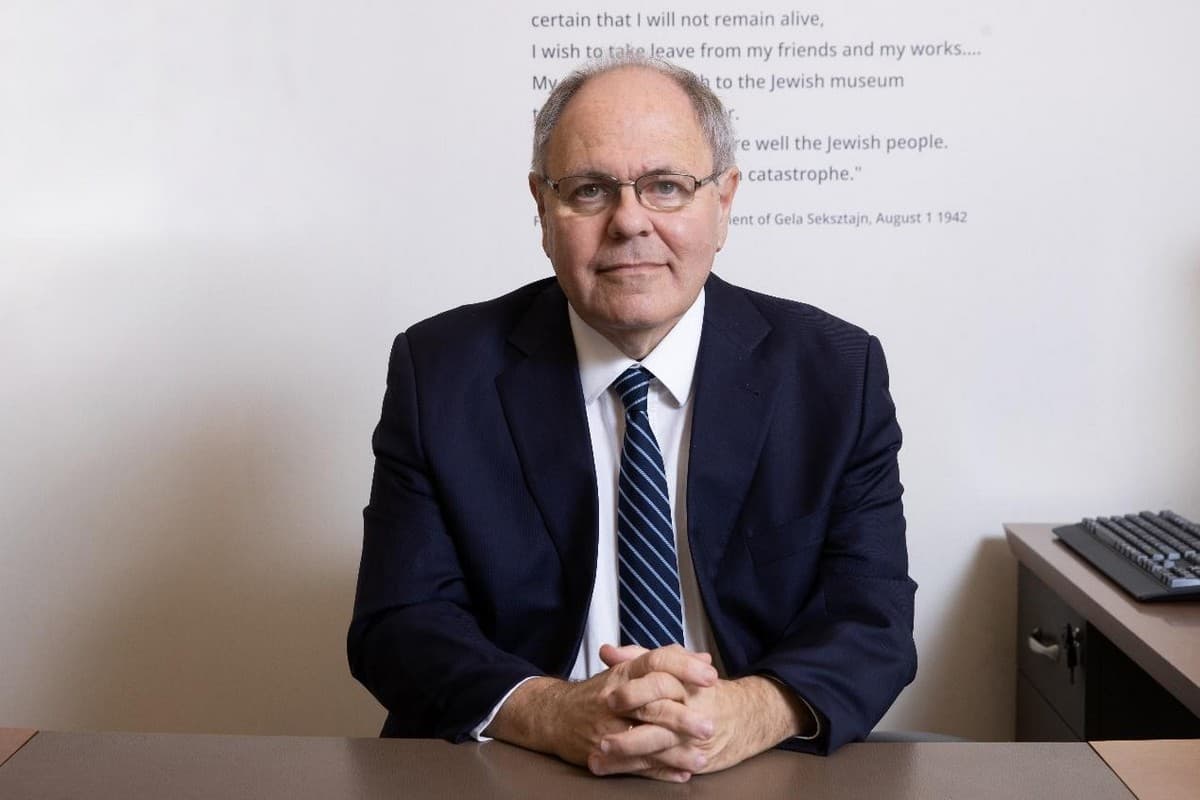
Chair of the International Holocaust Remembrance Alliance, Dani Dayan, told The Jewish Independent that he rebuts criticism of the Alliance’s definition of antisemitism.
Vic Alhadeff
Print this
Man in suit smiling

IHRA Chair Dani Dayan (Image: supplied).

Published: 31 July 2025

Last updated: 31 July 2025

The International Holocaust Remembrance Alliance (IHRA) definition of antisemitism has become a major focus of the criticism being directed at Special Envoy Jillian Segal’s plan to combat anti-Jewish racism. Yet the definition clearly states that criticism of Israel is not automatically antisemitic.

“Criticism of Israel similar to that levelled against any other country cannot be regarded as antisemitic,” the definition says. It depends on the context surrounding the criticism.

The definition was adopted by the IHRA at a meeting in Romania in 2016. Forty-six nations have endorsed it, including most of Europe, the US, and Australia in a bi-partisan decision in 2021.

The chief critique – which has existed since the definition was conceived, but has attracted sustained attention since the Segal announcement – is that it “conflates” criticism of Israel with antisemitism, therefore inhibiting people from making legitimate criticism of Israel and its state organs.

This is despite the definition stating that “criticism of Israel similar to that levelled against any other country cannot be regarded as antisemitic”. Furthermore, Spain and Ireland, for example, have endorsed the definition – yet the presidents of both have accused Israel of genocide.

"The claim that it suppresses criticism of Israel is completely false. What that claim does is let antisemites off the hook."

Dani Dayan, IHRA Chair

"The definition provides 11 illustrative examples of antisemitism, some relating to Israel, but only on the basis that these ‘could, taking into account the overall context', amount to antisemitism,” wrote Michael Easson, editor of the New Middle East website, in the Australian Financial Review.

"It is not automatic. There is no blanket characterisation of any particular set of words as antisemitic. Each case must be assessed in context and on its merits. The 'conflation' assertion is thus entirely bogus. Common sense should tell us that it is as fallacious to argue that political criticism of Israel, or of Zionism as a set of beliefs, can never amount to antisemitism as it is to argue that such criticism always amounts to antisemitism."

Political criticism of Israel is "of course" legitimate, "even warranted sometimes," emphasised Easson. "But antisemitism, a term for anti-Jewish racism and hatred, is not".

Buenos Aires-born Dani Dayan, who is chairman of Yad Vashem – the World Holocaust Remembrance Centre in Jerusalem – and is currently also serving as chair of the IHRA during Israel’s presidency of the Alliance this year, visited Australia last November and met with Premiers Chris Minns and Jacinta Allan, the Chancellors of Sydney and NSW universities, and Jillian Segal, who was working on her plan to combat antisemitism at the time.

Dayan offered a robust rebuttal of the concerns about conflation to The Jewish Independent. “The IHRA definition of antisemitism is the basic standard, both in practice and conceptually,” Dayan said. “And the claim that it suppresses criticism of Israel is completely false. What that claim does is let antisemites off the hook. If the claim were true, many Israelis would be guilty of being antisemitic! 

“Those who try to discredit the IHRA definition are turning a blind eye to the most prevalent form of antisemitism in the world today – anti-Zionism. Denying the Jewish people the right to a state. Plus demonisation of that state. Denying the legitimacy of the state of Israel.

Call for concrete action

“I believe that Premiers Minns and Allan are both allies in the struggle against antisemitism, and it was very important that the Prime Minister [Anthony Albanese] stood with Jillian Segal when she announced her plan. What we need now is concrete action. From the world’s leaders, as well as in Australia.”

"Holocaust awareness is a double-edged sword. As it becomes more prominent, it’s also being misused."

Dani Dayan, IHRA Chair

While there isn’t a great deal of good news to go around these days, “we do have one positive item”, Dayan asserted. “Holocaust awareness is increasing globally. International Holocaust Remembrance Day, January 27, was established in the 21st century, as was the IHRA definition. Both are recent innovations.

“That said, Holocaust awareness is a double-edged sword. As it becomes more prominent, it’s also being misused, such as in the war between Russia and Ukraine and in the rampant phenomenon of Holocaust inversion.

“Holocaust denial exists mainly at the fringes of social media, with the notable exception of Iran. My main concern is Holocaust distortion, which is increasing and dangerous. A few weeks ago, a Polish member of parliament denied that there were gas chambers at Auschwitz, for example. Or we hear the claim that the entire population of a certain country tried to help the Jews.

“Or we see the tendency to glorify Nazi war criminals because they fought the Communists. And in Russia we see a return to de-Judaisation, where the reference is to Soviet citizens who suffered, without identifying them as Jews.”

Key tool is authenticity

There are also concerns about artificial intelligence and social media in regard to Holocaust distortion, adds Dayan.

“AI is useful in telling the story, but it can also tell a distorted narrative. Which means Holocaust remembrance can never be completely secure," he explained.

“We’re currently at the crossroads of generations. In a few years’ time we’ll be living in a world without survivors and without witnesses. Our generation listened to the survivors; it was a formative experience. When we reach that crossroads, it will be ‘happy hour’ for deniers, and we will have to confront them."

“The greatest tool we have is authenticity. It’s one of the reasons why we continue extensive research at Yad Vashem. We have 200 million pages of documents and testimony, yet we go on searching all over the world. It’s a decisive argument against the deniers.

“Yet we also need tools to spread the knowledge, so we have to be innovative, as well as authentic.

"Knowledge of the Holocaust is an essential part of any strategy to combat antisemitism, but it isn’t sufficient. If you discuss antisemitism without a proper definition of the term, you are liable to end up with more antisemitism,” Dayan concluded.

You might also like
  • Beinart takes a wrecking ball to Israel
    Michael Visontay
  • When belonging becomes conditional
    Allen Zeesman
  • Distinguishing prejudice from political disagreement
    Larry Stillman
logomark.67a07ee3
We believe in the free flow of information

Republish our articles for free, online or in print, by using our Creative Commons licence

You might also like

    Erdogan Turkey
    AnalysisIsrael

    Turkey emerges as military threat to Israel

    Dror Doron
    interfaith war
    FeatureWorld

    The illusion of Just War: Conflict ethics in Judaism, Christianity and Islam

    Dave Moskovitz
    Netanyahu Ben Gvir Getty
    Israel Hamas WarAnalysisWorld

    Diaspora leadership must be candid about its disillusion with Netanyahu

    Colin Shindler 2

About the author

Vic Alhadeff

Vic Alhadeff

Vic Alhadeff OAM is former CEO of the NSW Jewish Board of Deputies and former editor of the Australian Jewish News.

More from the author

InterviewArts & Culture

‘The battle for the future of Jews will be fought in the cultural arena’

OpinionArts & Culture

40 years since Lanzmann’s Shoah, his central question remains: When is it too late?

OpinionAustralia

A shocking moment at Sydney Writers’ Festival

Comments2

  • Avatar of R Jackson

    R Jackson5 August at 12:46 am

    You have built your “Zionism is antisemitism” conclusion on a chain of premises the IHRA definition does not hold.

    1. “Anti‑Zionism is antisemitism.”
    The IHRA definition does not make this blanket claim. It says that in some contexts, like denying Jews the right to self‑determination or demonising Israel’s existence, anti‑Zionism can be antisemitic. That is different to saying all anti‑Zionism is antisemitism.

    2. “Zionism represents all Jews.”
    Neither the IHRA definition nor most Zionist organisations claim this. Zionism is the movement for Jewish self‑determination. Jews hold a range of political and religious views. Pretending otherwise erases the diversity you claim to defend.

    3. “Therefore all Jews are responsible for Israel’s actions.”
    This is exactly what the IHRA definition warns against. One example of antisemitism it gives is holding Jews collectively responsible for Israel’s actions.

    Your “gotcha” falls apart because the definition directly rejects the conclusion you claim it leads to.

    In your loud anti‑Zionism you manage to defend, or at least excuse, ethnoreligious nationalism that has colonised and erased minority cultures across the entire Middle East and North Africa. Yet Jewish self‑determination is the only one you treat as illegitimate.

  • Avatar of Wesley Parish

    Wesley Parish31 July at 07:51 am

    Here’s my view on the IHRA ‘working definition of antisemitism’:

    The Zionist Self-contradiction

    One of the joys of (sometimes) being on Twitter is seeing how some people acquire a taste for their toes. And their heels, in fact, the whole bleeding leg all the way up to the hips — because that is how far they put their feet in their mouths. Putting one foot in one’s mouth is an adorable sign of absentmindedness; putting both feet in up to the hip is just being greedy.

    Now there are several definitions of antisemitism out on the net, and many Zionist organizations have wholeheartedly adopted the International Holocaust Remembrance Alliance (IHRA) working definition of antisemitism. Many Zionist organizations also push the narrative that opposing the Zionist project is antisemitic. Which leaves us up the proverbial … without the proverbial …

    The basic equation being pushed is as follows “anti-Zionism is antisemitism”.

    Zionism is defined as the set of policies and procedures to establish and run a “Jewish” state. Anti-Zionism is defined as a rejection of those policies, particularly those concerning the Palestinians. Antisemitism is defined as the hatred and fear of Jews for just being Jewish. Jewishness is defined in several ways, the religious way being thus: you are Jewish if your mother was Jewish, or if you were born into a Jewish family. The state of Israel extends that to grandparents who were Jewish.

    In mathematics there is a simple operation used to solve equations or disprove their validity. It’s finding the common factors and factoring them out. Let us try that with this “equation”, factoring out the “anti”:

    “Zionism is the Jewish people”.

    Quite apart from the question of how policies are people, this — even broken down into something slightly saner and more palatable such as “Zionism represents all Jews” — has a severe problem. It’s related to that Latin legal dictum, cui bono? Who benefits? And its corollary, who is accountable, part of the necessary safeguards of a democracy. If Zionism represents all Jews, whether they like it or not, how does that not make all Jews, whether they like it or not, accountable for Israel’s crimes?

    And this is where the IHRA working definition of antisemitism plays an interesting part:

    “Holding Jews collectively responsible for actions of the state of Israel.”

    This is part and parcel of the IHRA definition of antisemitism. And as we have seen, the equation of “anti-Zionism is antisemitism” when factored down into “Zionism is the Jewish people; represents the entire Jewish people”, makes the Jewish people into collaborators in Israel’s ethnic cleansing, thus making them collectively responsible for that hideous communal violence. And the IHRA working definition of antisemitism, makes that an example of antisemitism.

    Thus starting with “Anti-Zionism is antisemitism”, we end up with “Zionism is antisemitism”.

    Slice and dice as you will, I still am driven to the conclusion that Zionists are more in need of a psychiatrist than a state.