Aa
  • Read, Watch, Listen
  • TJI Series
  • Community Action
  • Events
  • Zedi
Follow us and continue the conversation
  • LinkedIn
  • Instagram
  • FaceBook
  • X
  • YouTube
Test yourself with the TJI Quiz!

Adjust size of text

Aa

Follow us and continue the conversation

  • LinkedIn
  • Instagram
  • FaceBook
  • X
  • YouTube

Your saved articles

You haven't saved any articles

What are you looking for?

Original reporting, insightful analysis and diverse views, delivered straight to your inbox

  • LinkedIn
  • Instagram
  • FaceBook
  • X
  • YouTube
Your support fuels our mission to inform, entertain and inspire.

The Jewish Independent is bound by the Standards of Practice of the Australian Press Council. If you believe the Standards may have been breached, you may approach The Jewish Independent or make a complaint to the Australian Press Council in writing at www.presscouncil.org.au. The Council may also be contacted on 1800 025 712.

  • Our Story
  • Contact us
  • Our Team
  • Support us
  • Guidelines
  • Pitch your idea
  • Republishing us
  • Community Action
  • Our Awards
  • LinkedIn
  • Instagram
  • FaceBook
  • X
  • YouTube
Aboriginal FlagTorres Strait Islanders Flag

The Jewish Independent acknowledges Aboriginal and Torres Strait Islander peoples as the Traditional Owners and Custodians of Country throughout Australia. We pay our respects to Elders past and present, and strive to honour their rich history of storytelling in our work and mission.

© The Jewish Independent 2026All Rights Reserved
Website design and development by Your Creative, MelbourneTerms & ConditionsPrivacy Policy
HomeRead, Watch, ListenLifestyle
FeatureLifestyle

Is your last name code for ‘Jewish’?

US researchers rely on a list of 29 common Jewish family names for everything from medical research to chicken shops.
Asaf Elia-Shalev
Print this
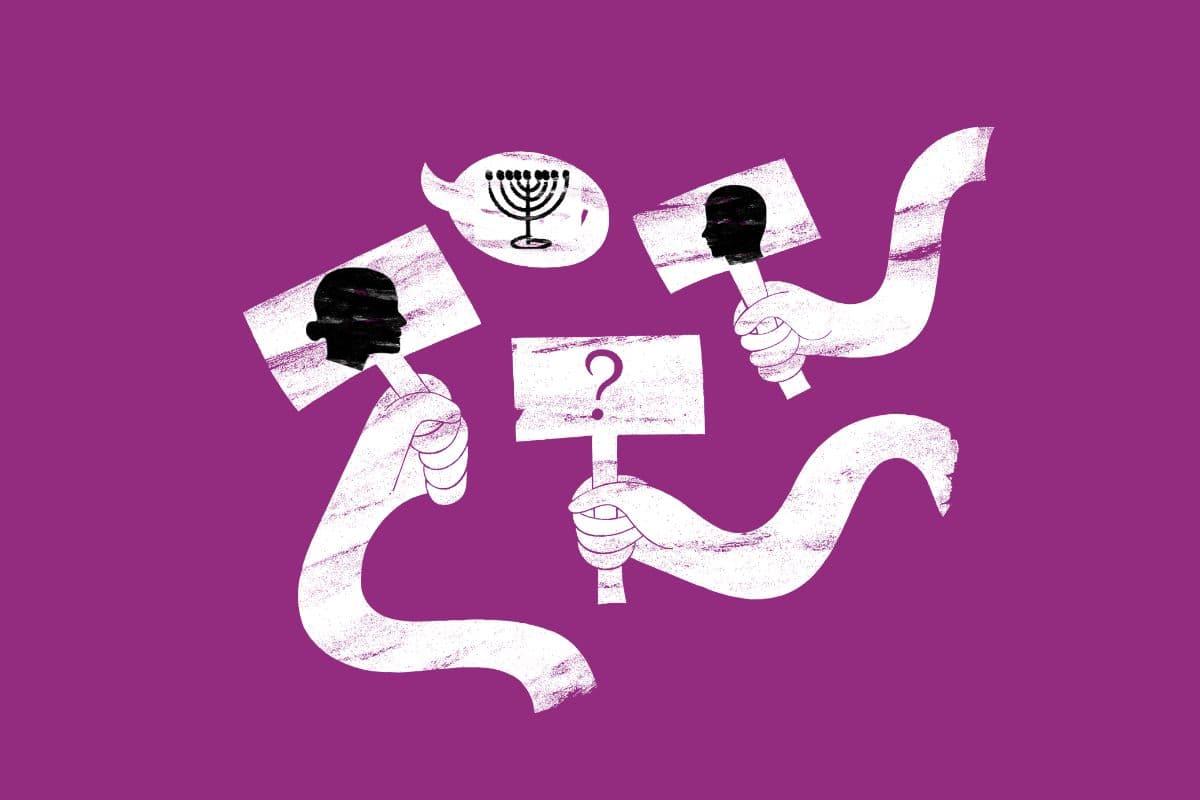
hands holding signs with faces, a question mark, and a menorah

Published: 4 April 2024

Last updated: 4 April 2024

(JTA) — Ira Sheskin is one of the most prominent demographers of American Jews. A professor at the University of Miami, Sheskin helps Jewish communities across the country carry out complicated population surveys. He sometimes works for businesses, too, and several years ago, a major kosher poultry company turned to him with a quandary.

The company had convinced Publix Super Markets to stock its kosher chicken products, but not in every store. In Birmingham, Alabama, the company had to pick just one of Publix’s several local branches. But how to pick the one closest to the largest number of Jews?

The way to obtain the most accurate results would be through making phone calls or even sending letters to a very large number of people across Greater Birmingham, asking if they are Jewish as part of a randomized survey. But it would be too expensive. 

Instead, Sheskin opted for a trick that Jewish demographers have been relying on for generations: checking the phone book for distinctive Jewish names. 

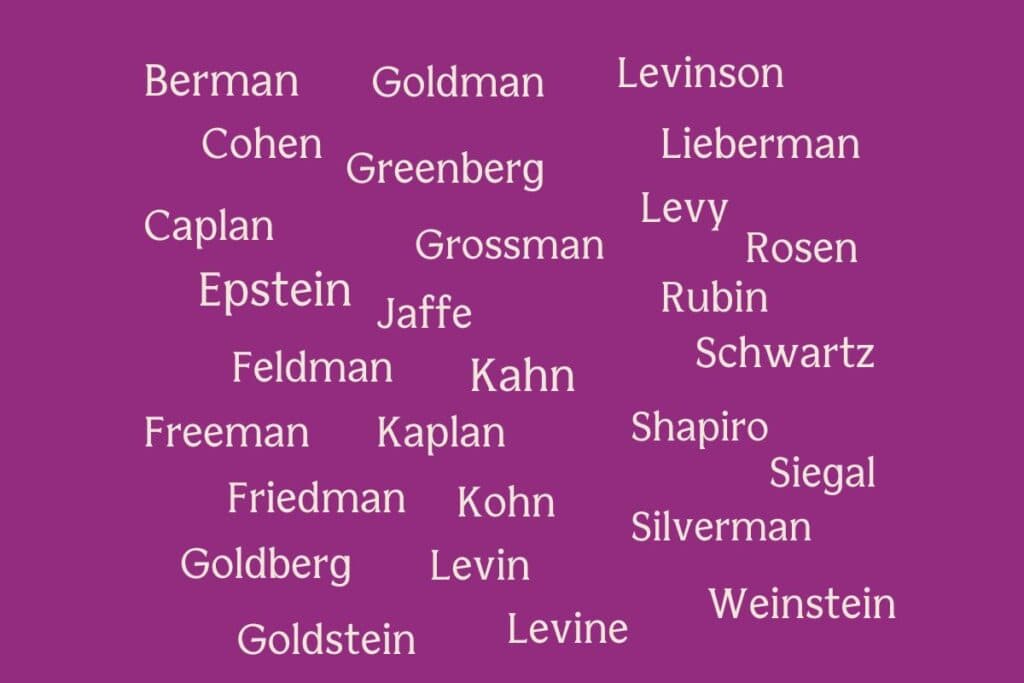
Researchers have a list of 29 last names that are so common among Jews in the United States, and so uncommon in the rest of the population, that they can be used to draw demographic conclusions. 

Not everyone with one of these last names is Jewish, and not even close to a majority of Jews — have one of them. An obvious issue is that the list consists of entirely Ashkenazi surnames, and would do poorly for identifying, for example, Persian, Israeli, or Russian Jews in the United States, which is a growing concern as American Jewry becomes increasingly diverse. But there’s still enough of a pattern to extrapolate total Jewish population estimates in most places using these names,

They are:
The Jewish Independent

A team of computer scientists recently used the set of distinctive Jewish names to determine roughly how many of the authors whose texts appear in artificial intelligence training data are Jewish. “The method felt both surprising and intuitive,” said one of the computer scientists, Heila Precel. In medical research, scientists testing medicines have turned to the so-called DJNs when they need to figure out which study participants are likely Jewish.

Screening for Jews is a major challenge. Assuming Jews are 2% percent of the population in a certain area, researchers have to screen 50 people to find one Jew or 150,000 people to find 3,000 Jews. And that’s assuming everyone picks up the phone. 

So instead of contacting anyone and everyone, researchers focus on people with distinctive Jewish names. 

“Getting a representative sample is tremendously expensive, very time-consuming, extraordinarily difficult, and just grotesquely inefficient,” said Matthew Boxer, a research professor at Brandeis University’s Cohen Center for Modern Jewish Studies. “If you can make that process more efficient, you should do so.”

The technique was originally devised in 1942 by a researcher named Samuel Kohs, who was charged at the time with assessing the recreational and cultural needs of the Jewish community of Los Angeles. He made a list of the most commonly appearing names in the files of Los Angeles’ Jewish federation. He then found that a set of 35 last names accounted for about 12% of names appearing on the Los Angeles list and on registries maintained by various other federations. Further research showed that 70%-92% of people with any one of 35 last names were Jewish. 

These ratios have largely held to this day, although Sheskin has refined the list down to 29 names, plus variations. 

You might also like
  • Ten ways to reflect, repair and renew this Yom Kippur
    Hannah Lundberg
  • On despair: A reflection after watching ‘Cancelled’
    Deborah Stone
  • Ash Densham: Building community through Humanistic Judaism
    Gideon Cohen
logomark.67a07ee3
We believe in the free flow of information

Republish our articles for free, online or in print, by using our Creative Commons licence

You might also like

    original-6ACA4B6A-4208-4277-A4EE-E687C3C87523
    FeatureLifestyle

    The right to an ordinary Jewish life

    Jarod Rhine-Davis
    single – lead image
    FeatureLifestyle

    On my own (terms)

    Jarod Rhine-Davis
    Neurodivergence panel
    VideoLifestyle

    Neurodivergence and inclusion in the Jcom

    The Jewish Independent

About the author

Asaf Elia-Shalev

author

Asaf Elia-Shalev is a California-based staff reporter for JTA.

More from the author

FeatureLifestyle

Search this list of names to find your hidden Middle Eastern family history

Comments

No comments on this article yet. Be the first to add your thoughts.