Aa
  • Read, Watch, Listen
  • TJI Series
  • Community Action
  • Events
  • Zedi
Follow us and continue the conversation
  • LinkedIn
  • Instagram
  • FaceBook
  • X
  • YouTube
Test yourself with the TJI Quiz!

Adjust size of text

Aa

Follow us and continue the conversation

  • LinkedIn
  • Instagram
  • FaceBook
  • X
  • YouTube

Your saved articles

You haven't saved any articles

What are you looking for?

Original reporting, insightful analysis and diverse views, delivered straight to your inbox

  • LinkedIn
  • Instagram
  • FaceBook
  • X
  • YouTube
Your support fuels our mission to inform, entertain and inspire.

The Jewish Independent is bound by the Standards of Practice of the Australian Press Council. If you believe the Standards may have been breached, you may approach The Jewish Independent or make a complaint to the Australian Press Council in writing at www.presscouncil.org.au. The Council may also be contacted on 1800 025 712.

  • Our Story
  • Contact us
  • Our Team
  • Support us
  • Guidelines
  • Pitch your idea
  • Republishing us
  • Community Action
  • Our Awards
  • LinkedIn
  • Instagram
  • FaceBook
  • X
  • YouTube
Aboriginal FlagTorres Strait Islanders Flag

The Jewish Independent acknowledges Aboriginal and Torres Strait Islander peoples as the Traditional Owners and Custodians of Country throughout Australia. We pay our respects to Elders past and present, and strive to honour their rich history of storytelling in our work and mission.

© The Jewish Independent 2026All Rights Reserved
Website design and development by Your Creative, MelbourneTerms & ConditionsPrivacy Policy
HomeRead, Watch, ListenAustralia
Israel Votes 2026InterviewAustraliaIsrael

The Israelis who flew home to vote

Hoping for different outcomes, three Israelis living in Melbourne each made the long journey home to vote in Israel’s election
Gideon Cohen
Print this
Planes Flying Over Barcelona

As many as 67,000 Israeli expats were estimated to have flown home to vote (Photo by Xavier Bonilla/NurPhoto via Getty Images)

Published: 19 November 2026

Last updated: 19 November 2026

The 2026 Israeli election drew the highest voter turnout in more than a quarter of a century. According to figures released after polls closed, more than 77 per cent of eligible voters cast a ballot, the highest since 1999.

Because Israel does not allow most citizens abroad to vote by post, tens of thousands of expatriates also flew home to take part. AID Coalition, a US-based nonprofit focused on strengthening Israel’s democracy, estimated as many as 67,000 would make the journey, based on data from its Fly&Vote initiative.

Among them were three Israeli citizens living in Melbourne who travelled to Israel to cast their votes, each with a different vision for the country’s political future.

Nirit Eylon, who leads the progressive Zionist organisation Hatikvah Australia, travelled to Israel to vote for the Democrats, led by Yair Golan. Eylon became a spokesperson for Saving Israel’s Democracy in 2023, helping coordinate Melbourne rallies against the Israeli government’s proposed judicial overhaul.

After October 7, she co-founded United with Israel Australia NZ, advocating for the release of the hostages and supporting Israelis evacuated from areas affected by the war.

“When you look at the list of the Democrats, they are the ones that were there when we rallied,” she told The Jewish Independent. “They were the ones fighting for the hostages … And for me, it was obvious that I’m going to give them my vote.”

On the Saturday night before the election, Eylon joined a large rally in Tel Aviv’s Hostages Square led by the families of October 7 victims. She and other volunteers handed out T-shirts bearing a Hebrew slogan meaning “rescue flight” to Israelis who had travelled from overseas. “They were gone within less than an hour,” she said.
“I represented the Hostages’ Families Forum, so I met lots of the families there and people who lost their loved ones. It was very emotional, and it was really full of hope.”

Locals grateful for expats flying to vote

On election day, she wore her T-shirt to the polling station. “People told me, ‘we’re so thankful that you guys came to vote,’” she said.

Hallely Kimchi, a Melbourne-based community leader and co-founder of Shelanu, an Israeli and Jewish culture hub in Melbourne, also flew home to vote for the Democrats.

Kimchi had planned to travel to Israel in mid-August for an event, but as rumours swirled about when the election would be called, the dates kept shifting. “The minute we realised it was October, we changed our tickets,” she said. 

“I felt that’s something I have to do for my country. I would not be able to live with myself. Especially us who did a lot from abroad for Israel in the past three years.”

At the polling station, she came across an older woman about to give up on a long queue. Kimchi recognised her as the mother of a girl from her primary school. “I said, ‘there’s no way you’re not voting. I came all the way from Australia to vote,’” she recalled. She took the woman by the hand and led her back into line.

The arrival of Israelis from abroad drew criticism from some commentators, who questioned whether people living outside the country should have a say in its government. Kimchi said she once shared that view. “I didn’t feel I had a vote to tell people how to live in Israel,” she said. “I’ve changed my mind, especially after being at the Zionist Congress last year.”

Voting seen as an obligation

“My vote is not only my right,” she said. “It’s my obligation.” She also rejects the word “Diaspora”: “I’m an Israeli citizen who lives outside of Israel.”

Turnout among Arab citizens, who make up about a fifth of Israel’s population, was reported by Channel 12 to have reached about 80 per cent. Eylon said she was “very happy to see them going out and voting”, and hoped it would “translate at the end to them being part of society, not only by working together and being there, but equally getting the same rights”.

Kimchi said the turnout reflected the make-up of the country. “They are citizens of Israel, and if it’s democratic, their vote and my vote is the same vote.”

Tamir Aloni, vice president of the Australian Jewish Association, a politically conservative Zionist organisation, took a different route to the ballot box.

Born in Israel, Aloni moved to Australia at 13. He was previously part of the Brisbane Jewish community and is now based in Melbourne, where he has lived for more than 20 years. A former Betar leader and current president of Betar Parents and Friends Victoria, he works in business development in the defence industry.

He landed in Israel on October 25, two days before the election, and stayed for two weeks, combining his vote with work and time with family.

It was the first time he had voted in an Israeli election, though he is eligible as a citizen. “I’ve never been to Israel during an election before,” he said. “But I really wanted more than to vote. I wanted to be there to experience it and understand the debate at street level, and what people’s concerns were.”

He also wanted to see how much the concerns of Jewish communities abroad shaped the election debate. “Being so involved in the Jewish community and Diaspora, after October 7, I wanted to understand how much of what is going on for the Diaspora plays into the discussions in relation to the election,” he said.

Focused on common interests

Aloni said he voted for a conservative party but did not specify which. His hope is for a coalition of Zionist Jewish parties from left and right of centre, “with the exclusion of the extremities, whether it be left or right”. 

“That would be my ultimate hope for Israel: that there’s a government that brings Bibi and the Likud party into a unity government on that basis,” he said. “That would be in Israel’s best interests, because then you exclude the more fringe parts of society.”

“Whether that’s possible, I don’t know. But I’d like to think people can resolve on the fact that they have a lot of things in common and only some things in difference.”

He also believes Israel should not be swayed by international pressures. “Israel needs to be very much independent, sovereign, and making decisions without influence by external Diaspora communities and also external governments,” he said, naming Australia, Canada and the UK.

The vote itself was inconclusive. Final results gave Netanyahu’s bloc 53 seats and the opposition bloc led by Gadi Eisenkot 48, with Arab-led parties winning 19, leaving neither side with the 61 needed for a majority in the 120-seat Knesset. The Democrats, the party Eylon and Kimchi voted for, won eight seats. 

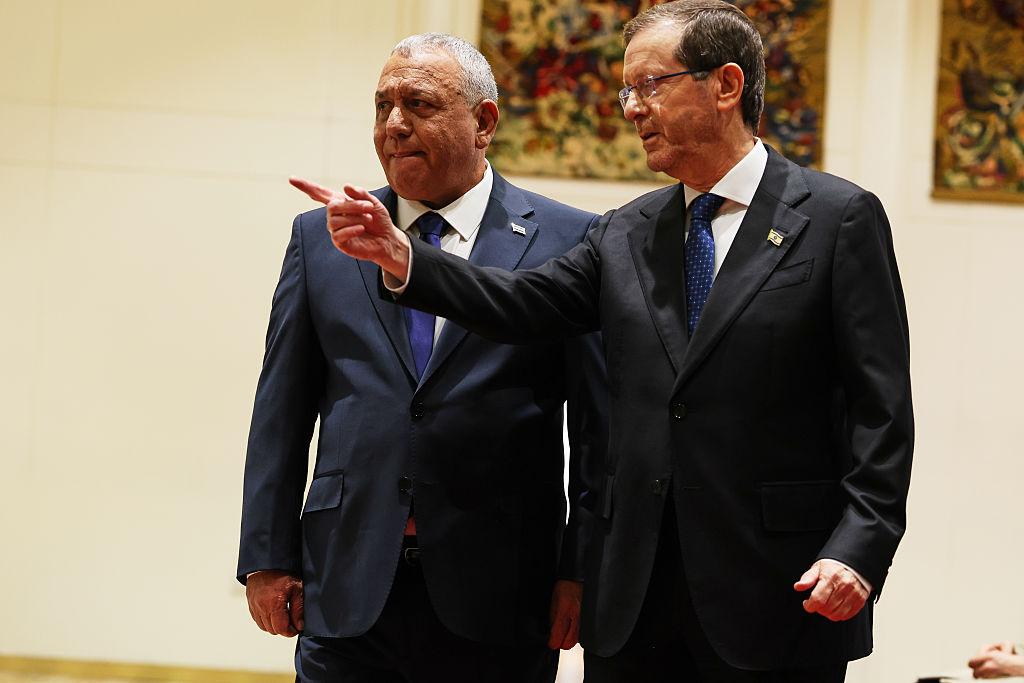
On November 8, President Isaac Herzog tasked Eisenkot with forming a government, giving him 28 days, with a possible 14-day extension. If no coalition can be formed, Israel could face another election.

Whatever their politics, all three described an election day that left a strong impression.

For Eylon, election day was “very buzzing”. “Everyone was participating in the democratic process,” she said. “Being able to get there and vote was very important to a lot of people … It was a good day.”

Kimchi said she was grateful Israel’s democracy had endured. “Thank God that we still have a democratic process,” she said. “I can’t even begin to tell you the amount of conversations, and all the spectators and the volunteers, the army of people trying to save Israel’s democracy, was above and beyond. We were doing everything possible, and it showed.”

Aloni said what struck him most was the atmosphere. “Unlike in Australia, where voting is compulsory, in Israel people are there because they want to,” he said. “I just loved the diversity of opinions on the street. It was really exciting, enthralling to be a part of it. It just felt like everyone was really enjoying exercising their democratic right.”

You might also like
  • Flooding and illness increase urgency of humanitarian relief in Gaza
    Shahar Burla
  • Australia’s latest sanctions raise the stakes, but stay on track
    Deborah Stone
  • Could the West be regained by an Eisenkot coalition?
    Dean Sherr
logomark.67a07ee3
We believe in the free flow of information

Republish our articles for free, online or in print, by using our Creative Commons licence

You might also like

    Menachem Vorchheimer
    InterviewAustralia

    Why Menachem Vorchheimer keeps taking people to court 

    Max Gross
    Eisenkot Herzog
    Israel Votes 2026NewsIsrael

    Diaspora Jews urge Israel’s change bloc to form a Jewish–Arab coalition

    Sharon Offenberger 2
    Joint list
    AnalysisIsrael

    Unlikely bedfellows: How Arab parties could deliver Israel’s next government

    Ben Lynfield 1

About the author

Gideon Cohen

Gideon Cohen

Gideon Cohen is a Melbourne-based journalist and a content creator and editorial assistant at TJI. He holds a master's degree in journalism from the University of Melbourne and his work has appeared in various publications including Broadsheet and The Jewish Chronicle.

More from the author

FeatureAustralia

Josh Frydenberg weighs political return as he releases his new memoir

FeatureAustralia

From the footy field to the film festival: the AJAX story onscreen

FeatureAustralia

‘Our children already belong’: Petition calls Jewish schools to cooperate for disabled support

InterviewAustralia

Joni Fleischer: Connecting charities with tech talent