Aa
  • Read, Watch, Listen
  • TJI Series
  • Community Action
  • Events
  • Zedi
Follow us and continue the conversation
  • LinkedIn
  • Instagram
  • FaceBook
  • X
  • YouTube
Test yourself with the TJI Quiz!

Adjust size of text

Aa

Follow us and continue the conversation

  • LinkedIn
  • Instagram
  • FaceBook
  • X
  • YouTube

Your saved articles

You haven't saved any articles

What are you looking for?

Original reporting, insightful analysis and diverse views, delivered straight to your inbox

  • LinkedIn
  • Instagram
  • FaceBook
  • X
  • YouTube
Your support fuels our mission to inform, entertain and inspire.

The Jewish Independent is bound by the Standards of Practice of the Australian Press Council. If you believe the Standards may have been breached, you may approach The Jewish Independent or make a complaint to the Australian Press Council in writing at www.presscouncil.org.au. The Council may also be contacted on 1800 025 712.

  • Our Story
  • Contact us
  • Our Team
  • Support us
  • Guidelines
  • Pitch your idea
  • Republishing us
  • Community Action
  • Our Awards
  • LinkedIn
  • Instagram
  • FaceBook
  • X
  • YouTube
Aboriginal FlagTorres Strait Islanders Flag

The Jewish Independent acknowledges Aboriginal and Torres Strait Islander peoples as the Traditional Owners and Custodians of Country throughout Australia. We pay our respects to Elders past and present, and strive to honour their rich history of storytelling in our work and mission.

© The Jewish Independent 2026All Rights Reserved
Website design and development by Your Creative, MelbourneTerms & ConditionsPrivacy Policy
HomeRead, Watch, ListenIsrael
Israel Hamas WarNewsIsrael

Flooding and illness increase urgency of humanitarian relief in Gaza

International pressure on Israel has intensified with worsening conditions in Gaza due to flooding and insufficient aid deliveries
Shahar Burla
Print this
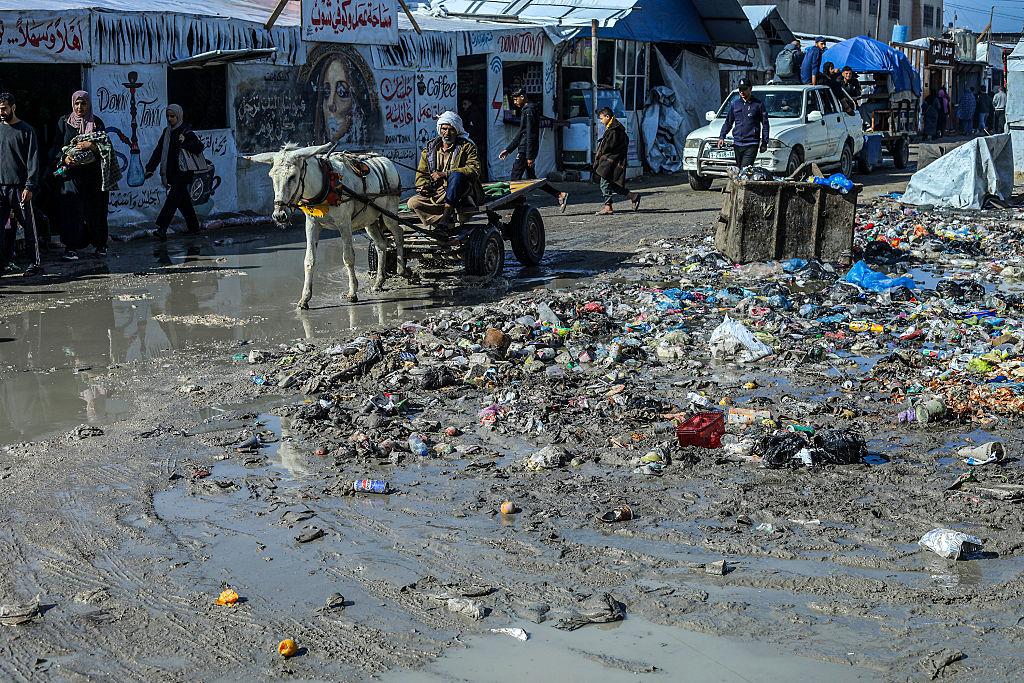
Displaced Palestinians face harsh conditions amid rain and destruction in Gaza

Khan Yunis – Palestinians struggle with harsh weather conditions in addition to the devastating impact of more than three years of war (Abed Rahim Khatib/Anadolu via Getty Images)

Published: 19 November 2026

Last updated: 19 November 2026

The World Health Organization (WHO) has warned of rising respiratory illnesses in Gaza, with conditions expected to worsen after heavy rains flooded tens of thousands of tents housing displaced Palestinians.

“The numbers already show the pressure. Acute respiratory infections are 33,000 cases higher than at the same time last year,” Dr Reinhilde Van De Weerdt, WHO representative in the Occupied Palestinian Territory, told reporters in Geneva from Jerusalem. 

The United Nations Office for the Coordination of Humanitarian Affairs (OCHA) reported in September that 94 per cent of Gaza’s population urgently needs shelter assistance. Around 65 per cent of households are living in tents or makeshift shelters, while 650,000 children require winter support, including warm clothing and blankets. By September, aid agencies had secured enough winter clothing for only 9,000 households and bedding for 50,000, well short of what was required. OCHA said funding shortages were further hampering preparations for winter.

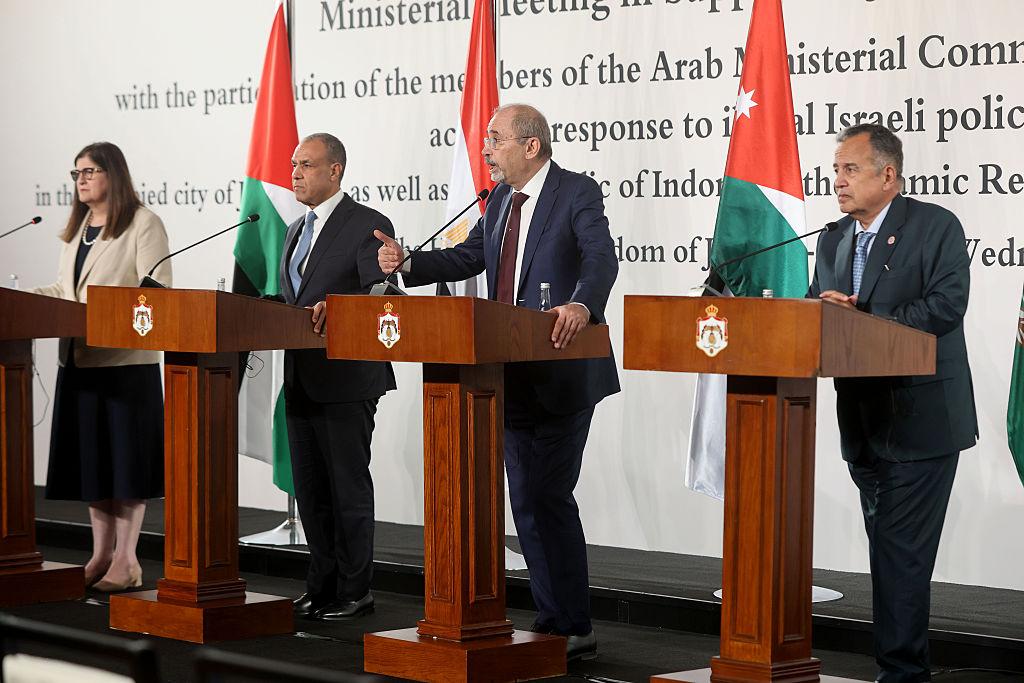
Australia, Canada, the United Kingdom and Italy have urged Israel to allow critical humanitarian aid into Gaza, describing conditions on the ground as “dire”.  The four countries issued a joint statement on Monday calling on Israel to permit the entry of 150,000 tents and other essential supplies currently being held at the border. “We, the foreign ministers of Australia, Canada, Italy and the United Kingdom, are clear that as winter takes hold in Gaza, the humanitarian situation on the ground is dire,” the statement said. “The recent floods have brought further suffering, and this was only the first storm of the winter. People in Gaza desperately need shelter and humanitarian assistance.”
The statement comes as Australia and the UK have increased pressure over West Bank settlements, adding sanctions against West Bank individuals, settlement organisations and a construction company.

The European Union also expressed grave concern over the worsening humanitarian situation in Gaza, warning that flooding was adding to already severe living conditions and urging Israel to allow immediate, large-scale aid deliveries.

On Saturday, 18 Arab and Islamic countries issued a joint statement condemning an Israeli airstrike on the Nasser Medical Complex last week, which killed six people, including a surgeon, and wounded at least 20 others. The signatories included Qatar, Jordan, the United Arab Emirates, Saudi Arabia, Egypt and Turkey. They also condemned continued Israeli attacks on Palestinian civilians. The EU described the strike on Nasser Hospital in Khan Yunis as “deeply concerning” and stressed the need to protect civilians, medical personnel and civilian infrastructure. “We urge Israel to allow immediate, unimpeded access and sustained distribution of humanitarian assistance and early recovery support at scale, and to reopen all Gaza border crossings,” the EU said.

Israel's own figures raise questions over aid commitments

Last week, the US-backed Board of Peace issued a statement expressing frustration at Israel’s policies governing humanitarian aid entering Gaza. As winter conditions set in, the group called on Israel to “abide by its commitments” and allow more supplies into the territory.

The criticism forms part of a broader international push for changes to Israel’s aid policies, including concerns over decisions by Major General Yoram Halevi, head of the Coordinator of Government Activities in the Territories (COGAT), the body responsible for overseeing aid access.

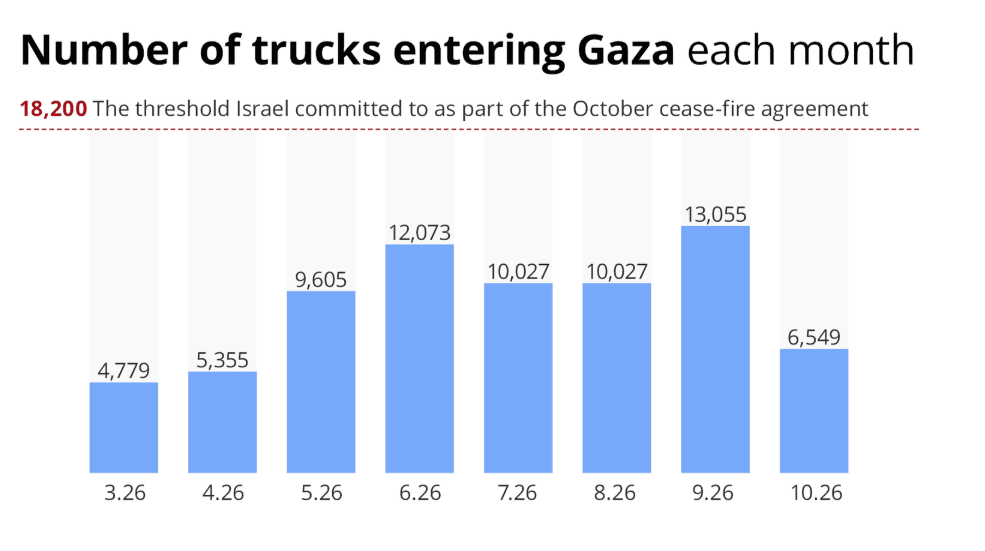
According to data obtained by Haaretz from the US-established Civil-Military Coordination Center in Kiryat Gat, Israel has fallen short of commitments made under the Gaza ceasefire agreement for much of the past eight months. The figures, supplied by COGAT to the US-run centre and verified by the United Nations, are the first Israeli data released since the ceasefire began in October 2025, showing that aid deliveries have not consistently met agreed targets. Under the ceasefire agreement, 4,200 trucks carrying humanitarian aid and commercial goods are meant to enter Gaza each week, equivalent to about 600 trucks a day. This amounts to roughly 18,200 trucks a month carrying food, fuel, medicine, medical equipment, shelter materials and other essential supplies.

Sources familiar with the aid operation told Haaretz that Israel met its commitments during January and February. In most months since then, however, truck numbers have reached only around half the agreed target or less. The data shows approximately 4,700 trucks entered Gaza in March, slightly more than a quarter of the target. Around 5,300 entered in April. Deliveries increased to more than 9,600 trucks in May, just over half the agreed level.

Source: <em>Haaretz</em>
Source: Haaretz

More than 12,000 trucks entered in June, followed by about 10,000 in both July and August. September recorded a high of more than 13,000 trucks, before falling sharply to just over 6,500 in October. So far this month, nearly 4,000 trucks have entered Gaza. COGAT has stopped publishing cumulative figures on aid truck entries since the ceasefire began, instead releasing only selected statistics, including updates on tent deliveries ahead of winter.

Mixed reaction to Australia's call

The Australia/Israel & Jewish Affairs Council (AIJAC) criticised Australia’s decision to join the joint statement with the United Kingdom, Canada and Italy, arguing it failed to acknowledge Hamas’ role in Gaza’s humanitarian crisis.

“Israel, like all parties to the conflict, has obligations under international humanitarian law. But these obligations must be considered alongside the reality that Hamas continues to exploit civilian infrastructure and humanitarian assistance for terrorist purposes, while refusing to disarm and relinquish control of Gaza, as Australia itself has previously called for,” AIJAC executive director Colin Rubenstein said in a media release.

Labor MP Ed Husic also dismissed the joint statement, arguing that stronger action was needed. “My view, like a lot of people in the Australian public, is that when you see vulnerable people, especially children, being targeted in horrific ways, we can’t stand by and say we’ll statement our way out of this,” Husic told News24.

Greens leader and foreign affairs spokesperson David Shoebridge said strong language alone would have little impact and called on the government to take more concrete measures. “The Israeli government has not responded to harsh words from Australia before, and it won’t now,” Shoebridge said. “Material action, sanctions on the war cabinet, ending the two-way arms trade and implementing sanctions on illegal settlements, as other nations have done. These are real actions the Albanese government can take but has failed to.”

You might also like
  • Australia’s latest sanctions raise the stakes, but stay on track
    Deborah Stone
  • Could the West be regained by an Eisenkot coalition?
    Dean Sherr
  • Haredi party may change sides, enabling Eisenkot to form new government
    Shahar Burla
logomark.67a07ee3
We believe in the free flow of information

Republish our articles for free, online or in print, by using our Creative Commons licence

You might also like

    Joint list
    AnalysisIsrael

    Unlikely bedfellows: How Arab parties could deliver Israel’s next government

    Ben Lynfield 1
    Arab league
    Israel Votes 2026FeatureIsrael

    Dear Israel, we don’t care who your next prime minister is

    Michal Yaari 1
    Resilience
    AnalysisIsrael

    Traumatech Nation: How Israel became a mental health leader

    Maayan Hoffman 1

About the author

Shahar Burla

Shahar Burla

Dr Shahar Burla is a Sydney-based researcher, lecturer and Contributing Editor of TJI. Shahar holds a Master’s degree in political science from Hebrew University and a PhD in political science from Bar-Ilan University. He is the author of Political Imagination in the Diaspora: The Construction of a Pro-Israeli Narrative (2013) and co-editor of Australia and Israel: A Diasporic, Cultural and Political Relationship (2015).

More from the author

AnalysisIsrael

Growing pressure for a minority Change government in Israel

ExplainerIsrael

Israel’s election fails to deliver a clear path to a government

AnalysisIsrael

‘Moroccan monkey’: Israel’s ethnic divide still shapes its elections

AnalysisIsrael

Israel now faces 138 sanctions across 63 countries