Aa
  • Read, Watch, Listen
  • TJI Series
  • Community Action
  • Events
  • Zedi
Follow us and continue the conversation
  • LinkedIn
  • Instagram
  • FaceBook
  • X
  • YouTube
Test yourself with the TJI Quiz!

Adjust size of text

Aa

Follow us and continue the conversation

  • LinkedIn
  • Instagram
  • FaceBook
  • X
  • YouTube

Your saved articles

You haven't saved any articles

What are you looking for?

Original reporting, insightful analysis and diverse views, delivered straight to your inbox

  • LinkedIn
  • Instagram
  • FaceBook
  • X
  • YouTube
Your support fuels our mission to inform, entertain and inspire.

The Jewish Independent is bound by the Standards of Practice of the Australian Press Council. If you believe the Standards may have been breached, you may approach The Jewish Independent or make a complaint to the Australian Press Council in writing at www.presscouncil.org.au. The Council may also be contacted on 1800 025 712.

  • Our Story
  • Contact us
  • Our Team
  • Support us
  • Guidelines
  • Pitch your idea
  • Republishing us
  • Community Action
  • Our Awards
  • LinkedIn
  • Instagram
  • FaceBook
  • X
  • YouTube
Aboriginal FlagTorres Strait Islanders Flag

The Jewish Independent acknowledges Aboriginal and Torres Strait Islander peoples as the Traditional Owners and Custodians of Country throughout Australia. We pay our respects to Elders past and present, and strive to honour their rich history of storytelling in our work and mission.

© The Jewish Independent 2026All Rights Reserved
Website design and development by Your Creative, MelbourneTerms & ConditionsPrivacy Policy
HomeRead, Watch, ListenIsrael
Israel Hamas WarAnalysisIsrael

Israel now faces 138 sanctions across 63 countries

A new database tracking sanctions against Israel reveals that the long-predicted 'diplomatic tsunami' has arrived, even if many Israelis barely feel its effects
Shahar Burla
Print this
Boycott Israel sign

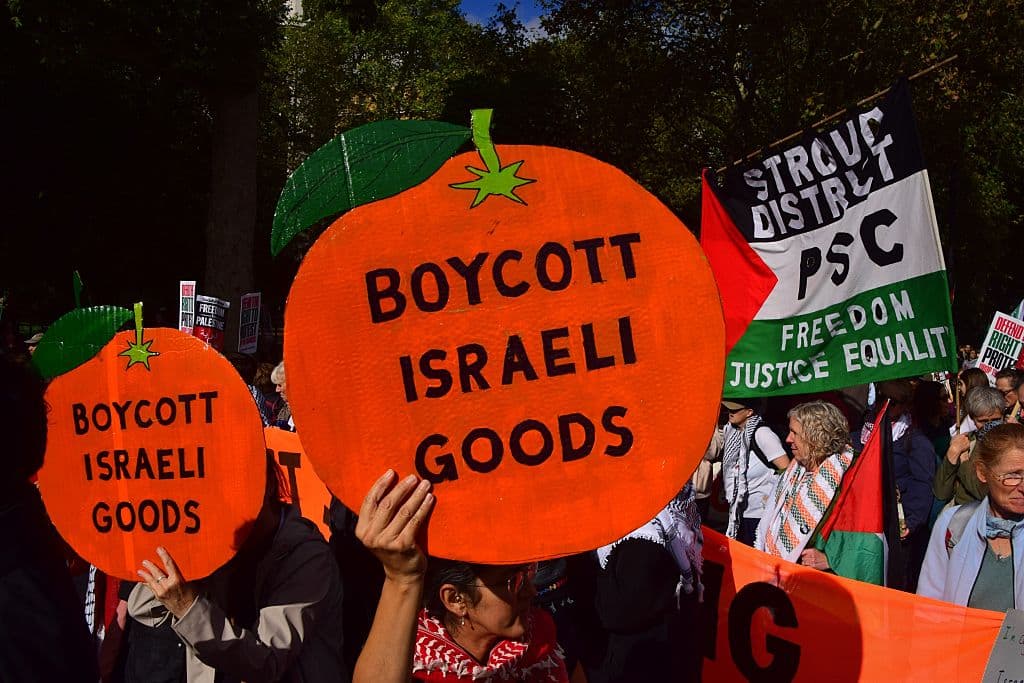
A protester holds a ‘Boycott Israeli goods’ placard during the National March for Palestine in London on October 10, 2026 (Vuk Valcic/SOPA Images/LightRocket via Getty Images)

Published: 15 October 2026

Last updated: 15 October 2026

Fifteen years ago, then Defence Minister Ehud Barak warned that Israel faced “a diplomatic tsunami, of which most of the public is not aware”. Speaking in 2011, he argued that international recognition of Palestinian statehood would intensify pressure unless Israel reached a compromise with the Palestinians.

For more than a decade, his warning appeared misplaced. Palestinian recognition remained largely symbolic, settlements expanded, and the occupation deepened. Benjamin Netanyahu presented Israel’s ability to withstand international criticism as evidence of his diplomatic skill.

The devastating war in Gaza that followed the October 7 massacre has changed that equation. The International Criminal Court’s arrest warrants for Netanyahu and former defence minister Yoav Gallant, alongside the genocide case against Israel at the International Court of Justice, form part of a much wider deterioration in Israel’s international standing.

The tsunami is here. Its effects may remain barely visible in many Israelis’ daily lives, but that does not make the accumulating diplomatic, commercial and institutional restrictions insignificant. A new database from the Jewish People Policy Institute (JPPI) makes their breadth increasingly difficult to dismiss.

While new sanctions peaked in 2024 and have declined since, the total number in effect has never been higher, with the JPPI recording 138 measures. Most are targeted sanctions against West Bank settlements, extremist organisations or individual settlers, but there are also academic boycotts, diplomatic measures and limits on imports from Israel proper.
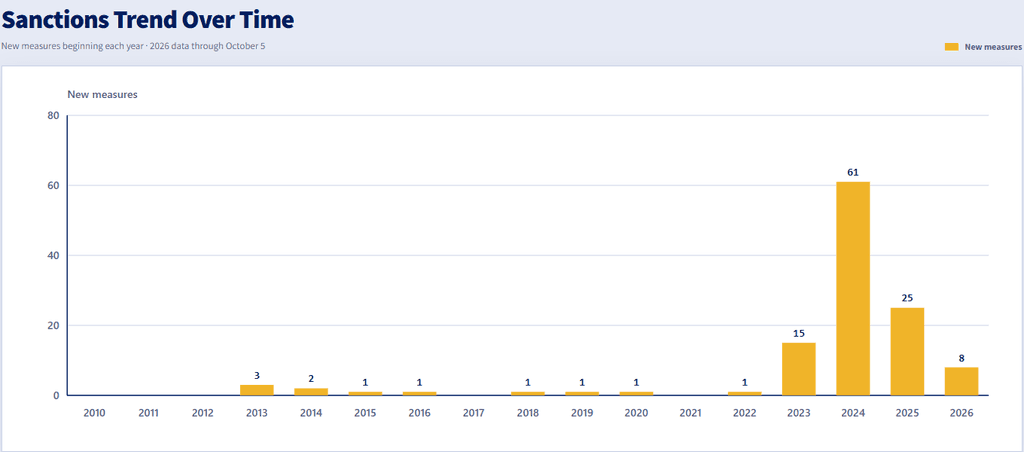
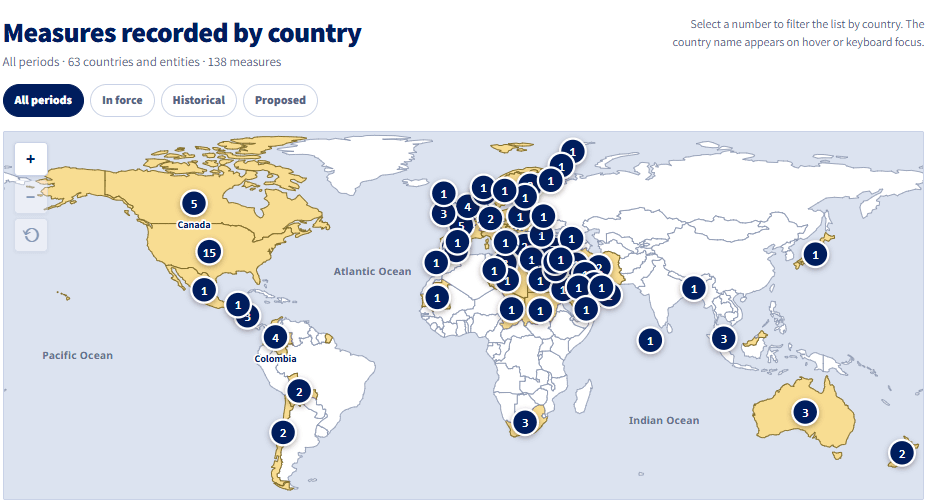
Source: <em>Sanctions Against Israel Database, The Jewish People Policy Institute (JPPI)</em>
Source: Sanctions Against Israel Database, The Jewish People Policy Institute (JPPI)

Mapping the pressure

The institute’s published snapshot, dated October 5, 2026, documents 138 sanctions, restrictions and policy measures across 63 countries and entities. It lists 110 active measures, including 17 academic measures, alongside 19 historical measures and nine proposals. Its headline count of 93 active sanctions excludes the academic category. 

Source: <em>Sanctions Against Israel Database, The Jewish People Policy Institute (JPPI)</em>
Source: Sanctions Against Israel Database, The Jewish People Policy Institute (JPPI)

The database brings government decisions, legal restrictions and institutional boycotts into one searchable picture, but these actions differ substantially in their authority, scope and consequences. A university boycott is not equivalent to a national arms embargo.

Users can examine measures by country, sector and status, following links to supporting sources. The published page is a dated snapshot rather than a continuously updated live service.

Its significance lies in showing how restrictions that might otherwise appear isolated form a much broader pattern. Israel’s international difficulties extend beyond hostile speeches or unfavourable UN votes into decisions affecting access, cooperation and commercial relationships.

Limited damage does not mean limited danger

In a recent Haaretz analysis, economic commentator Meirav Arlosoroff reported that Luxembourg had stepped back from its role approving Israel Bonds issues in the European Union, after Ireland previously relinquished the responsibility. The immediate financial consequences may be limited, but the withdrawal illustrates how reputational damage can reach arrangements once considered routine.

Arlosoroff also argued that Israel has so far absorbed much of the economic pressure. Alternative trading relationships have helped cushion the loss of Turkish trade, while technology exports remain a source of strength. That resilience is important. It does not establish that sanctions will remain manageable indefinitely.

Restrictions aimed at settlements can create additional compliance costs for businesses dealing with Israel. Investors and trading partners may become more cautious when legal obligations are complicated or future restrictions uncertain. Such decisions can spread beyond the formal targets of a sanctions package.

The danger is cumulative: international relationships can weaken before the consequences register clearly in national economic statistics. A functioning economy offers little reassurance about the durability of diplomatic support.

Australia’s increasingly targeted response

Australia illustrates both the expansion of international pressure and the need to distinguish different kinds of action.

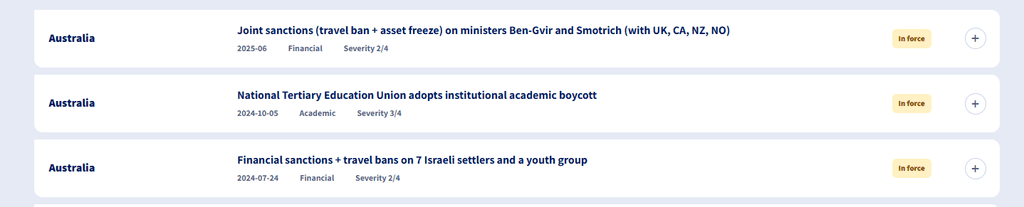
On July 25, 2024, the Albanese government imposed targeted financial sanctions and travel bans on seven Israeli individuals involved in settler violence against Palestinians in the West Bank. It also imposed financial sanctions on a youth group accused of inciting and perpetrating violence against Palestinian communities.

Foreign Minister Penny Wong’s announcement identified attacks involving beatings, sexual assault and torture, including cases resulting in death. It called on Israel to hold perpetrators accountable and cease settlement activity, which Australia regards as illegal under international law and an obstacle to peace.

Source: <em>Sanctions Against Israel Database, The Jewish People Policy Institute (JPPI)</em>
Source: Sanctions Against Israel Database, The Jewish People Policy Institute (JPPI)

A more politically significant step followed in June 2025, when Australia joined Canada, New Zealand, Norway and the United Kingdom in announcing measures against ministers Itamar Ben-Gvir and Bezalel Smotrich. Australia imposed targeted financial sanctions and travel bans on both men. 

The five governments accused the ministers of inciting extremist violence and serious abuses of Palestinian human rights. They linked their action to protecting the two-state solution, while reaffirming support for Israel’s security and condemning Hamas’ October 7 attacks. 

This marked a substantial shift: longstanding partners were imposing personal restrictions on serving Israeli cabinet ministers, rather than limiting their response to diplomatic criticism.

Australia expanded its approach again on June 2, 2026, sanctioning three additional Israeli individuals and four entities. Individuals faced travel bans as well as financial sanctions. For the first time, the designated entities included farming outposts described by the government as hubs for settler violence. 

Academic action follows a separate track. In July 2024, more than 80 per cent of members voting at a National Tertiary Education Union ACT division meeting supported recommending an academic boycott to the union’s National Council. Reporting on the October council meeting subsequently confirmed endorsement of an institutional academic boycott.

A union policy does not itself bind Australian universities or constitute a government sanction. Nevertheless, it demonstrates how opposition to Israeli policies is being translated into organised pressure within institutions that sustain international research and academic relationships.

Australia’s measures remain targeted. Their significance is that a country committed to Israel’s security has repeatedly concluded that accountability requires practical restrictions, including against members of its government.

Washington offers protection, with uncertainty

The Trump administration remains an important source of support for Israel, but its response to European settlement sanctions is unsettled.

On October 6, Assistant Attorney General Harmeet Dhillon warned that countries participating in boycotts of Israel could face American retaliation. She characterised such actions as part of the BDS movement and antisemitic. European governments maintain that their measures target settlements rather than Israel as a whole.

Jewish Insider reported disagreement within the administration over a possible response. An anonymous Republican congressional source described Treasury and Commerce officials as prepared to act, while saying State Department clearance remained an obstacle. The department declined to discuss the alleged internal deliberations. 

American protection may constrain further pressure. It cannot erase restrictions already adopted by other governments and institutions, or guarantee that future administrations will take the same approach.

Barak’s warning no longer describes a distant possibility. The question is how far the pressure will spread. Israelis may not yet feel its full force, but the database records a consequential change: international condemnation is increasingly accompanied by action.

You might also like
  • Brazilian Jews treated as pawns in presidential election
    Karina Stange Calandrin
  • There are three likely outcomes in Israel’s election. None is simple
    Sharon Offenberger
  • A Gazan doctor’s journey of hope
    Deea Okasha
logomark.67a07ee3
We believe in the free flow of information

Republish our articles for free, online or in print, by using our Creative Commons licence

You might also like

    Diaspora election
    Israel Votes 2026OpinionIsrael

    Diaspora Jews can’t vote, but Israel’s election result will affect them

    Vanina Vaisman-Levy 1
    party map copy
    Israel Votes 2026NewsIsrael

    Parties, polls, processes: detailed election guide

    The Jewish Independent
    Gaza after street map
    Israel Hamas WarFeatureIsrael

    One year after the ceasefire, Gaza remains in ruins with no solution in sight

    Shahar Burla 2

About the author

Shahar Burla

Shahar Burla

Dr Shahar Burla is a Sydney-based researcher, lecturer and Contributing Editor of TJI. Shahar holds a Master’s degree in political science from Hebrew University and a PhD in political science from Bar-Ilan University. He is the author of Political Imagination in the Diaspora: The Construction of a Pro-Israeli Narrative (2013) and co-editor of Australia and Israel: A Diasporic, Cultural and Political Relationship (2015).

More from the author

FeatureIsrael

One year after the ceasefire, Gaza remains in ruins with no solution in sight

FeatureIsrael

Netanyahu’s lightning UN visit reveals his growing isolation

ExplainerIsrael

Israel election explainer: the main parties

FeatureIsrael

New evidence Netanyahu was warned about October 7