Aa
  • Read, Watch, Listen
  • TJI Series
  • Community Action
  • Events
  • Zedi
Follow us and continue the conversation
  • LinkedIn
  • Instagram
  • FaceBook
  • X
  • YouTube
Test yourself with the TJI Quiz!

Adjust size of text

Aa

Follow us and continue the conversation

  • LinkedIn
  • Instagram
  • FaceBook
  • X
  • YouTube

Your saved articles

You haven't saved any articles

What are you looking for?

Original reporting, insightful analysis and diverse views, delivered straight to your inbox

  • LinkedIn
  • Instagram
  • FaceBook
  • X
  • YouTube
Your support fuels our mission to inform, entertain and inspire.

The Jewish Independent is bound by the Standards of Practice of the Australian Press Council. If you believe the Standards may have been breached, you may approach The Jewish Independent or make a complaint to the Australian Press Council in writing at www.presscouncil.org.au. The Council may also be contacted on 1800 025 712.

  • Our Story
  • Contact us
  • Our Team
  • Support us
  • Guidelines
  • Pitch your idea
  • Republishing us
  • Community Action
  • Our Awards
  • LinkedIn
  • Instagram
  • FaceBook
  • X
  • YouTube
Aboriginal FlagTorres Strait Islanders Flag

The Jewish Independent acknowledges Aboriginal and Torres Strait Islander peoples as the Traditional Owners and Custodians of Country throughout Australia. We pay our respects to Elders past and present, and strive to honour their rich history of storytelling in our work and mission.

© The Jewish Independent 2026All Rights Reserved
Website design and development by Your Creative, MelbourneTerms & ConditionsPrivacy Policy
HomeRead, Watch, ListenAustralia
FeatureAustralia

Josh Frydenberg weighs political return as he peddles his new memoir

The former treasurer reflected on being the son of a Holocaust survivor, his responses to October 7 and Bondi, and whether he’ll return to politics.
Gideon Cohen
Print this
Josh Frydenberg Gideon Kline

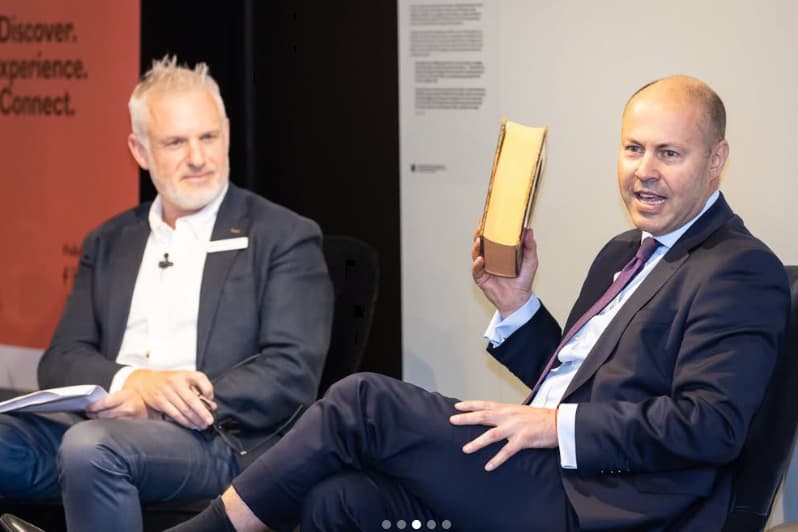
Josh Frydenberg (right) with Jewish Museum president Gideon Kline

Published: 5 November 2026

Last updated: 5 November 2026

“History will be kind to me because I intend to write it.” Winston Churchill’s maxim was on Josh Frydenberg’s mind when he lost Kooyong in 2022. His answer is A Grateful Son, a memoir that puts his own account on the record.

The book, which he calls “both a personal and a political narrative,” is named for his gratitude to his parents, his community and Australia, which welcomed his family as migrants. Speaking at Melbourne’s Jewish Museum of Australia last Thursday, he told the audience: “But for Australia providing that warm embrace and that open door to them and to their family, I wouldn’t be here to tell the tale.”

During an hour-long conversation with the museum’s president, Gideon Kline, Frydenberg spoke about his family heritage as the son of a Holocaust survivor, his emotional response to the Bondi attack, his views on the Royal Commission into Antisemitism and Social Cohesion, and whether he will return to politics.

Written with author Gideon Haigh, who Frydenberg says turned him down repeatedly before agreeing, the memoir touches on his family’s path to Australia. His father was born here to Polish parents who arrived in the 1930s. His mother, a Holocaust survivor, migrated after the war. When she landed in 1950, he said, the nationality box on her arrival card read “stateless.”

That history made the challenge to his own citizenship in 2019 all the more painful. Frydenberg said a group of climate activists in his electorate took him to the Court of Disputed Returns, arguing he was a Hungarian citizen.

“This was obviously deeply personal, and it was hurtful,” he said. Support came from across the political divide, he said, from Malcolm Turnbull and Noel Pearson to Labor figures including Tanya Plibersek, who argued it was “a bridge too far” to challenge the citizenship of someone whose family had survived the Holocaust. The full Federal Court ultimately ruled unanimously that he was not a Hungarian citizen.
The 2022 election campaign that followed, Frydenberg said, showed there was “no one in politics who is holier than thou.” The example he tried to follow was Sir Zelman Cowen, the former Governor-General who mentored him from his student days. After Frydenberg won Kooyong in 2010, he went to breakfast at the Cowens’ home, where they gifted him a Jewish Bible. Its inside cover was inscribed to record that the Chief Justice had used it to swear in Cowen as Governor-General in December 1977.

Frydenberg was later sworn into his ministries on it. He showed the Bible to the audience and said he would lend it to the Jewish Museum, along with the only copy of his first budget papers, from 2019-20.

Later in the interview, Kline compared Cowen’s role in healing a fractured nation to Frydenberg’s address at Bondi after the attack. Frydenberg said he was at his nephew’s bar mitzvah when the news came through. Days later he flew to Sydney and joined the mourners at the flowers. A stranger asked him to say Kaddish, and he pulled out the kippah that had stayed in his jacket pocket since the bar mitzvah. He then spoke, saying he “just put out the words.”

That night, he gave a pre-recorded interview to the ABC’s Sarah Ferguson on the condition that it not be edited. She asked whether him speaking out after Bondi was motivated by a desire to re-enter politics, which he called “an outrageous question,” given his children attend a school with armed guards at the gate. The interview resonated across the country, he believes, because of his on-air response: “If not now, when, and if not me, who?”

“I was very happy after the 2022 election to go quiet from public life. I was very content with my new life, being a present father, and I rejected every request to go and do interviews,” he said. However, after October 7 and the rise of antisemitism in Australia, he said he felt compelled to speak out. 

He set up the Dor Foundation as an emergency response to “correct the blood libels,” and now describes a “pre-Bondi Australia” and a “post-Bondi Australia.” Jewish life here, he said, “is not just going to happen. We actually have to work at it.”

He is watching the Royal Commission, led by Virginia Bell and due to report in December, closely. Frydenberg said the Jewish community was better off for having used it to put the last three years on the public record, but he was “not entirely” happy with it, arguing that the prime minister and senior ministers should have been called to account. He wants it to confront what he calls blood libels against Israel and to treat antisemitism and anti-Zionism as “two sides of the one coin.” “Knock me down with a feather if they don’t,” he said. 

He also called for stronger enforcement of existing laws, for violent extremist groups on the left and right to be banned, and for visa holders who incite hatred to be deported, citing the idea of “reciprocity” at the heart of the migrant story.

Whether he returns to politics, Frydenberg said, will be decided “early next year.” “I literally haven’t made that decision,” he said, pointing to the personal cost of public life, including being protected by four federal police for two and a half years as treasurer, and the recent attack on independent MP Helen Haines in October.

Asked by Kline what caption he would like beside his portrait in the museum in 50 years, he had an answer ready: “He once had hair.”

You might also like
  • Who volunteers? The hidden network sustaining our community
    Florencia Tuchin
  • ‘Our children already belong’: Petition calls Jewish schools to cooperate for disabled support
    Gideon Cohen
  • Freedom Rides: Allyship for dark times
    Eliezer Rubenstein Sturgess
logomark.67a07ee3
We believe in the free flow of information

Republish our articles for free, online or in print, by using our Creative Commons licence

You might also like

    kadoury main V2
    InterviewAustralia

    From antisemite to ally: the power of friendship

    Elana Benjamin
    Online hate
    AnalysisAustralia

    Social media regulation is a necessary brake on harmful speech

    Dean Sherr 1
    QUESTION TIME
    NewsAustralia

    Australian universities to face $2 million fines over antisemitism

    Michael Visontay

About the author

Gideon Cohen

Gideon Cohen

Gideon Cohen is a Melbourne-based journalist and a content creator and editorial assistant at TJI. He holds a master's degree in journalism from the University of Melbourne and his work has appeared in various publications including Broadsheet and The Jewish Chronicle.

More from the author

FeatureAustralia

From the footy field to the film festival: the AJAX story onscreen

FeatureAustralia

‘Our children already belong’: Petition calls Jewish schools to cooperate for disabled support

InterviewAustralia

Joni Fleischer: Connecting charities with tech talent

FeatureArts & Culture

From Bondi to the Tree of Life