Aa
  • Read, Watch, Listen
  • TJI Series
  • Community Action
  • Events
  • Zedi
Follow us and continue the conversation
  • LinkedIn
  • Instagram
  • FaceBook
  • X
  • YouTube
Test yourself with the TJI Quiz!

Adjust size of text

Aa

Follow us and continue the conversation

  • LinkedIn
  • Instagram
  • FaceBook
  • X
  • YouTube

Your saved articles

You haven't saved any articles

What are you looking for?

Original reporting, insightful analysis and diverse views, delivered straight to your inbox

  • LinkedIn
  • Instagram
  • FaceBook
  • X
  • YouTube
Your support fuels our mission to inform, entertain and inspire.

The Jewish Independent is bound by the Standards of Practice of the Australian Press Council. If you believe the Standards may have been breached, you may approach The Jewish Independent or make a complaint to the Australian Press Council in writing at www.presscouncil.org.au. The Council may also be contacted on 1800 025 712.

  • Our Story
  • Contact us
  • Our Team
  • Support us
  • Guidelines
  • Pitch your idea
  • Republishing us
  • Community Action
  • Our Awards
  • LinkedIn
  • Instagram
  • FaceBook
  • X
  • YouTube
Aboriginal FlagTorres Strait Islanders Flag

The Jewish Independent acknowledges Aboriginal and Torres Strait Islander peoples as the Traditional Owners and Custodians of Country throughout Australia. We pay our respects to Elders past and present, and strive to honour their rich history of storytelling in our work and mission.

© The Jewish Independent 2026All Rights Reserved
Website design and development by Your Creative, MelbourneTerms & ConditionsPrivacy Policy
HomeRead, Watch, ListenAustralia
FeatureAustralia

Jewish campus experience is not all about antisemitism

Adam Levy
Print this
pollster

Published: 5 September 2023

Last updated: 5 March 2024

The recent AUJS-ZFA survey found two thirds of Jewish students had experienced antisemitism. But the questions were narrow and the sample flawed, argues ADAM LEVY.

The psychologist Abraham Maslow once observed, "If the only tool you have is a hammer, it is tempting to treat everything as if it were a nail."

As a former president of AUJS at Sydney University, it saddens me to see a report on campus life, which I know provides so much joy and meaning to my fellow students, described as nothing more than a series of nails.

The Jewish University Experience Survey by AUJS and the ZFA focuses solely on antisemitism. There were no questions about cultural engagement, no analysis of identity, and no place to talk about positive experiences.

The emphasis raises questions about the sponsoring organisations’ core values and the Jewish community’s priorities. Too much emphasis on antisemitism can swamp positive identification and reduce engagement.

Gen17 data indicates that 63% of Jewish respondents consider "combatting antisemitism" to be “very important” to their Jewish identity. This takes precedence over other key aspects of Jewish identity, such as "being part of a Jewish community" (58%), feeling connected to "the Jewish people worldwide" (57%), and a “learning about Jewish history" (48%). This heavy focus on battling antisemitism paints a picture of a reactive community which fears antisemitism more than it loves Judaism.
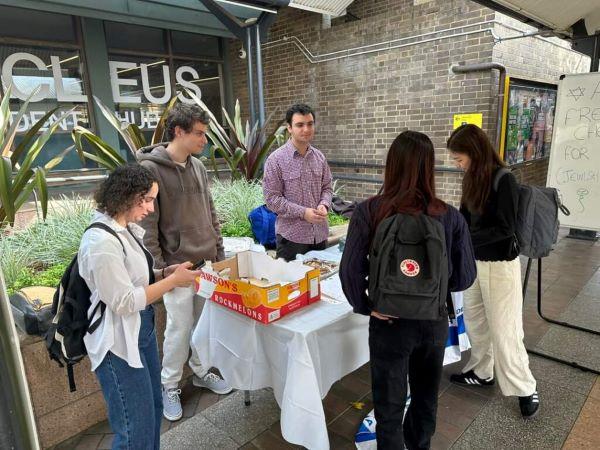
Jewish students give away cheesecake on campus to celebrate Shavuot

This focus on antisemitism fosters a sense of crisis, allowing AUJS to position itself as the vanguard against potential threats. It has steered AUJS away from its earlier endeavours, such as annual revues and summer camps, which have now been eclipsed by "Political Training Seminars". These seminars, where politicians address AUJS members before being gifted books like Bari Weiss's How to Fight Anti-Semitism or David Baddiel's Jews Don't Count, signal a shift away from positive cultural engagement and internal community-building. The question arises: Are we defining our Jewish identity primarily through our capacity to confront antisemitism?

This is not to say that there is no problem of antisemitism on campus. Of course, there is, I have faced my own share of it. However, a survey which asks only about antisemitism will unsurprisingly label the Jewish university experience as one constantly marred by antisemitism.  Why did the survey not ask if students had experienced positive or supportive responses from staff or other students? Why did it not ask practical questions regarding the availability of kosher food or the ease of changing exams away from festivals?

These limitations combined with the self-selected sampling process, mean the survey is flawed. It skews for those who have experienced antisemitism and therefore consider it useful to engage with the limited subject matter.

The unrepresentative sample of Jewish students is evident in the disparity between respondents' Jewish streams and Gen17 findings. AUJS respondents were twice as likely to be Modern Orthodox and half as likely to be secular than the general population. While results don't detail incidents by stream, speculation arises: Modern Orthodox Jews, predominantly Zionist (85% vs. 55% secular), may perceive left-wing critiques of Israel as an assault on their identity. Notably, almost 90% of all respondents labelled Israel as important to their Jewish identity, influencing discomfort with political displays and making it hard to separate attacks on the Jewish state from attacks on them personally as Jews.

In addition, data was to stress antisemitism as being a defining factor in many Jews’ day-to-day experience, regardless of whether or not this is the case.

The most glaring example of this is the widely cited figure of 19% of Jewish students feeling like they need to avoid campus due to antisemitic behaviour. A closer examination of the numbers reveals that of these students, 13% say this happens rarely (with only 6% responding that they feel threatened “always or sometimes”), and 74% of students reporting that they never avoid attending campus due to antisemitism. Among students who had faced antisemitism at university, this number was roughly the same. Do these figures not paint pictures of Jewish resilience to antisemitism? Why then was the angle chosen in reporting not more positive?

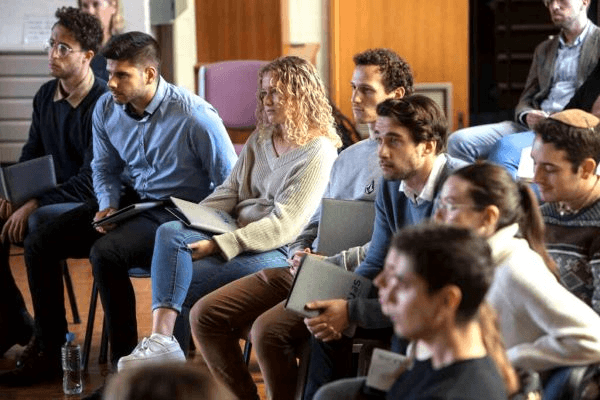
Students at the 2021 AUJS political training seminar

AUJS and ZFA cite the survey as evidence in favour of the IHRA definition of antisemitism. A substantial 84% of students indicated greater confidence in reporting antisemitism if their university adopted this definition. However a telling revelation emerged: when asked to classify an "offensive statement or action" as antisemitic: 39% of respondents were unclear in discerning what qualifies as antisemitism. This finding suggests less whole-hearted support for the IHRA definition, which classifies certain kinds of attacks on Israel as antisemitism.

Critics argue that IHRA might suppress legitimate criticism of Israel by conflating anti-Israel arguments with antisemitism. Regardless of this contention's validity, discussions about antisemitism are intrinsically linked with conversations about anti-Zionism and the responses to it. An anecdote in the survey's appendix is telling: a student expresses feeling uneasy on campus during incidents related to Israel due to student reactions, particularly around Nakba Day. Responses to an optional question reveal that "anti-Israel sentiment crossing over into antisemitism" is the predominant theme of campus antisemitism. This underscores the complex challenge of creating a safe environment for Jewish students while respecting freedom of expression.

There is a grey area between perceived "antisemitic vibes” and discriminatory actions or clearly offensive remarks, causing uncertainty among Jewish students. Unease around non antisemitic, pro-Palestinian peers may be mistaken for broader antisemitism concerns. While old fashioned Jew-hatred is universally condemned, disdain for Zionists has never been more acceptable. The existence of Gentile Zionists and non-Zionist Jews demonstrate the possibility of such a distinction. Combatting antisemitism and anti-Zionism separately is vital; conflating them uses the antisemitism card against legitimate anti-Israel stances.

It is clear from talking to Jewish students that the intergenerational trauma of antisemitism still looms large in their lives. Many of these students knew Holocaust survivors in their own families, and the rest always have family stories of pogroms and expulsions. These events understandably impacted what it meant to be Jewish for many people.

The time has come to unpack that trauma and shift the current narrative of fear towards one of resilience, optimism, and pride in who we are.

Top image: Avi Katz

You might also like
  • Regina Spektor escaped Soviet anti-Zionism. In America, Bowen Yang called her a ‘Zio’
    Gideon Cohen
  • Why I’m still voting Labor in Victoria
    Dean Sherr
  • Why Menachem Vorchheimer keeps taking people to court 
    Max Gross
logomark.67a07ee3
We believe in the free flow of information

Republish our articles for free, online or in print, by using our Creative Commons licence

You might also like

    Jess Wilson
    OpinionAustralia

    Why I am voting Liberal in the Victorian election

    Nomi Kaltmann
    Eva Geller
    Australia

    Bondi victim dies after almost 11 months fighting

    The Jewish Independent
    Josh Frydenberg
    FeatureAustralia

    Josh Frydenberg weighs political return as he releases his new memoir

    Gideon Cohen

About the author

Adam Levy

Adam Levy

Adam Levy is a graduate of the University of Sydney, where he studied Linguistics and Psychological Science. During his time at university, he served two terms as AUJS President.