Aa
  • Read, Watch, Listen
  • TJI Series
  • Community Action
  • Events
  • Zedi
Follow us and continue the conversation
  • LinkedIn
  • Instagram
  • FaceBook
  • X
  • YouTube
Test yourself with the TJI Quiz!

Adjust size of text

Aa

Follow us and continue the conversation

  • LinkedIn
  • Instagram
  • FaceBook
  • X
  • YouTube

Your saved articles

You haven't saved any articles

What are you looking for?

Original reporting, insightful analysis and diverse views, delivered straight to your inbox

  • LinkedIn
  • Instagram
  • FaceBook
  • X
  • YouTube
Your support fuels our mission to inform, entertain and inspire.

The Jewish Independent is bound by the Standards of Practice of the Australian Press Council. If you believe the Standards may have been breached, you may approach The Jewish Independent or make a complaint to the Australian Press Council in writing at www.presscouncil.org.au. The Council may also be contacted on 1800 025 712.

  • Our Story
  • Contact us
  • Our Team
  • Support us
  • Guidelines
  • Pitch your idea
  • Republishing us
  • Community Action
  • Our Awards
  • LinkedIn
  • Instagram
  • FaceBook
  • X
  • YouTube
Aboriginal FlagTorres Strait Islanders Flag

The Jewish Independent acknowledges Aboriginal and Torres Strait Islander peoples as the Traditional Owners and Custodians of Country throughout Australia. We pay our respects to Elders past and present, and strive to honour their rich history of storytelling in our work and mission.

© The Jewish Independent 2026All Rights Reserved
Website design and development by Your Creative, MelbourneTerms & ConditionsPrivacy Policy
HomeRead, Watch, ListenLifestyle
AnalysisLifestyle

Why do Jews win so many Nobel prizes?

Education culture? Good genes? Migration momentum? I have another theory as to why Jewish scientists are so overrepresented at the top of their game.
Zachary Picker
Print this
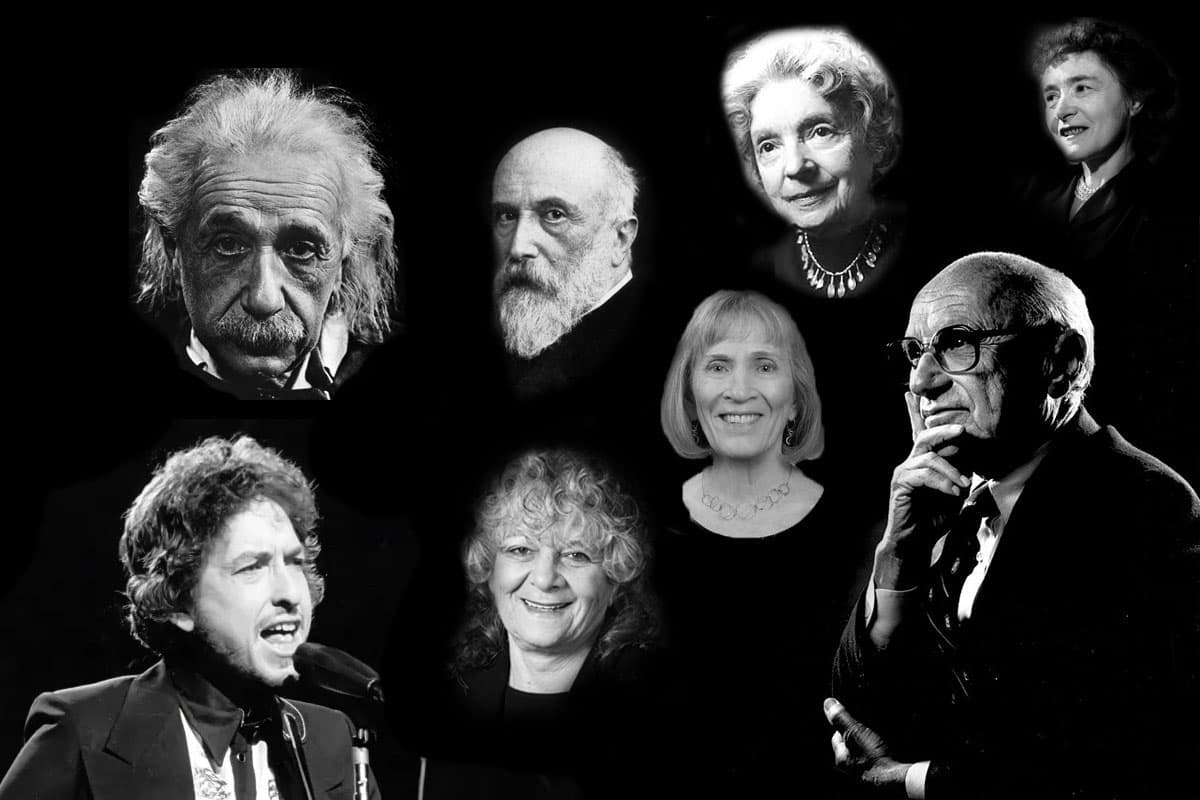
ewish Nobel prizewinners: Top (from left) Albert Einstein, Adolf von Baeyer, Nelly Sachs, Gerty Cori. Bottom (from left) Bob Dylan, Ada Yonath, Claudia Goldin, Milton Friedman (Image: Composite).

ewish Nobel prizewinners: Top (from left) Albert Einstein, Adolf von Baeyer, Nelly Sachs, Gerty Cori. Bottom (from left) Bob Dylan, Ada Yonath, Claudia Goldin, Milton Friedman (Image: Composite).

Published: 8 October 2025

Last updated: 9 October 2025

As a Jewish theoretical physicist, I have often been asked by colleagues, both Jewish and not, why Jews are so overrepresented among Nobel prize winners.

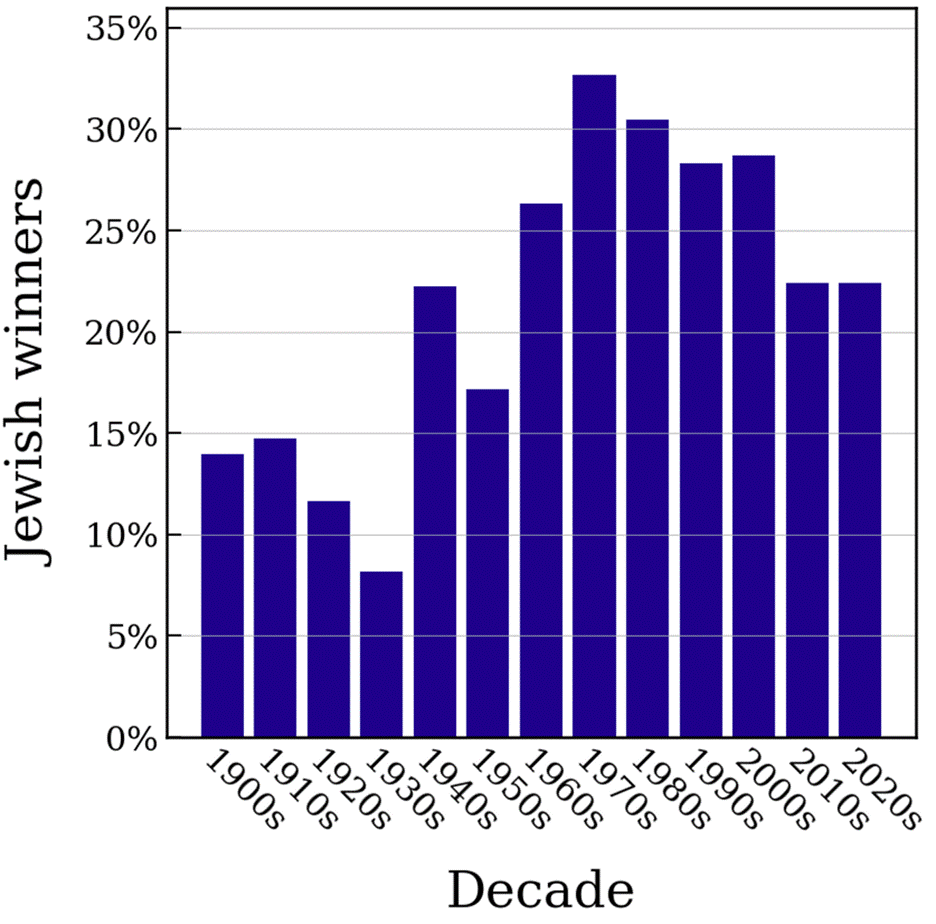
The data shows the impression of many Jewish Nobel prize winners is unambiguously accurate. Below I have plotted the proportion of Nobel prizes won by Jewish people in academic categories, adding the Fields Medal, the equivalent top prize in mathematics.

The numbers are astonishingly high — in the 1970s, for example, more than 30% of Nobel laureates were Jewish.
The Jewish Independent

More players, more winners

My playful response to the question of why is usually along the lines of, ‘Well, like pugs being bred for their funny looks, Jews have spent two millennia un-naturally selecting for literary analysis.’

Jokes aside, however, the phenomenon is so pronounced that it merits more serious analysis.

I strongly object to any explanation involving Jewish people being mentally superior to non-Jews — assigning cultural trends (good or bad) to genetic predisposition is a dangerous game. I know many stupid people, Jews and gentiles alike. Nor do I believe that this trend has anything to do with bias on the part of the Nobel selection committee.


Rather, I expect success in academic fields mirrors the participation of Jewish people overall in science and academic research. Studies conducted by sociologists in the 1970s found Jewish participation in academia in America was disproportionately high, and that participation was unevenly skewed towards more prestigious research universities. And once a trend has begun, others follow in their footsteps more easily — professors are 25 times more likely to have parents with a PhD.

We see a general decreasing trend of Jewish laureates with time. Tempting though it is, I don’t believe this belies a decrease in the general intelligence of the Jewish community. I suspect this dip, rather, indicates an increase in the diversity of academia around the globe. And since Nobel prizes tend to lag some decades behind the frontier of research, one should reasonably expect the proportion of Jewish winners to continue decreasing.

Ambition and migration

The question then becomes: why have so many academics been Jewish? This question has been addressed many times, but I don’t often find myself satisfied with the explanations.

Some answers reference the similar overrepresentation of Jewish doctors and lawyers. But there is a more straightforward societal answer there. Medical or legal practices have long been accessible ways of earning a good living for Jews. The same cannot be said for universities. Prior to the twentieth century, most universities around the world implicitly or explicitly did not allow significant Jewish participation. Many universities, both in America and across Europe, had strict quotas on Jewish enrollment even as late as the 1950s.

Research group meetings should feel like Shabbat dinner — lively and chaotic, no one safe from criticism, but ultimately rooted in mutual respect

That Jews are an immigrant people is another common factor in answers. Immigrants may be more likely to emphasise ‘portable’ skills and knowledge, or to impart the virtues of hard work and education on their children. In this regard, though, it is hard to say that Jewish people obviously stand out. There have been many immigrant groups throughout the last 200 years, many of whom were just as ‘Western’ as Ashkenazis, and certainly as hardworking — why should they not be similarly overrepresented in academia?

An artefact of history?

One answer comes from sociologist Nathan Glazer, who suggests that the unusual existence for two millennia of diaspora Jews as ‘othered’ people is a necessary factor: "Far more than any other immigrant group, [Jews] engaged for generations in the middle-class occupations… The Jewish habits of foresight, care, moderation probably arose early during the 2,000 years that Jews have lived primarily as strangers among other people". 

In other words, the diaspora experience carefully nurtured a neuroticism which is somehow useful for academics.

Alongside this, it is often repeated that Judaism is a ‘culture of learning,’ with historically high literacy rates and an emphasis on education. While I certainly believe this, it’s less clear to me that this historical emphasis on learning translates to contemporary academia. Are the studious rabbis of Fiddler on the Roof’s shtetl really the same people as the secular Jews formulating philosophy and mathematics in Vienna and Princeton? What advantage do those Jews actually have over their non-Jewish contemporaries?

Historian Charles Singer suggested that secular Jews occupied a distinct niche, not being learned religious Jews but still remaining outsiders in gentile academia: "The double maladjustment… was yet enough to give an independence of approach, a philosophic detachment to the entrant into the newly accessible scientific field. This was certainly an advantage. An impartial outlook is a significant part of the equipment of the man of science". An intelligent outsider can perhaps make leaps that insiders could not see.

How science really works

I am not a historian or a sociologist — I am a practicing physicist and irregularly practicing Jew who finds himself surrounded at work by an uncharacteristic proportion of Jews. While I find the above arguments interesting, I can only speak with any mild authority on the opposite question: what makes scientists successful?

While the execution of the scientific method is a technical task, the generation of ideas and hypotheses belongs exclusively within the domain of creativity. I personally feel as if I exercise the same part of my brain when I write fiction as when I brainstorm research ideas.

On an individual level, the best physicists I know flourish because they are broadly learned and wildly creative. While Singer seems to say that Jews excel because they are neither religious Jews nor gentile scientists, I wonder if the opposite stance is not more enlightening. Perhaps Jewish people, double-dipping fluently in their Jewish and secular identities, are primed to engage with this interdisciplinary intellectual curiosity.

But I suspect any explanation which focuses on the individual is missing the point. Science is not done alone, but by large cooperating teams. What drives the success of a lab, group, department or research community? To me, the most important characteristic of a thriving research culture is the ability and willingness of anyone to question anyone else, regardless of seniority, age, or any other discriminating feature. I always know a research group is good when I see undergraduate students asking questions and professors gladly admitting when they’re wrong.

If this is at the crux of successful science, I’m not sure anyone argues better, or respects authority less, than Jews. Research group meetings should feel like Shabbat dinner — lively and chaotic, no one safe from criticism, but ultimately rooted in mutual respect and a shared sense of direction. I think it is this deep, egalitarian skepticism that is at the heart of every Jewish Nobel laureate.

Isidor Rabi won the Nobel Prize in 1944 for his foundational work on quantum mechanics and magnetism. If you’ve ever had an MRI, you are familiar with the fruits of his discoveries. Rabi famously remarked: "My mother made me a scientist without ever intending it. Every other Jewish mother in Brooklyn would ask her child after school: “So? Did you learn anything today?” But not my mother. She always asked me a different question. “Izzy,” she would say, “did you ask a good question today?”"

You might also like
  • Sanctioning settlements is a defence of Israel, not an attack
    Elisheva Madar
  • Sanctions must influence, not just perform disapproval
    Adam Slonim
  • Mind the mentality: not every rejection is antisemitism
    Nomi Kaltmann
logomark.67a07ee3
We believe in the free flow of information

Republish our articles for free, online or in print, by using our Creative Commons licence

You might also like

    original-6ACA4B6A-4208-4277-A4EE-E687C3C87523
    FeatureLifestyle

    The right to an ordinary Jewish life

    Jarod Rhine-Davis
    single – lead image
    FeatureLifestyle

    On my own (terms)

    Jarod Rhine-Davis
    Keshet
    FeatureLifestyle

    ‘We won’t ever leave’: Keshet Europe’s fight for Jewish LGBT+ inclusion

    Gideon Cohen

About the author

Zachary Picker

Zachary Picker

Zachary Picker is a postdoctoral fellow at Queen’s University (Canada) in the McDonald Institute astroparticle theory group.

Comments3

  • Avatar of Edward Boyapati

    Edward Boyapati10 October at 07:12 am

    The people of the world must be forever grateful to Jews for the conveniences of life they enjoy: we would have been so much poorer without them (I am not a Jew). Whatever is their ‘secret sauce’ we must all copy!

  • Avatar of Ben selinger

    Ben selinger9 October at 05:05 am

    I’m a retired physical chemist professor from ANU or maybe a chemical physicist. Two disciplines tending to use different models of the world. So there always seems to be two right answers to a question. Yes, being stubborn, argumentative, yet also sensitive to the fact that you are regarded “as different -undefined” in the general community helps creativity because you have an excuse to look outside the box. Whatever!

  • Avatar of Alan Slade

    Alan Slade9 October at 04:12 am

    Surprisingly, Zachary ignores Darwinian theory. With so many progroms, persecutions and expulsions of Jews over the millennia, the strongest, mentally and physically, not only survived, but thrived. It will be interesting to monitor the coming decades, should antisemitism decline.