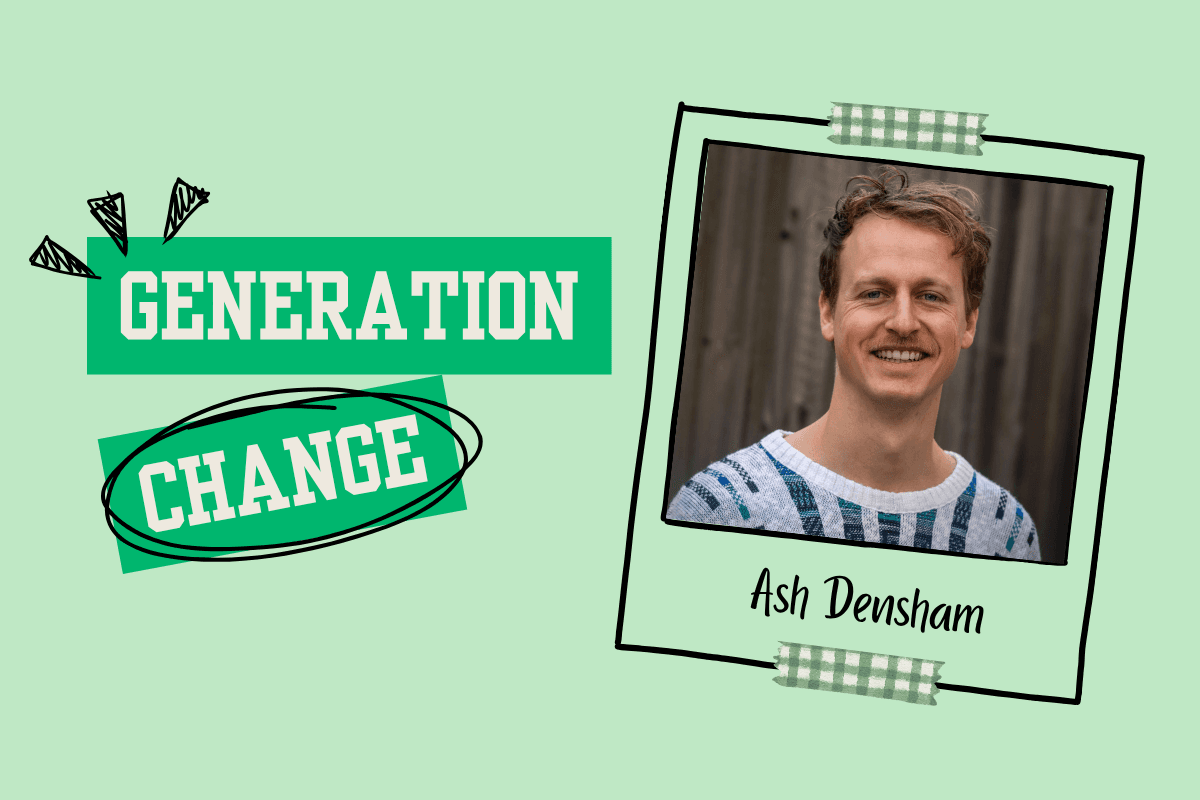
Ash Densham: Building community through Humanistic Judaism
After spending a year immersed in Jewish culture in Israel, Ash Densham returned to Melbourne and, in 2012, co-founded Kehilat Kolenu, a youth-led congregation creating new ways for people to engage with Jewish traditions.
Gideon Cohen
Ash Densham is a co-founder of Kehilat Kolenu and served as the Mekasher of the organisation from 2017-2021.
Published: 17 September 2026
Last updated: 17 September 2026
To start off, tell us about yourself – what do you do?
I am working for Tesla in energy policy, and I have been involved with Kehilat Kolenu since its inception many, many years ago. So, I have multiple interests transcending cultural Judaism and energy and enlightenment, and that’s been most of my professional career since I since I left school.
What was your connection to Judaism growing up?
I was raised in a traditional Jewish household in Doncaster, where there was a small yet thriving Jewish community as I was growing up. My brothers and I went to Doncaster Jewish Day School, which was an Orthodox school under the auspices of Yeshiva, so we had a modern Orthodox education and then went to Mount Scopus and Habonim. So much of my secondary schooling was this juxtaposition of a secular youth movement experience and a modern orthodox Jewish education at Scopus.
My local shul was in Doncaster and I had my bar mitzvah in in Israel. I was always very much connected to my Jewish upbringing and my tradition. I joined the synagogue choir for high holidays for a few years as when I was 15 with a friend. So, that was really nice.
What does your Jewish identity look like today?
I feel very strongly aligned and in touch with my Jewish ancestry and culture, and very much involved with the Jewish community through Kehilat Kolenu. We would define ourselves as a Humanistic Jewish congregation, but very much open to Jews of all backgrounds and beliefs and upbringings.
So, I would say that I am very much practicing in the specific Jewish way, in terms of marking the festivals, life cycle, Shabbat. It’s a big part of who I am and my identity now.
It was always very intentional that the music was a way for us to connect with our tradition, Hebrew, and the ritual of Shabbat
When did Kehilat Kolenu first start? What was the goal in creating it?
It started in 2012, and in the lead up to that year, myself, my brother and a close friend were all going through our own individual exploration of our Jewish identity. I personally was spending a year in Israel with Habonim, and that was a very beautiful year away with close friends, exploring many concepts of Judaism and social justice and our connection to our history.
I think a big part of that year away was being able to connect with what it means to live a Jewish life in a cultural sense. The Jewish festivals were really meaningful, powerful and beautiful; to be able to celebrate those festivals in Israel, in the land which very much is seasonally connected to the Jewish calendar, and everyone there is celebrating at the same time. It’s a very immersive experience.
So, some of my favourite memories of that year away were the Jewish festivals, like spending Yom Kippur in the old city of Akko, surrounded by thousands of people in the streets wearing white, who are up all night chatting under the moonlight and the warm summer sky. Or spending Shabbat in Jerusalem and going to the Kotel at sunrise and spending Purim in Tel Aviv, which is a whole different experience of street parties and everyone dressing up and thousands of people having an amazing time.
When I came back, I felt that same depth of experience was lacking in Melbourne, and realised that there was a space missing in the fabric of the Jewish community to be able to start a Jewish congregation, focused on celebrating Judaism in a cultural way. And so, mid-2012, my brother and a close friend of ours had a couple of meetings and decided to start a Shabbat service out of Habonim.
We called it a humanistic Shabbat service, and we compiled the Sidur, which is very much based on the modern orthodox Kabbalat Shabbat, but mainly including psalms and songs that refer to non-theistic themes. I would say more centred around humanity and nature. We started meeting every Friday night, and it was always very intentional that the music was a way for us to connect with our tradition, Hebrew, and the ritual of Shabbat.
It’s incumbent upon us to be able to leave the world in a better condition than that into which we were born, to use whatever capacities or skills or talents that we might have
For those who haven’t yet been to Kolenu, how would you describe the experience?
It’s a very musical-centred experience. We sing a lot of traditional Hebrew music inspired by both contemporary melodies and ancient melodies, and we have percussion and drums and, increasingly, other instruments like wind and strings.
We call it tefillah in a way, but I wouldn’t really say it's prayer. Some people might call it prayer, but if you look at the word tefillah it has a different meaning. It means to judge oneself. So, we use Hebrew music as a way to connect with our culture and our ritual.
Kabbalat Shabbat is very much about singing. We sit in concentric circles, so men, women, children and grandparents; everyone is all together. Then we have a weekly d’var Torah on Friday nights from a community member. We’re very democratic, community-led. We don’t have a rabbi.
For the high holidays and for Tikkun Leil and some other chagim, again we have musical services. All the blessing and music are in Hebrew, but we do some English readings as well, so that people can connect and understand what we’re speaking about.
How has Kolenu's community grown and changed since it first began?
It began out of Habonim, which was critical for it to get started because we already had a group of willing participants, mainly in their early 20s and even younger.
As we grew, we eventually found our own space and named ourselves Kehilat Kolenu around 2014, which means "the community of our voice". We found that a lot of the original Habonim members were still coming, but they would bring their parents, they’d bring their siblings, eventually they’d bring their grandparents, and the community matured.
But youth is still very much the centre of our community in many ways. Most of our facilitators draw from youth movements or have youth movement background. Our musicians are very youthful. It’s open to everyone, but it’s strategic that we want to keep being relevant to young people.
That said, if you walk into Kehilat Kolenu on Yom Kippur, you’ll see people of all ages, from babies to great grandparents, and we’re really proud to be very much established and a focal point for everyone at any age.
We like to end with the same question, what does social impact mean to you?
My dad always taught me that when you borrow something, you should endeavour to give it back in a better condition than how you found it. I think the same goes with social impact.
We are all born into a world that has its imperfections, is in need of improvement, and has its challenges. It’s incumbent upon us to be able to leave the world in a better condition than that into which we were born, to use whatever capacities or skills or talents that we might have.
I think that's very much a Jewish concept, and a big part of what it means to be Jewish as well; to be able to enact social justice or tzedek.
About the author
Gideon Cohen is a Melbourne-based journalist and a content creator and editorial assistant at TJI. He holds a master's degree in journalism from the University of Melbourne and his work has appeared in various publications including Broadsheet and The Jewish Chronicle.