Aa
  • Read, Watch, Listen
  • TJI Series
  • Community Action
  • Events
  • Zedi
Follow us and continue the conversation
  • LinkedIn
  • Instagram
  • FaceBook
  • X
  • YouTube
Test yourself with the TJI Quiz!

Adjust size of text

Aa

Follow us and continue the conversation

  • LinkedIn
  • Instagram
  • FaceBook
  • X
  • YouTube

Your saved articles

You haven't saved any articles

What are you looking for?

Original reporting, insightful analysis and diverse views, delivered straight to your inbox

  • LinkedIn
  • Instagram
  • FaceBook
  • X
  • YouTube
Your support fuels our mission to inform, entertain and inspire.

The Jewish Independent is bound by the Standards of Practice of the Australian Press Council. If you believe the Standards may have been breached, you may approach The Jewish Independent or make a complaint to the Australian Press Council in writing at www.presscouncil.org.au. The Council may also be contacted on 1800 025 712.

  • Our Story
  • Contact us
  • Our Team
  • Support us
  • Guidelines
  • Pitch your idea
  • Republishing us
  • Community Action
  • Our Awards
  • LinkedIn
  • Instagram
  • FaceBook
  • X
  • YouTube
Aboriginal FlagTorres Strait Islanders Flag

The Jewish Independent acknowledges Aboriginal and Torres Strait Islander peoples as the Traditional Owners and Custodians of Country throughout Australia. We pay our respects to Elders past and present, and strive to honour their rich history of storytelling in our work and mission.

© The Jewish Independent 2026All Rights Reserved
Website design and development by Your Creative, MelbourneTerms & ConditionsPrivacy Policy
HomeRead, Watch, ListenLifestyle
ReflectionLifestyle

My path to leaving Lubavitch

The path out of Orthodoxy involved arroz con pollo, a Renaissance painting of Jesus, and a gradual loss of belief in God.
Zalman Newfeld
Print this
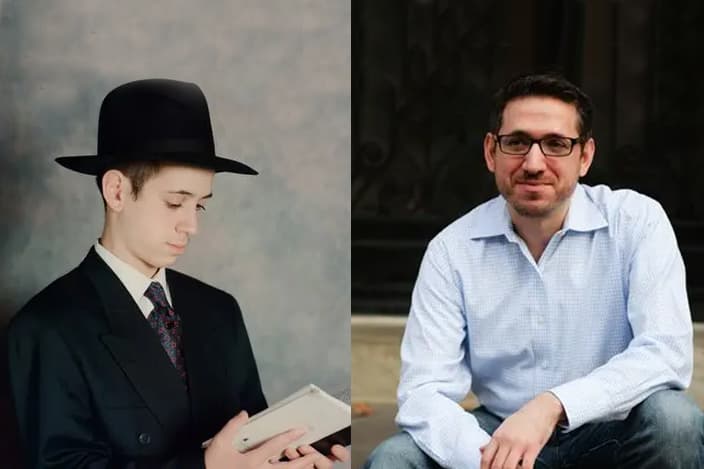
Zalman then and now

Published: 27 April 2026

Last updated: 27 April 2026

I can’t pinpoint the day when I stopped believing in God. But some time during college I realised I simply didn’t believe anymore — just as children stop fearing the dark gradually and imperceptibly. I realised there was no one above peering down at me and judging me or keeping a tally of my merits and demerits. It was just me and billions of other people trying to live our lives on this pale blue dot of a planet, to use the astronomer Carl Sagan’s phrase.  

It’s as if you’re walking with someone along a trail and eventually realise that no one is walking beside you. You are alone, and the sensation of the other presence was all in your head. You were told that it was there, so you believed it; you accepted it without question. You wanted the companionship, so you imagined the other entity into being.  

But all the wishing in the world and all the hoping couldn’t change the simple reality that you had been alone all along. There was no “Aha!” moment when I realised I no longer believed in God. I only came to realise that my belief was gone when one after noon in a Mexican restaurant I felt comfortable ordering non-kosher chicken. I no longer feared a lightning bolt tearing through the sky to strike me dead. It was anticlimactic. I just sat there listening to Marc Anthony sing Y Hubo Alguien and munching on my arroz con pollo.

The kosher taboo

Growing up with a mother who was a talented chef and surrounded by tons of kosher restaurants and pizza shops, I didn’t for the most part envy or fantasise about non-kosher food, except for Wise Onion Rings (which were technically kosher but not kosher enough for Lubavitchers) and the large soft pretzels sold at the ice skating rink at Prospect Park. Their aroma was heavenly, but they were strictly off-limits.

The kosher restrictions started to really bother me when I was travelling abroad and I realised that these restrictions created a substantial separation between me and the local population.  
Only then did I begin to resent the elaborate planning that went into every trip, making sure we had enough food so that we would not have to rely on what was available locally to the general public.

So what if we were born Lubavitch? We can decide to be anyone we choose

Although I had no problem eating non-kosher chicken and beef, I couldn’t imagine eating pork. After years of hearing that “hazeirim (pigs) are disgusting; they roll around in the mud—yuck,” I just couldn’t imagine putting that in my mouth. The taboo was too great, like the taboo against eating bugs for most Americans.  

The association between pigs and “uncleanness” is very old in the Jewish tradition. The Talmud records a rabbinic opinion that “the mouth of a swine is as dirty as dung itself”. Some Jews have taken their disgust of pigs beyond merely not consuming them. Wilhelm Rothschild, a banker and a head of the Frankfurt House of Rothschild, who was also very pious, refused to shake the hand of any person who had touched pork that day. But then again, as one of the wealthiest men in Europe, he had the luxury of being insulting. Regardless, for better or worse, I never got over my abhorrence of pig.

Around that time, I also stopped believing in the Rebbe. The Rebbe was there to connect me to God. Once I stopped believing in God, my belief in the Rebbe disintegrated. The Rebbe had tremendous per sonal charisma: He was a firebrand who couldn’t help but ignite and set aflame those around him. I still respected his commitment to the Jewish people and his vast learning, but I no longer believed he possessed supernatural powers.

Crossing a line

Although so much of my thinking had shifted while I was in college, my clothing and outer appearance had remained the same.  

This disjuncture sometimes caused consternation on the part of others, in particular one Sunday afternoon at the Metropolitan Museum of Art on Manhattan’s Upper East Side. I was there fulfilling a class assignment from my art history teacher to explore an installation and write a two-page visual analysis of it.  

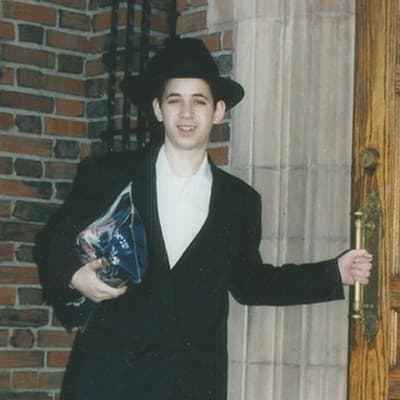
Newfield as a young Lubavitcher

I chose as my subject the Renaissance painting Madonna and Child Enthroned with Saints Mary Magdalene and John the Baptist, painted by Bugiardini on the side of an altar for the Church of Santa Maria Maddalen all’Isola at Incisa, in the Arno Valley south of Florence, in the early 16th century. It stands more than six feet high and five feet wide and was prominently mounted in a gilded wooden frame. I settled onto the hard wooden bench in front of the painting and began to explore.  

Why couldn’t a guy who looked like me be entranced by a Renaissance painting of Jesus simply for the joy of it? 

Bugiardini depicts the Virgin, pious and maternal, seated on a golden throne holding a plump naked infant Jesus in her lap. Jesus, in turn, is holding a crystal globe in his right hand, and his left hand is resting on his mother’s breasts. Bugiardini paints two cherubic winged angels in the background kneeling on a ledge bestowing a gold crown on the Virgin. John the Baptist, suntanned and muscular, and Mary Magdalene, rosy-cheeked and devoted, are standing in the foreground. John is holding the cross, and Mary Magdalene is extending a chalice to the Virgin. I stared at the painting for some time, transfixed by its vitality and luxurious gold, blue, red, green, and orange colours. 

“Excuse me,” asked a middle-aged white woman holding a sketch pad. “Is there a problem?” “No, of course not,” I answered, not sure what sort of “problem” one could have in a quiet room full of Renaissance art. I tried to return to my thinking. A few minutes later, a middle-aged man, not wearing a yarmulke but visibly Jewish, walked by and just glared at me.  

What is wrong with all these people? I tried to cast out these intrusions. The more I looked at the painting, the more I felt how realistic, logical, and even mathematical it seemed. The figures are presented proportionately, and the painting has great symmetry. There are two central figures, two angels, two figures in the foreground, and two pilasters in the background. Twenty minutes passed.  

A young Modern Orthodox Jewish couple walked by, the man clean-shaven, sporting a small blue yarmulke with a New York Yankees emblem, and wearing a striped button-down shirt and grey pants, and the woman wearing a purple top that was stylish but modest and a tight black pencil skirt. The guy came over to me and, with a knowing grin, asked, “Oh, so you’re doing an art project?”  

Only then did it dawn on me. All these people were staring at me and were somehow oddly troubled by the sight of a Hasidic Jew with a long beard and big black velvet yarmulke sitting intently looking at a massive painting of Jesus. After the couple walked away, I could feel my heart tighten. OK, he happened to be right this time, but why did it have to be so? Why couldn’t a guy who looked like me be entranced by a Renaissance painting of Jesus simply for the joy of it?  

It was as if I was somehow violating an unspoken pact that we each keep to our own turf. It wasn’t a Jew-versus-non-Jew thing. It was a worldly-versus-cloistered thing. “They” would not disturb us in “our” synagogues in Brooklyn on Saturday mornings as we swayed in prayer, and we would not show up at the Met on Sunday afternoon. After four hours, I felt I had gathered enough information for my assignment and scooped up my notes and coat.  

Newfield as an adult

As I entered the subway station to take me back to Brooklyn, I quickly bundled my coat to keep out the cold. It suddenly occurred to me: The painting captures a magical moment, a snapshot of distinct elements coming together — but it can’t last. We each have a mission. The angelic cherubs need to ascend to heaven. Baby Jesus needs to grow up and be crucified. The mother of Jesus needs to mourn the loss of her son. John the Baptist needs to travel the Earth to proclaim the good news.  

Mary Magdalene needs to be absorbed into myth and await Dan Brown’s retelling of her sexual relationship with Jesus. And I… I need to go back to Brooklyn where onlookers will not be disturbed by my presence. I vowed right there and then, on the grimy and dank subway platform of the 4 train at 86th Street, that I would return.  

Was it possible to truly leave?

Although my thinking about God and the Rebbe was beginning to solidify, the question of the kind of life I should live was far from settled. I was like a dreidel that had already been spun but hadn’t yet come to rest. One morning as we explored Bubby Ruth’s vast book collection, my brother Yossi and I debated whether we could put our Lubavitch upbringing and indoctrination behind us and move on. Yossi stood in the dining room encircled by legions of potted plants and overstuffed bookcases, neither of which had changed much in 40 years.  

He played with his black baseball cap that shielded him from the sun and from criticism for not wearing a yarmulke and said, “maybe we were born Lubavitch and we’re just stuck with it for life. We can’t escape.”

I stood in front of a bookcase and spotted a well-worn copy of Chaucer’s The Canterbury Tales and said, “What you’re saying is medieval. Modernity, the Enlightenment taught that people can choose their own path, that birth is not destiny. We are not the descendants of cobblers who are forced to continue in our forefathers’ trade.  

“So what if we were born Lubavitch? We can decide to be anyone we choose.”  

I picked up the copy of Chaucer and opened its cover to discover my father’s name written inside: My father, who had made his own active choice to join Lubavitch. Yossi wasn’t convinced and tried to enlist into his argument Solomon Maimon — the 18th-century Russian-born philosopher who struggled to gain entry into Berlin’s high society.  

“Solomon Maimon wrote that he couldn’t get rid of the sing-song melody and rhythmic swaying of his Talmud study and that he never felt completely at home in secular society. If Maimon couldn’t manage to gain acceptance in mainstream society, man d’char shmei [it goes without saying] that we have no chance.”  

“Well,” I said as I leafed through a stack of Yiddish socialist pamphlets I’d found on a bottom shelf tucked behind a jar containing my father’s collection of fossilised shark teeth, “that was hundreds of years ago, and things aren’t the same today.” Yossi just kept going. “According to Yosef Hayim Yerushalmi, the historian from Columbia University, although Freud played down his Jewish roots, in the end psychoanalysis was still accused of being a ‘Jewish science’.”  

“Come on,” I said. “I’m just saying, many Jews have found a path out, but they’re always stamped as a Jew.” “You think there’s some kind of conspiracy against Jews that prevents them from being fully accepted?”  

“Well, Rashi does say that it’s a halacha [a law] that Esav [Esau] hates Yaakov [Jacob], meaning that non-Jews will always hate Jews.” “You’re seriously quoting Rashi? So now you are basing your argument about the prospect of integrating into mainstream society in the 21st century on an 11th-century biblical commentator who is quoting an ancient rabbinic source.”  

We discussed this as if our lives depended on it — because our lives did depend on it. What’s the point of attempting to assimilate if the outside world would always view us as Lubavitch weirdos, even if we shaved and plastered our office walls with fancy diplomas? 

This is an extract from Brooklyn Odyssey: My Journey out of Hasidism, by Zalman Newfield, published by Temple University Press (US). It can be purchased at online bookstores. 

You might also like
  • Tucker Carlson, Candace Owens and the war on Chabad
    Farah-Lee Yudelman
  • After 38 years, justice for the sexual abuse victim who never gave up
    Michael Visontay
  • Newcastle: a regional Jewish community revived
    Nomi Kaltmann
logomark.67a07ee3
We believe in the free flow of information

Republish our articles for free, online or in print, by using our Creative Commons licence

You might also like

    Futurism
    OpinionLifestyle

    Jewish Futurism? We’ve been practising it for millennia 

    Renata Zimbarg 1
    Rosh Hashanah Customs
    FeatureLifestyle

    10 little-known Rosh Hashanah customs from around the world

    Menachem Posner
    Tal Slome visible difference
    Lifestyle

    Being seen with all our differences

    Tal Slome 1

About the author

Zalman Newfeld

Zalman Newfeld

Dr Zalman Newfield is an Associate Professor of Sociology and Jewish Studies at Hunter College, City University of New York

Comments5

  • Avatar of IK

    IK27 May at 11:16 pm

    Wow, there are a bunch of really insecure people who are so wounded by someone telling a story from his life that they feel the need to reflexively attack.

    It’s sad that they have such an insecure connection to their own life that their response to someone making another life choice is not to be happy that someone is coming into his own but to lash out.

    It’s as if they think the choice to go off the derech undermines their own choice to stay on the derech. It doesn’t, obviously — except for people who stand on very shaky feet. I feel sorry for them.

  • Avatar of Akiva

    Akiva1 May at 11:21 am

    Feels more like Zalman repeats his story to try and justify to himself his own selfish and petty behaviour

  • Avatar of CR

    CR29 April at 07:55 pm

    Zalman is an insightful writer who
    really makes you feel what it was like to be a Lubavitcher and what it’s like to leave.

  • Avatar of Katherine Lipkin

    Katherine Lipkin29 April at 04:18 pm

    The author had no reason to write this post explaining his reason for becoming an atheist. Why is he trying to justify his choice?
    Live and let live.

  • Avatar of Florence Peyser

    Florence Peyser29 April at 02:01 am

    Really juvenile. It’s embarrassing the author wrote an entire book about his immature encounters with basic philosophy. And he’s a professor now?