Aa
  • Read, Watch, Listen
  • TJI Series
  • Community Action
  • Events
  • Zedi
Follow us and continue the conversation
  • LinkedIn
  • Instagram
  • FaceBook
  • X
  • YouTube
Test yourself with the TJI Quiz!

Adjust size of text

Aa

Follow us and continue the conversation

  • LinkedIn
  • Instagram
  • FaceBook
  • X
  • YouTube

Your saved articles

You haven't saved any articles

What are you looking for?

Original reporting, insightful analysis and diverse views, delivered straight to your inbox

  • LinkedIn
  • Instagram
  • FaceBook
  • X
  • YouTube
Your support fuels our mission to inform, entertain and inspire.

The Jewish Independent is bound by the Standards of Practice of the Australian Press Council. If you believe the Standards may have been breached, you may approach The Jewish Independent or make a complaint to the Australian Press Council in writing at www.presscouncil.org.au. The Council may also be contacted on 1800 025 712.

  • Our Story
  • Contact us
  • Our Team
  • Support us
  • Guidelines
  • Pitch your idea
  • Republishing us
  • Community Action
  • Our Awards
  • LinkedIn
  • Instagram
  • FaceBook
  • X
  • YouTube
Aboriginal FlagTorres Strait Islanders Flag

The Jewish Independent acknowledges Aboriginal and Torres Strait Islander peoples as the Traditional Owners and Custodians of Country throughout Australia. We pay our respects to Elders past and present, and strive to honour their rich history of storytelling in our work and mission.

© The Jewish Independent 2026All Rights Reserved
Website design and development by Your Creative, MelbourneTerms & ConditionsPrivacy Policy
HomeRead, Watch, ListenArts & Culture
FeatureArts & Culture

Legendary magicians who made their Jewish identities disappear

Many magicians of the Golden Age of Magic were Jewish, but audiences were unlikely to know it.
Nina Siegal
Print this
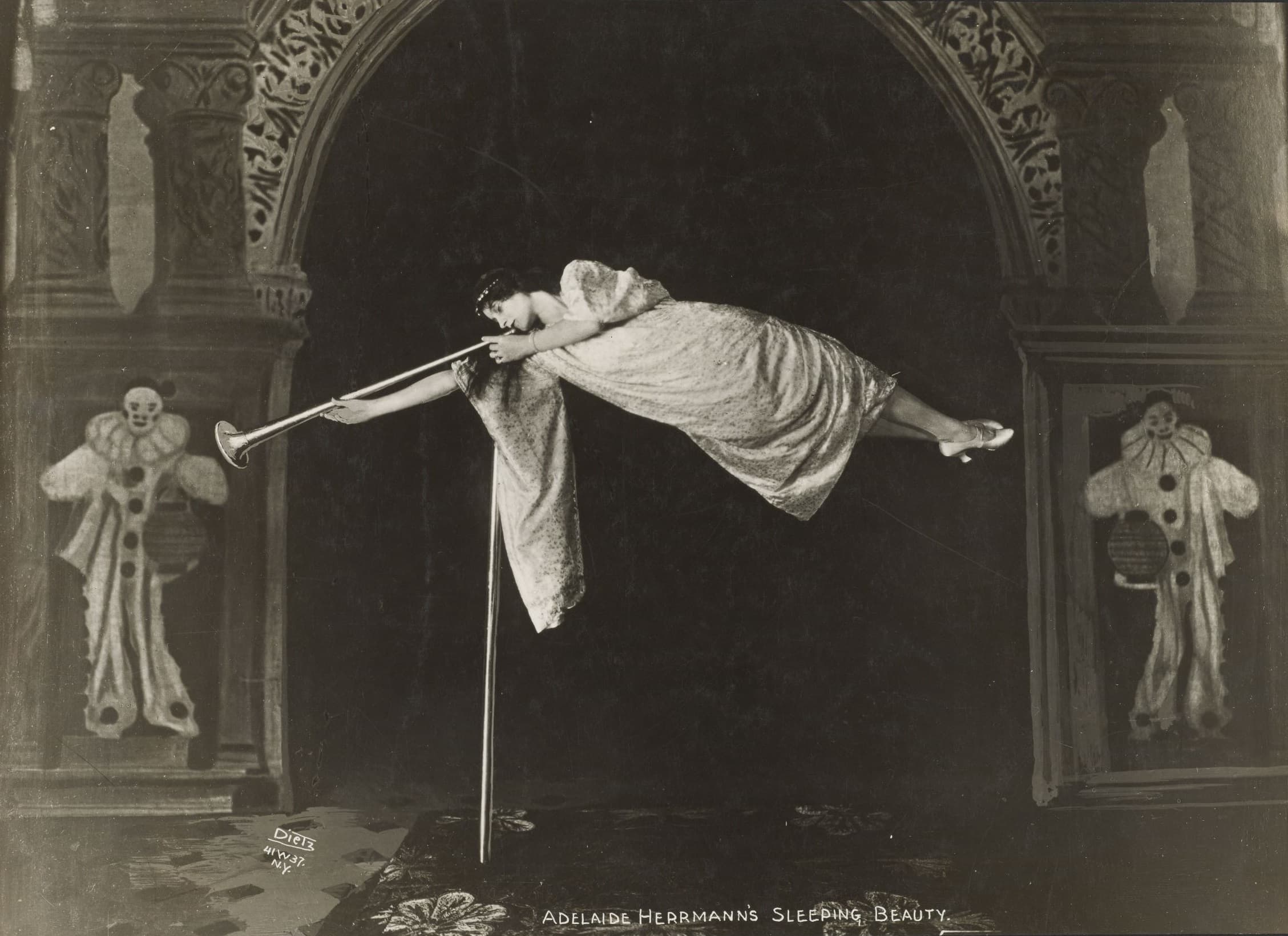
Adelaide Hermann magicianHarvard_Theatre_Collection_-_Hermann_TCS_28

Magician Adelaide Hermann aka The Queen of Magic performing in 1903 (Harvard Theatre Collection)

Published: 13 October 2026

Last updated: 13 October 2026

This story was originally published in the Forward. Click here to get the Forward's free email newsletters delivered to your inbox.

Harry Houdini liked to tell people that he was the son of a rabbi, and although he was known for the tricks he played on audiences, that story was true.

The world-famous escape artist was born as Erik Weisz in Budapest to Rabbi Mayer Samuel and Cecelia Steiner Weisz. The whole family emigrated to Wisconsin in 1878.

Many magicians of the Golden Age of Magic, from roughly the 1850s through the 1930s, were Jewish. Estimates put the number as high as 20%. But audiences were unlikely to know it. Onstage, these performers often became someone else.

“Abracadabra,” a new exhibit at Amsterdam’s Jewish Museum highlights the biographies of these Jewish magicians. It reveals the extraordinary tricks they created and popularized, and suggests that they may have tried to escape antisemitism through their stage acts.

Titia Zoeter, who curated the exhibition with Joanne Rosenthal, said the simplest reason why Jews took up magic as a profession was that they were often barred from tradesman guilds and other professions. Magic offered a way to earn a living independently.

The exhibition focuses on a few key figures, like Houdini, Horace Goldin, the “Whirlwind Illusionist” (born Hyman Goldstein); the Bamberg family, which produced magicians Okito and Fu Manchu, as well as the married couple Alexander and Adelaide Herrmann who toured the globe as “Herrmann the Great” and the “Queen of Magic.”

Harry Houdini prepares to jump from Harvard Bridge in Boston, Massachusetts, on 30 April 1908. (Image: John H. Thurston / Library of Congress / Public domain)

“The fact that several major names from that era were Jewish was reason enough to dedicate an exhibition to this subject.” Zoeter said. “Through these magicians, we could tell a socio-cultural story about Jews and other migrant communities seeking security and building lives in places where opportunities were available to them.”

It’s not entirely clear why Jewish performers are overrepresented in the world of magic, Zoeter said, but it was in part because of the same factors that drew Jews into the performing arts, vaudeville and Hollywood. The stage offered not only a livelihood but a chance to adopt a new persona.

Houdini sometimes played down his Jewish roots, and often told people he’d been born in the United States, rather than Hungary. Adam Begley, author of the recent biography, Houdini: The Elusive American, described how Houdini married a non-Jewish woman, moved away from the orthodoxy of his youth, and sent out Christmas cards.

But he did not deny his Jewish background, and often talked about his father, the rabbi. Audiences long questioned whether the story was true. It wasn’t until 2016 that Mayer Samuel Weiss’s rabbinical ordination certificate was discovered in the Milwaukee County Historical Society.

“Houdini broke free from his history, maybe the history of Jewish persecution, because he became very well loved, popular and famous,” Zoeter said, “although he was a Jew.”

The Bamberg family started as court magicians in 18th century Holland, and the Dutch family went on to produce five more generations of magicians.

Tobias David Bamberg, who went by Theo, became the first global star of the Bamberg magicians at the end of the 19th century. At age 18, he created a Japanese-style act that he performed in Berlin, that he went on to alter over time. He invented tricks that he built himself, including a coin box and a disappearing wand.

Hans Klok, a well-known contemporary Dutch illusionist, inherited a collection of magic props from Okito some years ago, which he loaned to the Jewish Museum for the exhibition. The 25 Okito items on display include a confetti box, which magically turns confetti into silk handkerchiefs, as well as stage decorations, a scrapbook and family photos.

Okito fled to Latin America as World War II was approaching, and later moved to New York, where he opened a magic shop.

As the Orientalist character Fu Manchu, Theo’s son, David Tobias Bamberg, created shows full of spectacular illusions and also appeared in films and musicals.

Alexander Herrmann, a French magician who once performed for Abraham Lincoln, adopted a suave devilish look, complete with tuxedo and goatee, which later became a popular fashion choice for many other magicians. He became famous for levitating his wife, Adelaide, and also shooting her out of a cannon.

For some of these performers, these elaborate stage identities were a form of protection against antisemitism. Dressing in “exotic” clothes and pretending to be unable to speak English added to their mystique, and allowed them to avoid revealing their true identities.

Asian-themed costumes also served a practical purpose: Okito’s oversized kimono had sleeves wide enough to hide all kinds of vanishing objects.

The exhibition also explores the role of women in magic, not only as indispensable assistants, but also as solo performers. After her husband, Alexander, died, Adelaide Herrmann (who was not Jewish) went on to have a very successful career on her own for another 30 years.

Trained in aerial acrobatics and ballet, Herrmann (born Adelaide Scarcez in London to Belgian parents) performed illusions in which she appeared to cut off her own head, and to catch bullets between her teeth.

She also encouraged many other women into the world of magic, as a mentor and advocate.

“I shall not be content until I am recognized by the public as a leader in my profession,” she once said, “and entirely irrespective of the question of sex.”

The Holocaust claimed the lives of many Golden Age magicians, and forced others to flee Europe, often emigrating to the Americas. In 1933, when Hitler came to power, a German author and amateur, Guenther Dammann, put together a book of some of the best magicians of the Golden Age, “Die Juden in der Zauberkunst,” or “Jews in Magic.”

Many of the Jewish magicians profiled in this exhibition also appeared in his book, which is now considered a record of a lost era.

“Abracadabra” runs until March 29, 2027 at the Jewish Museum in Amsterdam.

The Jewish Independent
You might also like
  • Sydney Uni commissions independent review after ‘Globalise the Intifada’ campaign
    Deborah Stone
  • New evidence points to Iranian responsibility for Diaspora antisemitic attacks
    Colin Shindler
  • How not to apologise
    Zac Klugman
logomark.67a07ee3
We believe in the free flow of information

Republish our articles for free, online or in print, by using our Creative Commons licence

You might also like

    Picture 1
    FeatureArts & Culture

    Eight Jewish and Israeli video games you should check out 

    Jarod Rhine-Davis
    Fauda
    Israel Hamas WarAnalysisArts & Culture

    Fauda and the illusion of vengeance

    Ittay Flescher 1
    Eden Bahar
    InterviewArts & Culture

    ‘L’chaim for the next 1,500’: Israeli drummer celebrates Cirque Du Soleil milestone

    Gideon Cohen

About the author

Nina Siegal

Nina Siegal is an author and journalist from New York who has been based in Amsterdam for 20 years. Her most recent book, ‘The Diary Keepers’ (Ecco/Harper Collins, 2023), explores first-hand accounts of the Holocaust in the Netherlands.