Aa
  • Read, Watch, Listen
  • TJI Series
  • Community Action
  • Events
  • Zedi
Follow us and continue the conversation
  • LinkedIn
  • Instagram
  • FaceBook
  • X
  • YouTube
Test yourself with the TJI Quiz!

Adjust size of text

Aa

Follow us and continue the conversation

  • LinkedIn
  • Instagram
  • FaceBook
  • X
  • YouTube

Your saved articles

You haven't saved any articles

What are you looking for?

Original reporting, insightful analysis and diverse views, delivered straight to your inbox

  • LinkedIn
  • Instagram
  • FaceBook
  • X
  • YouTube
Your support fuels our mission to inform, entertain and inspire.

The Jewish Independent is bound by the Standards of Practice of the Australian Press Council. If you believe the Standards may have been breached, you may approach The Jewish Independent or make a complaint to the Australian Press Council in writing at www.presscouncil.org.au. The Council may also be contacted on 1800 025 712.

  • Our Story
  • Contact us
  • Our Team
  • Support us
  • Guidelines
  • Pitch your idea
  • Republishing us
  • Community Action
  • Our Awards
  • LinkedIn
  • Instagram
  • FaceBook
  • X
  • YouTube
Aboriginal FlagTorres Strait Islanders Flag

The Jewish Independent acknowledges Aboriginal and Torres Strait Islander peoples as the Traditional Owners and Custodians of Country throughout Australia. We pay our respects to Elders past and present, and strive to honour their rich history of storytelling in our work and mission.

© The Jewish Independent 2026All Rights Reserved
Website design and development by Your Creative, MelbourneTerms & ConditionsPrivacy Policy
HomeRead, Watch, ListenArts & Culture
FeatureArts & CultureAustralia

How this artist went from hiding to embracing her Mizrahi heritage

Camille Fox used to pretend she was French. Now her Egyptian Jewish heritage has become her favourite subject
Elana Benjamin
Print this
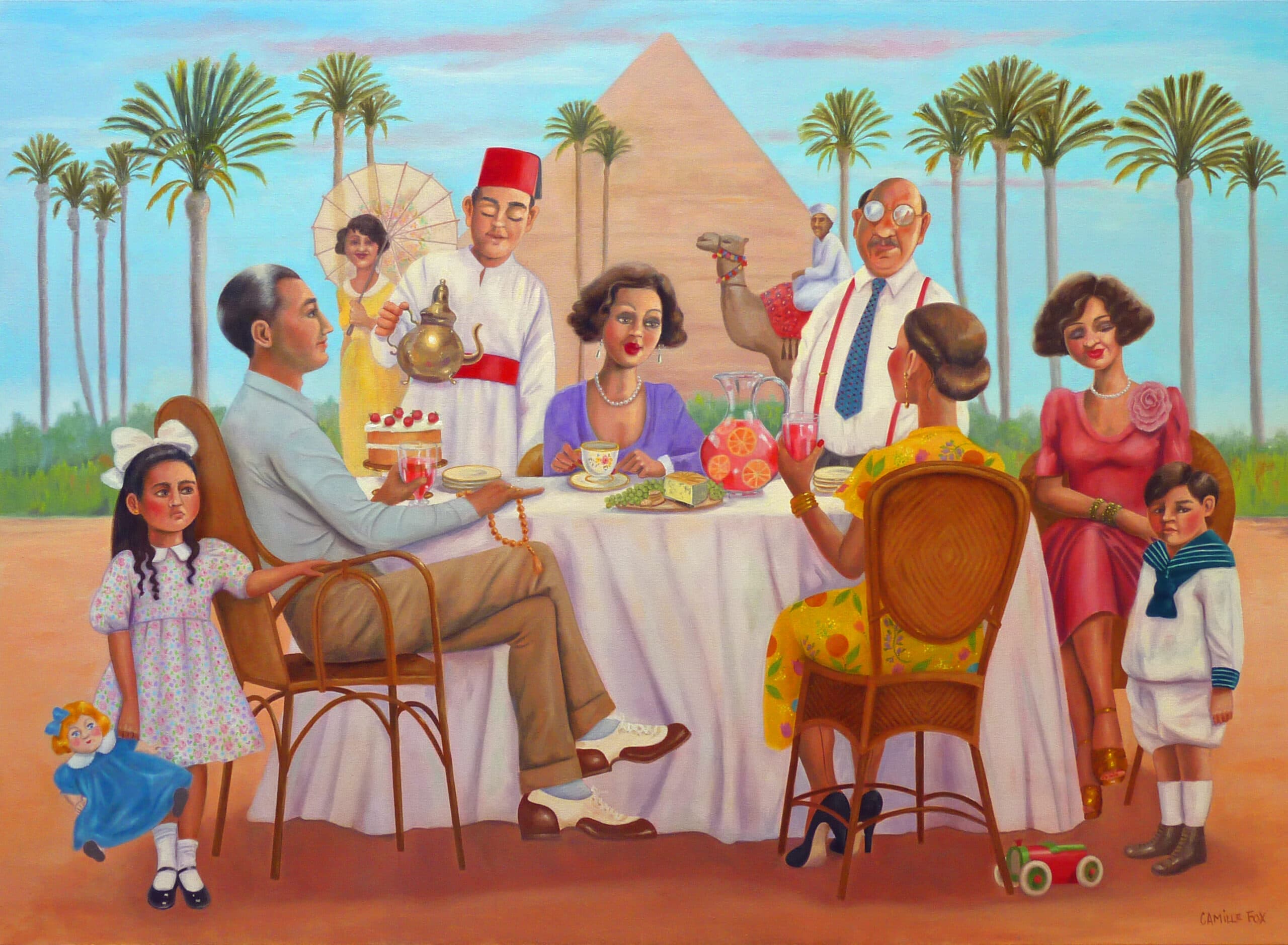
At the Edge of the Desert

‘At the Edge of the Desert’ by Camille Fox (Image: supplied)

Published: 4 November 2026

Last updated: 4 November 2026

Sydney artist Camille Fox is perhaps best known for her vibrant oil paintings of Egyptian Jewry’s bygone era. Yet for decades, Fox rarely disclosed that she’s fourth-generation Egyptian, instead telling people she was French.

“When you say you're from Egypt, people think you're an Arab … I didn’t want to be mistaken. And it was difficult to explain,” she tells The Jewish Independent in an interview for Mizrahi Heritage Month.

With French as her first language, it was easy for Fox to obscure her Mizrahi origins. It was only after she reluctantly agreed to travel to Egypt from Israel – by which time she was already in her 50s – that Fox changed her perspective. Since then, Egypt is the theme that the figurative artist keeps returning to in her work. But it’s an Egypt that’s alive only in memory. 

Fox’s series Halcyon Days, for example, depicts the everyday life of Egypt’s bourgeoisie in the 1930s. This was the heyday of Fox’s grandparents, when, as Fox writes on her website, “Christians, Muslims and Jews celebrated each other's festivals and attended each other's weddings, played cards, enjoyed afternoon tea on sunny terraces in the winters of Cairo and sailed in Alexandria's harbour in summer.” 

However, the establishment of Israel in 1948, the fall of King Farouk in 1952 and the rise of the Nasser dictatorship combined to create hostility towards Jews, culminating in confiscation of property, persecution and expulsion. Of the 80,000 Jews living in Egypt in 1948, nearly all of them left; Fox’s family among them – Fox was just six when she and her parents fled Alexandria for Israel in 1954.
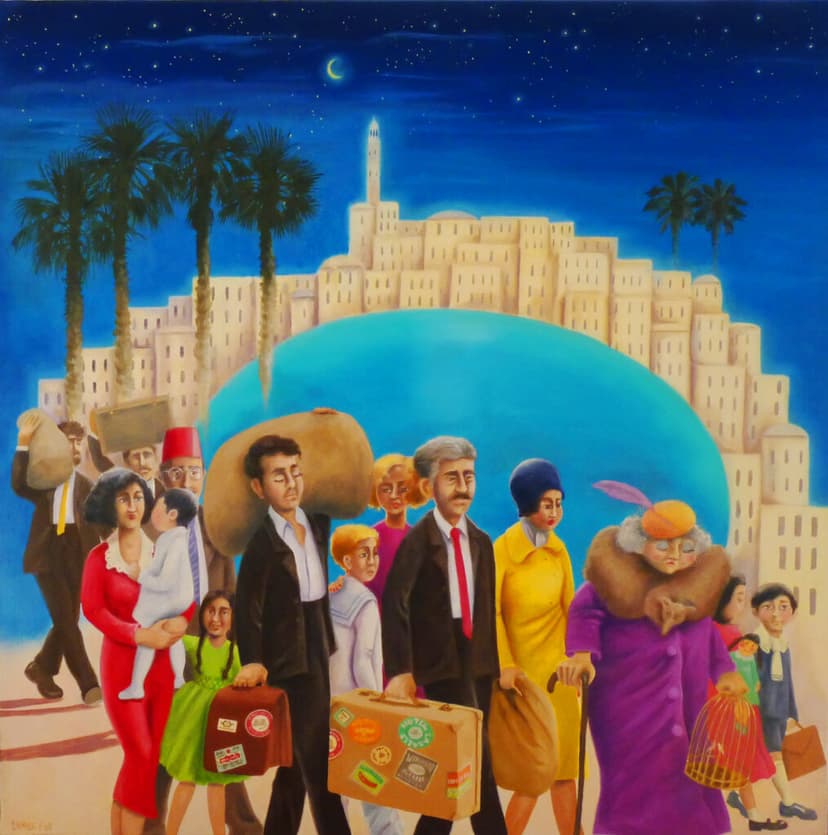
<em>Exodus</em> by Camille Fox
Exodus by Camille Fox

It’s a familiar Jewish story; a golden age which didn’t last. As the late Lucette Lagnado, author of the award-winning memoir, The Man in the White Sharkskin Suit, writes, “Once upon a time the Jews of Egypt were a thriving, glittering community active in every realm from commerce to journalism, from finance to the arts.”

So much so that Egypt’s Jews were among the wealthiest Jews in the Middle East. They were also very European, says Fox. And so it was that Fox’s family were wholly unprepared for life in newly-established Israel. 

When Fox and her parents arrived in Haifa, they were greeted by Fox’s uncle, a fervent Zionist who’d left Egypt for Israel in 1947. He was waiting for them “in a jeep in his little blue shorts and kova tembel (bucket hat). And we got down [off the boat] with our Louis Vuitton luggage. I had a massive Italian doll in my arms, my mother was wearing the latest Paris Dior fashion, [and] my father with a Panama hat,” Fox says wryly.

The family’s new home was in Kfar Aviv, a moshav in central Israel established by exiled Egyptian Jews in 1952. They arrived at night, in total darkness. “And then in the morning, I opened my eyes, and for me, it was absolute magic – the fields, the flowers,” says Fox. But for her parents, as for most Mizrahi Jews, the culture shock was enormous.

The moshav had no roads and no electricity. At night, everyone had to put black cardboard on their windows and use kerosene lamps in case of air attacks from Egypt. “My parents were horrified. And my poor grandparents with their life of luxury …” her voice trails off. “My grandparents didn’t do well at all.”

In Kfar Aviv, everyone was from Egypt and spoke French. And Israelis knew that Jews had been expelled from Egypt and other Arab lands. So in Israel, Fox didn’t claim to be French. 

It was in Australia – where Fox and her parents moved six years later, in 1960 – that Fox told people she was from France and had lived in Israel. She never mentioned Egypt. “I felt it easier to say I was French in Australia because it would have taken too much to explain to people who had no idea, and still don’t, that there were Jewish communities in the Middle East,” she says.

When Fox arrived in Sydney, she was 12, had no English, and was heartbroken to leave her life in Israel. As an only child, she had spent hours in Egypt at her family’s dining room table with pencils and paper. “I wasn’t allowed to paint because it was too messy,” she says, “but I got very good at drawing, and that’s how I grew to love it”.

Fox spent less time on artistic pursuits in Israel, but in Australia, she reconnected with her love of drawing. After finishing school, she studied commercial art at East Sydney Technical College (now the National Art School). And when she graduated, she got a job in the art studio of George Patterson’s advertising agency as an illustrator, drawing everything by hand.

Fox’s career as an artist had begun. But it would take many years before she had the luxury of focusing on painting (“all I wanted to do was paint”, she says) – and before her work incorporated her Egyptian heritage. 

In 2000, Fox and her second husband, Tony, were planning to visit Fox’s son in Israel, who was then serving in the IDF. Tony suggested a side trip to Egypt from Israel. Fox was not keen but eventually agreed.

They arrived in Ismailia and, Fox says, “it was the first time I started showing interest in Egypt, because my mother grew up there.” Later, their tour guide guessed that Fox was Egyptian. “I was born here”, she admitted. 

“Welcome home!” he said.

“From then on, that was it, I melted. “The people were so wonderful, so hospitable, and they knew why we [Jews] left.”

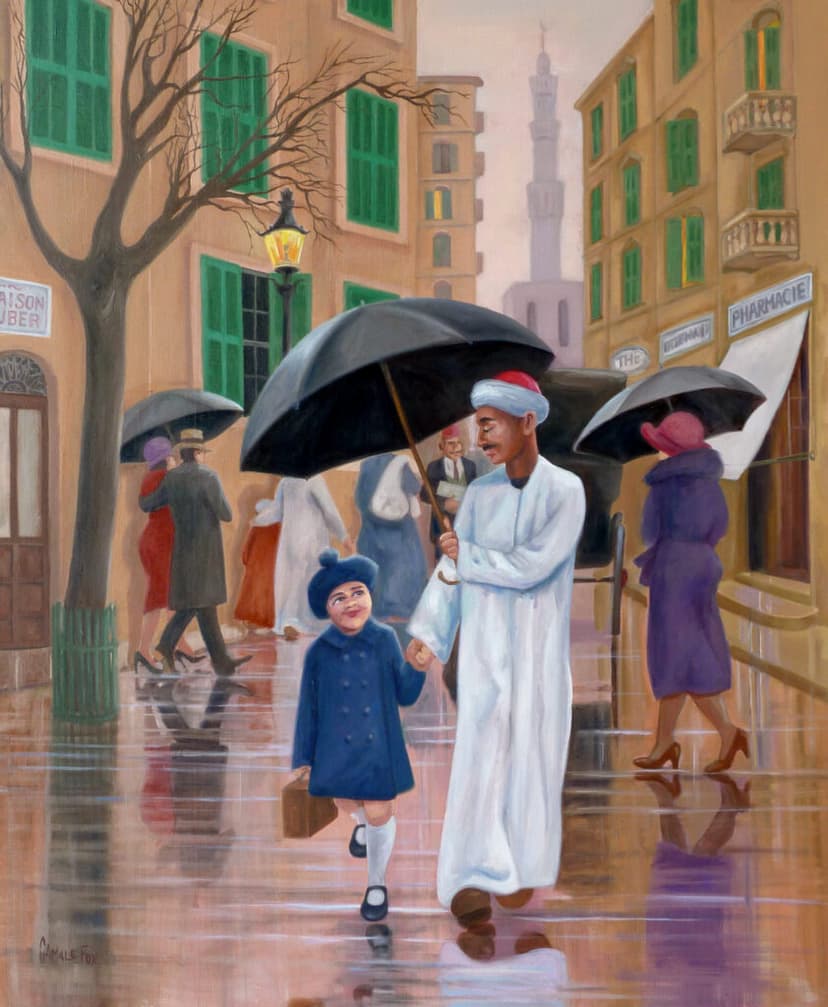
That trip, says Fox, in which she also visited her family home in Alexandria and met the Muslim man, then in his 90s, who had walked her to school as a child, awakened a curiosity in her. Years later, Fox painted a picture of Mohammed and her child self, holding hands on their way to school. 

<em>The Walk to School</em> by Camille Fox
The Walk to School by Camille Fox

Fox’s striking paintings of Jewish Egypt – including Hope and Joy and Midnight Recital– were exhibited at the Sydney Jewish Museum (SJM) during its Jews from Islamic Lands exhibition in 2020. (SJM have since commissioned Fox to produce a series of artworks depicting key Jewish life cycle events and chagim.) Fox’s work also graces the cover of the French edition of The Man in the White Sharkskin Suit, the celebrated memoir of an Egyptian-Jewish family.

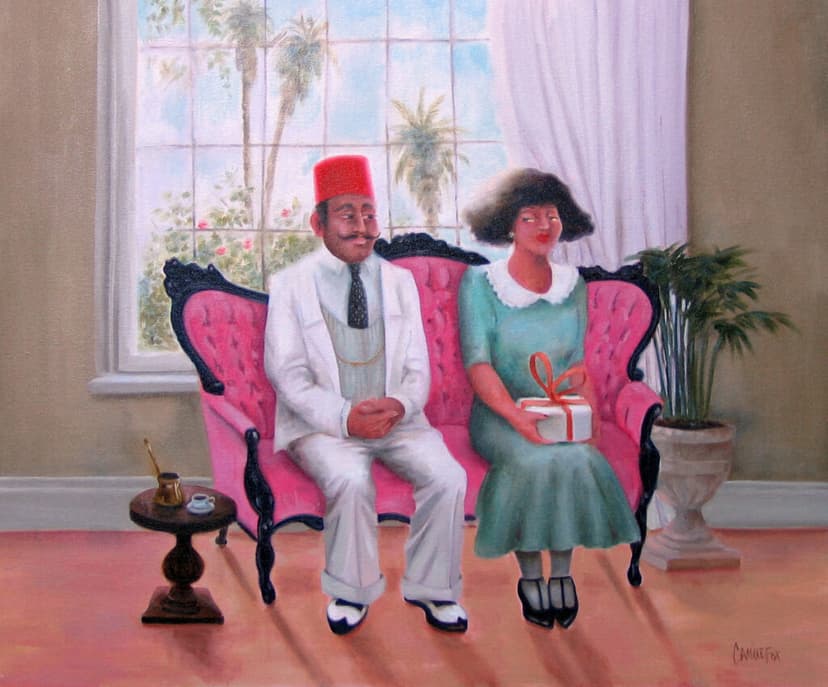
<em>The Courtship</em> by Camille Fox
The Courtship by Camille Fox

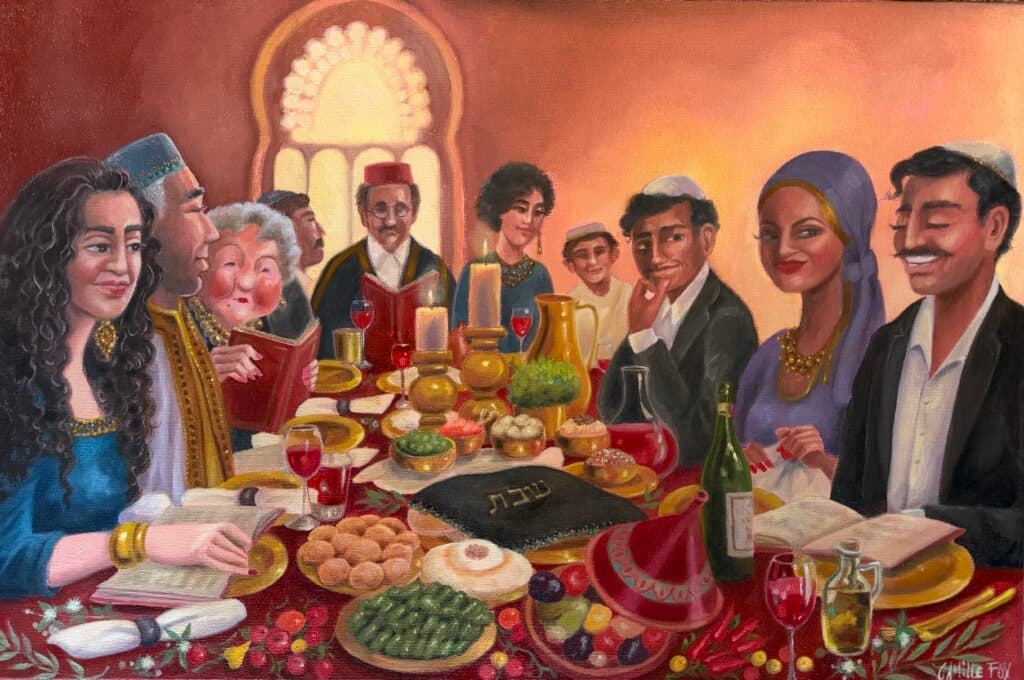
But she doesn’t solely paint the lost world of Jewish Egypt. With its tarboosh-clad host and table laden with stuffed vine leaves and tagine, Fox’s Sephardi Family Shabbat Dinner incorporates broader Mizrahi heritage. It is in the collection of the Sydney Jewish Museum.

<em>Sephardi Family Shabbat Dinner</em> by Camille Fox
Sephardi Family Shabbat Dinner by Camille Fox

Her large body of work spans vignettes of Sydney as well as Israeli scenes. She’s also painted portraits of prominent Australians including Malcolm Turnbull, Dave Sharma and Kellie Sloane, and her portrait of her granddaughter, Filled with Blessings, featured in this year’s Holding Light exhibition. More recently, Fox has painted the commemorative cover image for the forthcoming December edition of Bondi’s Beast magazine, marking the one-year anniversary of the Bondi massacre. 

However, it’s Egypt that always pulls her back. Now in her late 70s, Fox isn’t showing any signs of stopping. “There’s always a wealth of things that I haven’t touched on,” she says. Indeed, Fox is currently working on a series capturing the Jewish women of the Levant during the first half of the 20th century, inspired by the lives of her two grandmothers, her great-aunts, and their relatives and friends. The women are depicted enjoying the pleasures of Levantine life: laughing, dressing with deliberate elegance, and moving through sun-drenched spaces with confidence.

Egypt, says Fox, has become her passion, her raison d'être. And while she never held back about being Jewish and Zionist, she now equally embraces her Mizrahi identity. “I say now: I'm a Jew. I'm a Zionist. I'm Mizrahi. And I would never have said that before.”

You might also like
  • A Gazan doctor’s journey of hope
    Deea Okasha
  • From Bondi to the Tree of Life
    Gideon Cohen
  • Rachel Moshel: Creating a space for Jewish art and joy
    Gideon Cohen
logomark.67a07ee3
We believe in the free flow of information

Republish our articles for free, online or in print, by using our Creative Commons licence

You might also like

    C care volunteers
    FeatureAustralia

    Who volunteers? The hidden network sustaining our community

    Florencia Tuchin
    Scribe main
    InterviewArts & Culture

    The publishing house that Henry built

    Michael Visontay
    EDITH BRUTMAN FUNERAL
    ExplainerAustralia

    Why the Bondi victims’ bodies were not ritually cleansed before burial

    Nomi Kaltmann

About the author

Elana Benjamin

Elana Benjamin

Elana Benjamin is a Sydney-based writer whose articles have been published widely, including in Good Weekend, Sunday Life and the Sydney Morning Herald. Elana is also the author of ‘Indian-Jewish Food: Recipes and Stories from the Backstreets of Bondi’, which is out now.

More from the author

ReflectionArts & Culture

At last, a writers festival invites Ruptured authors to speak

FeatureAustralia

In western Sydney, a thriving Jewish community looks to the future

ReflectionLifestyle

How do introverts fit into Jewish life?

InterviewArts & Culture

Why the Jewish way of reading is perfect for getting children to read