Aa
  • Read, Watch, Listen
  • TJI Series
  • Community Action
  • Events
  • Zedi
Follow us and continue the conversation
  • LinkedIn
  • Instagram
  • FaceBook
  • X
  • YouTube
Test yourself with the TJI Quiz!

Adjust size of text

Aa

Follow us and continue the conversation

  • LinkedIn
  • Instagram
  • FaceBook
  • X
  • YouTube

Your saved articles

You haven't saved any articles

What are you looking for?

Original reporting, insightful analysis and diverse views, delivered straight to your inbox

  • LinkedIn
  • Instagram
  • FaceBook
  • X
  • YouTube
Your support fuels our mission to inform, entertain and inspire.

The Jewish Independent is bound by the Standards of Practice of the Australian Press Council. If you believe the Standards may have been breached, you may approach The Jewish Independent or make a complaint to the Australian Press Council in writing at www.presscouncil.org.au. The Council may also be contacted on 1800 025 712.

  • Our Story
  • Contact us
  • Our Team
  • Support us
  • Guidelines
  • Pitch your idea
  • Republishing us
  • Community Action
  • Our Awards
  • LinkedIn
  • Instagram
  • FaceBook
  • X
  • YouTube
Aboriginal FlagTorres Strait Islanders Flag

The Jewish Independent acknowledges Aboriginal and Torres Strait Islander peoples as the Traditional Owners and Custodians of Country throughout Australia. We pay our respects to Elders past and present, and strive to honour their rich history of storytelling in our work and mission.

© The Jewish Independent 2026All Rights Reserved
Website design and development by Your Creative, MelbourneTerms & ConditionsPrivacy Policy
HomeRead, Watch, ListenArts & Culture
OpinionArts & Culture

A tale of two exhibitions: fortitude at Bondi and fawning at the Biennale

While the media has largely overlooked an artistic response to the Bondi Beach terror attack, it has gushed over Khaled Sabsabi at Venice
John McDonald
Print this
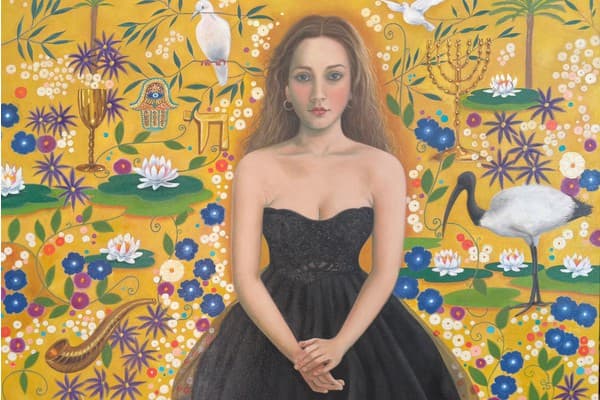
Filled with Blessings Camille Fox 600

Filled with Blessings (detail), by Camille Fox

Published: 28 May 2026

Last updated: 28 May 2026

This year’s Federal Budget was a washout for arts and culture, with few significant cuts or windfalls. Most notable, for me at least, was the complacent support given to the National Cultural Policy, with its five shaky “pillars”, and extra funding for Creative Australia, as a reward for another year of dysfunction and scandal. It’s clear the treasurer is happy to leave all the cultural stuff in the hands of Arts Minister, Tony Burke, who has shown a complete unwillingness to question any of the status quos he has created.

There are dangerous outcomes of the government’s cultural policies, and one of the worst has been the steady shift of political priorities in funding bodies, the national broadcaster and associated media. This has seen public money and exhibition opportunities channelled away from some groups, such as those of Jewish or Chinese origins (not to mention the Old White Blokes!), and lavished on those who identify as Indigenous or Muslim.

In saying this, I’m simply identifying an obvious shift in focus. I’m not saying that Indigenous or Muslim artists are in any way inferior or less deserving than their Jewish or Chinese counterparts, I’m arguing that artists of all creeds and ethnicities should be allowed the same opportunities. This may sound like pure fantasy in the current political climate, but it is the way a healthy liberal democracy stays healthy.

What should be a source of alarm for the government is that their funding priorities and policies tend to mirror the views of that strident alliance of pro-Palestinian and Indigenous activists, who draw a false equation between Israel and Australia as “settler colonies”. The upshot of this political manoeuvre, which ignores the radical differences between both forms of settlement, is to create a group of saintly figures who are history’s heroes and victims, and another who can only be portrayed as villains. It’s historically preposterous to maintain such a fiction, but one sees the impact of these ideas in every part of our cultural life.
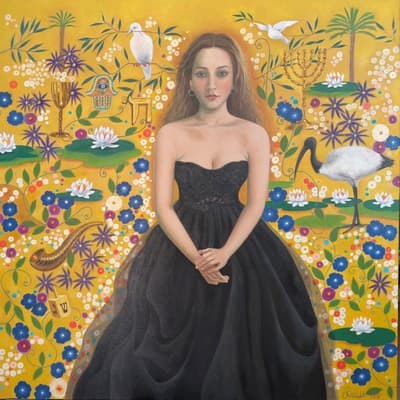
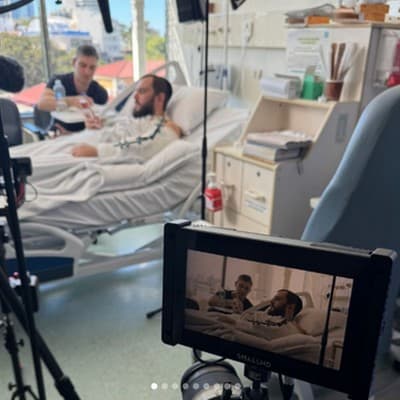
Artistic response to Bondi attack

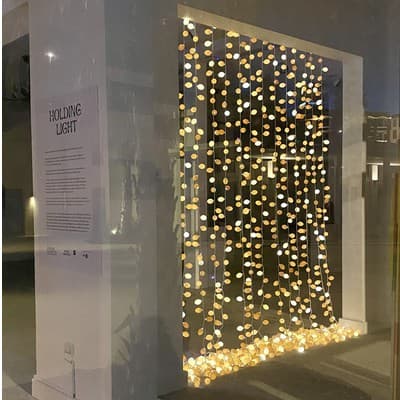
For instance, last week, I went to see Holding Light at the Bondi Pavilion. The show, organised by the Shalom collective, is billed as an “artistic response to the Bondi Beach terror attack” and includes work by both Jewish and non-Jewish artists. It’s a modest display of 28 works, both amateur and professional, incorporating painting, sculpture, graphic art, ceramics, photography and installation. Easily the most powerful piece is Michael Puterflam’s half-hour video, in which the families of those killed in December’s terror attack talk about their loved ones.

The film puts a human face to the victims, reminding us that every person, no matter how ordinary, had some part of them that was extraordinary. It should be required viewing for those celebrity antisemites who feel their freedom of speech is being impugned if they are expected to refrain from inciting hatred and violence.

Filled with Blessings (Camille Fox)
Scene from Michael Puterflam’s video (Instagram)
'All that is solid melts into air': Vigil by Sue Saxon and Jane Becker

While there’s a sombre, elegiac aspect to most of the works, there are also pieces that celebrate survival and resilience, such as Camille Fox’s Filled with Blessings – a portrait of her granddaughter, a young woman who has her whole life ahead of her. There’s even a painting by an Indigenous artist, Munganbana Norman Miller, who obviously does not subscribe to the “settler colonies” narrative.

One might think that an exhibition linked to the Bondi massacre, which generated such an outpouring of grief, would attract more attention

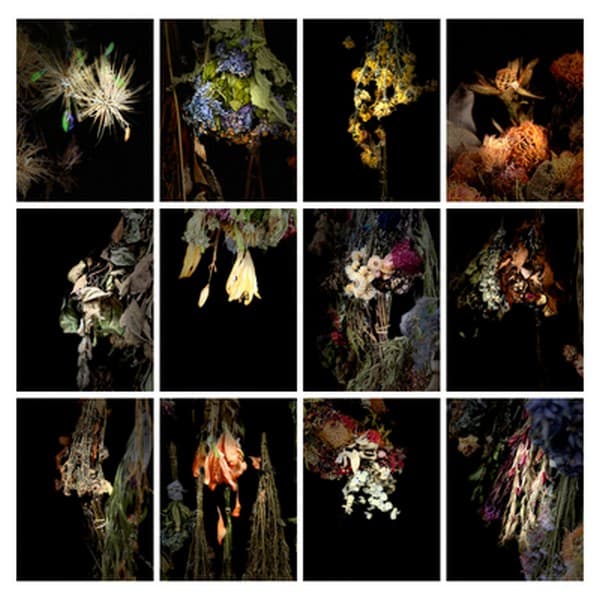
Ella Dreyfus, Nature Morte Zikaron, 2026. Complete artwork comprises 12 framed photographs

The most accomplished work is Ella Dreyfus’s Nature Morte – Zikaron, a suite of 12 photographs featuring flowers gathered from the Bondi Beach Memorial and left to dry. The faded bouquets against a black background make a simple statement about memory and mortality. Our memories of the Bondi killings will gradually fade, like the flowers, but these images will remain. It’s a piece that should be acquired for a public collection.

I searched for reviews of this show but the only ones I could find were in specialised Jewish publications. One might think that an exhibition linked to the Bondi massacre, which generated such an outpouring of public grief, would attract more attention. Instead, anything with a Jewish connection seems to be met with silence by a large part of the media.

I’ve also begun to wonder about an ABC News Radio interview last week, in which I was cut off when saying something positive about Michael Zavros’s Archibald portrait of Alex Ryvchin. It did not register at the time, but afterwards I began getting inquiries about this rapid change of subject. It can’t be checked either way, because the ABC chose not to preserve the interview online. I doubt I’ll be asked to comment on arts matters in the future.

It may sound naive or idealistic, but I genuinely do not understand why so many people can’t be shocked and angry at the Netanyahu government’s callous actions in Gaza and Lebanon, without directing their anger at Jewish Australians or whitewashing Hamas’s barbaric crimes of 7 October. It’s the mentality of the mob, given respectability by the complicity of media outlets that quietly avoid some topics while going overboard on others.

Khaled Sabsabi's artwork 'conference of one’s self at the Venice Biennale, with Islamic scripts chosen by the artist on the surrounding walls (Creative Australia, Andrea Rossetti)

Sabsabi written up as a hero

One subject drawing torrents of gushing adulation from the media, is Khaled Sabsabi’s contribution to the Venice Biennale, which may be found in not one, but two venues. This double dose is a direct result of the cancellation of Sabsabi’s selection, which set off a chain of events, which ironically made him “one of only three artists in the event’s 131-year history to present work in both a national pavilion and the biennale’s main exhibition,” as an ABC report breathlessly informed us last week.

Unlike a large contingent from Creative Australia, I didn’t make it to Venice for the party this year, so I can only go by the reports available online or news from friends. This means I’m in no position to make any definitive judgements about either khalil, at the Arsenale, or conference of one’s self in the Australian pavilion. It’s not presumptuous to imagine that the lack of capital letters in these titles is intended as a sign of the artist’s modesty.

The former is described as a 40-metre-long painting of abstract lines, with a 64-minute video of abstract forms superimposed over the top. It obviously needs to be experienced first-hand, but it reminded me of those students at art school who try to turn a bad painting into a work of contemporary genius by projecting images onto it. I hope this is an uncharitable suspicion.

How is it that the pavilion in Venice, which represents the entire population of Australia, has been transformed into a showcase for Islamic religious signs and symbols?

As for conference of one’s self, which is loosely based on Farid ud-Din Attar’s famous 12th century Persian poem, The Conference of the Birds, it too relies on large abstract pattern paintings, arranged in a hexagon, with shifting forms projected onto the surfaces. But it’s the peripheral additions that sound so intriguing.

According to an AI summary of the press accounts, “Visitors enter the central space through one of two interchangeable “thresholds”. These entrances feature door hangings inspired by Sanjak – sacred ceremonial textile banners used by Sunni, Shia, and Sufi communities. The banners were hand-stitched by a multicultural women’s hub based in Parramatta, Western Sydney.”

Meanwhile, “the walls surrounding the installation are adorned with selected Islamic scripts chosen by Sabsabi to act as a symbolic form of spiritual protection inside the pavilion.”

Without having seen this multimedia installation, one may ask two questions. Firstly: “How is it that the pavilion in Venice, which in theory represents the entire population of Australia, has been transformed into a showcase for Islamic religious signs and symbols, including masses of Qur’anic script that most Australians are unable to read?”

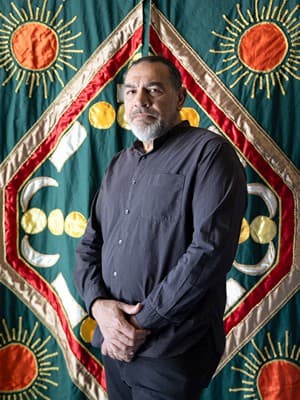
Khaled Sabsabi (Andrea Rossetti/CA)

Regardless of all the claims that Sabsabi is presenting a peaceful Sufi version of Islam that “operates as a broader metaphor for how coexistence, global unity, and healing from displacement require a deep, personal connection with both the inner and outer self,” I daresay this is not a display that will resonate with the average Australian. Some may see it as a great moment in multiculturalism but others will find it profoundly alienating.

Second question: “Even if we allow that Sabsabi’s installation is a statement on behalf of peace and coexistence, how can Creative Australia justify transforming the Australian pavilion into a pulpit for a particular world religion?” It must be beholden on the government body that manages the pavilion to ensure this biennale display is a secular one, not devoted to the promulgation of any sectarian belief.

Imagine if Creative Australia had chosen a devout Christian who filled the pavilion with benign quotations from the Bible, and erected crucifixes and other Christian symbols around the doorways? (Remember Bindi Cole Chocka, the Indigenous artist-activist, who found Jesus and saw her artistic career disappear?) Imagine if they’d chosen a Jewish artist who coated the walls with quotations from the Torah in Hebrew, and displayed the signs and symbols of Judaism?

Neither of the above scenarios could ever have been taken seriously, so why turn the Australian pavilion into a shrine for the Islamic faith? It’s not exactly an unexpected scenario, when Sabsabi has said: “For me, Islam is the core, the foundation – and the inspiration.”

Imagine if Creative Australia had chosen a Christian who filled the pavilion with quotations from the Bible, and erected crucifixes around the doorways?

One of the most startling Instagram posts I’ve seen from Venice, was by Liz Ann Macgregor, the former director of Sydney’s Museum of Contemporary Art, who wrote: “Lovely moments at the Australian pavilion today. The sounds of the performance by the Anasheed from Western Sydney resonated out across the Giardini (not filmed).” The picture shows Sabsabi presenting four Sufis in long white robes and skull caps, who have just performed – or are about to perform – “spiritual songs and devotional chants popular throughout the Islamic world that express love for the Prophet (peace be upon him)”.

I take this description from the website of the 2024 Adelaide Biennial, in which the same group, Ahbab Al-Mustafa, were flown down to perform in front of Sabsabi’s installation. I’ve been unable to find any information as to who funded Ahbab Al-Mustafa’s trip to Venice and their accommodation. Was the visit paid for or subsidised by Creative Australia? Did the artist dip into some of the money he’s been paid for his efforts? Was there a crowdfunding campaign in the western suburbs? I’d love to know.

Once again, imagine our hypothetical Christian artist flying in a group to sing hymns, or our Jewish artist bringing in a cantor to lead the faithful in prayer. It’s unthinkable – and so it should be. The Australian taxpayers who are bankrolling the Venice pavilion, have every right not to be subjected to expressions of any religious persuasion. Faith should be a personal matter, not a public imposition.

I’ve not been able to find a single report on the Australian contribution in Venice that asks any meaningful questions or portrays Sabsabi’s show as other than a triumph. The artist is universally written up as a hero who had to overcome the indignity of being unjustly cancelled before fighting his way back into the job.

My position has been clear from the beginning. Given the ongoing bloodshed in the Middle East, it was never appropriate to send an artist to Venice who has such clear partisan associations, especially when the Creative Australia selection processes were highly questionable. The heavy-handed religious aspects of the display only throw these concerns into sharper relief.

There was always a danger that this project would portray Australia as a clear supporter of one side of the Gaza conflict, making a mockery of all our diplomatic tightrope-walking. In reality, it has gone much further, professing our national allegiance to Islam, even as the local news runs tabloid shock-horror stories about the ISIS brides returning to Australia.

The media have done their best to make sure there is only good news from Venice, but if the tide turns, the government will have to explain why Sabsabi was reinstated when the nature of his work, past and present, has remained the same. It’s a case of institutional authority being swayed by a campaign that was perceived as capable of inflicting electoral damage in seats where there is a substantial Muslim population – seats such as that occupied by Arts Minister, Tony Burke. The government could not allow the impression that dropping Sabsabi was an implicitly anti-Muslim act. The result was a complete capitulation, which has allowed the artist to treat the Australian pavilion as a temple of worship.

It’s the other side of the coin to the government’s chain-dragging with Jillian Segal’s report on antisemitism, which was left to gather dust on a shelf until the Bondi incident induced a sense of political panic. As a result, all the report’s recommendations were rushed through without due discussion or debate, which may give rise to a whole new set of problems.

The overall picture is one of a culture in disarray, in which the government makes poor decisions for opportunistic, cowardly or ideologically blinkered reasons that can only lead to further disarray, while preaching the gospel of “social cohesion”.

Reprinted with the permission of the author. This is an edited version of an article first published at John McDonald’s Substack, everythingthe.com, where he posts art and film reviews alongside an editorial, Everything the art world doesn't want you to know.

You might also like
  • Confronting Richard Flanagan and the myth of the Israel lobby
    Mary Garden
  • Prime minister’s absence exposes weakness in Royal Commission hearings
    Michael Visontay
  • Safety not just security: the last word to the Royal Commission
    Yehoram Ulman
logomark.67a07ee3
We believe in the free flow of information

Republish our articles for free, online or in print, by using our Creative Commons licence

You might also like

    haredi street guitar
    Photo EssayArts & Culture

    Jerusalemites through the lens

    Sharon Gabay
    MJBW main
    FeatureArts & Culture

    Melbourne writers fest a place of connection both outward and inward

    Peter Kohn
    Copy of Website books template (2)
    FeatureArts & Culture

    The winning Jewish books by Australians in the past year

    Gideon Cohen

About the author

John McDonald

John McDonald

John McDonald is a former art critic for the Sydney Morning Herald, and film critic for the Australian Financial Review. He now posts art and film reviews at everythingthe.com alongside an editorial, Everything the art world doesn't want you to know.

Comments4

  • Avatar of Kim Lester

    Kim Lester29 May at 04:32 pm

    I have no problem with Australia funding an Australian artist inspired by religion.
    I agree that the Bondi exhibition should be more celebrated and discussed. Art can really help us understand or find some peace – please try to not be so angry – both exhibitions sound fascinating to me.

  • Avatar of Kim Lester

    Kim Lester29 May at 04:26 pm

    I’m not worried about Australia funding an Australian artist who is deeply inspired by a religious cultural tradition. I also loved Marc Chagalls

  • Avatar of Vincent

    Vincent29 May at 04:13 am

    Thank you for publishing something with spine

  • Avatar of Zia Ahmad

    Zia Ahmad28 May at 08:31 pm

    This is a very disappointing article with Islamophobic undertones and clear bias against Islam, Muslims and Palestine.
    Why can’t Australian art be representative of our Multicultural Australia showcasing the best of our Indigenous, Christian, Jewish and Islamic rich traditions synthesising with our secular culture and modern living?