Aa
  • Read, Watch, Listen
  • TJI Series
  • Community Action
  • Events
  • Zedi
Follow us and continue the conversation
  • LinkedIn
  • Instagram
  • FaceBook
  • X
  • YouTube
Test yourself with the TJI Quiz!

Adjust size of text

Aa

Follow us and continue the conversation

  • LinkedIn
  • Instagram
  • FaceBook
  • X
  • YouTube

Your saved articles

You haven't saved any articles

What are you looking for?

Original reporting, insightful analysis and diverse views, delivered straight to your inbox

  • LinkedIn
  • Instagram
  • FaceBook
  • X
  • YouTube
Your support fuels our mission to inform, entertain and inspire.

The Jewish Independent is bound by the Standards of Practice of the Australian Press Council. If you believe the Standards may have been breached, you may approach The Jewish Independent or make a complaint to the Australian Press Council in writing at www.presscouncil.org.au. The Council may also be contacted on 1800 025 712.

  • Our Story
  • Contact us
  • Our Team
  • Support us
  • Guidelines
  • Pitch your idea
  • Republishing us
  • Community Action
  • Our Awards
  • LinkedIn
  • Instagram
  • FaceBook
  • X
  • YouTube
Aboriginal FlagTorres Strait Islanders Flag

The Jewish Independent acknowledges Aboriginal and Torres Strait Islander peoples as the Traditional Owners and Custodians of Country throughout Australia. We pay our respects to Elders past and present, and strive to honour their rich history of storytelling in our work and mission.

© The Jewish Independent 2026All Rights Reserved
Website design and development by Your Creative, MelbourneTerms & ConditionsPrivacy Policy
HomeRead, Watch, ListenArts & Culture
ReflectionArts & Culture

The very Jewish thinking behind ‘You Can see Everything’

The filmmaker of a new documentary about convicted fraudster Elizabeth Holmes went to Talmud Torah. It shows.
Merissa Nathan Gerson
Print this
Nathan-Fielder-(left)-and-Elizabeth-Theranos-in-new-A24-doc copy

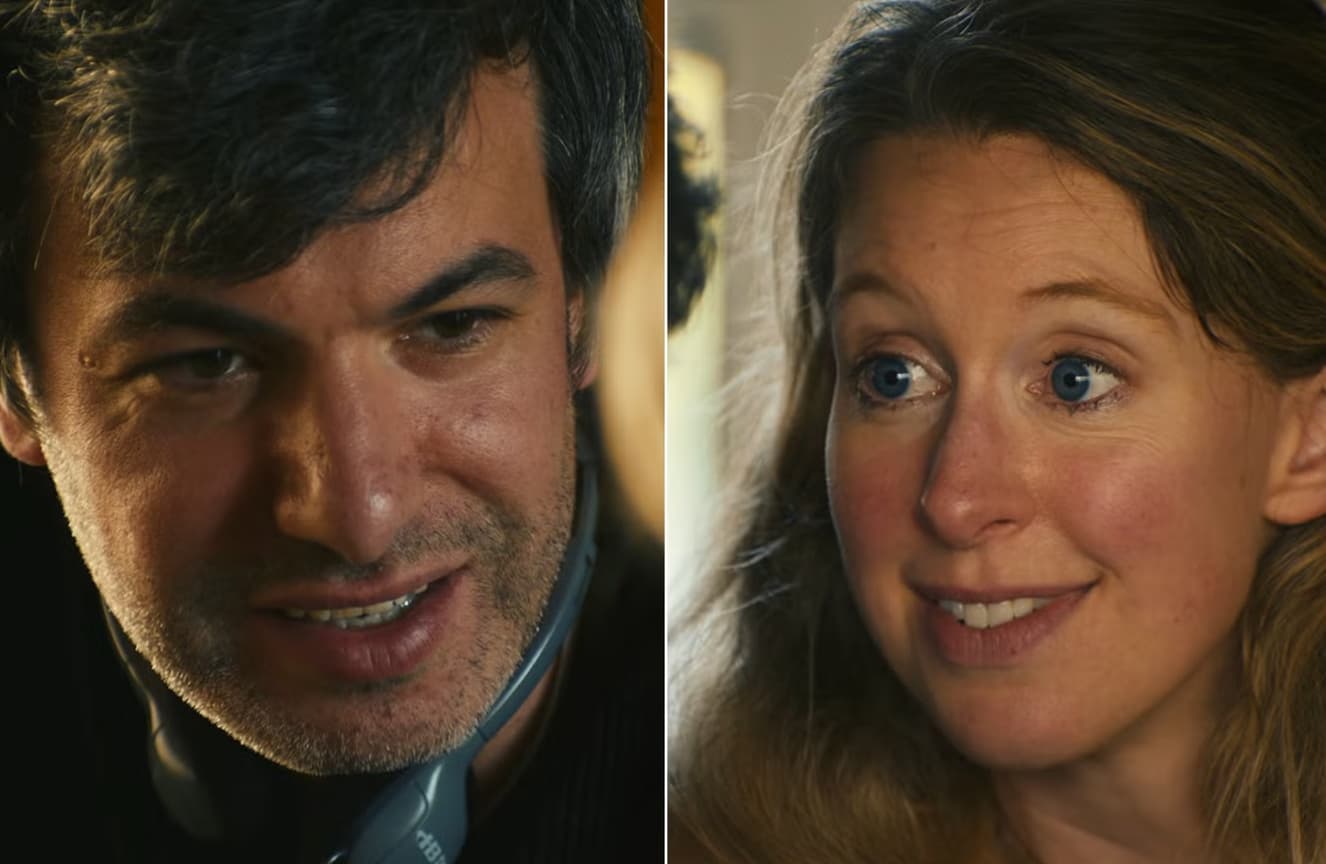
Nathan Fielder (left) and Elizabeth Holmes in stills from the film ‘You Can See Everything’

Published: 4 November 2026

Last updated: 4 November 2026

The second night that I took ayahuasca in Mt. Shasta in 2022, there was a long pregnant silence, and then, a sudden bellowing scream. It came out of me. According to the others in the room it felt like a kickoff siren for the ceremony. 

 This is how I felt the moment that Nathan Fielder confronted Elizabeth Holmes in You Can See Everything about the humor of Abbot and Costello. He asks if she knows who they are. No. He shows her a YouTube clip of “Who’s on First.” Her face flushes red. She giggles. And he asks her, What is funny? It is not what you would expect. She doesn’t compute “Who” as a name. 

Suddenly we see their consciousness coordinates staring face to face. See? This joke? Who’s on first? Get it? She was giggling, but she did not get the wordplay. Fielder, confounded, probes deeper, tries to teach her the mechanisms of the humour, but it simply does not translate. I saw in her eyes how I felt attempting to learn 7th-century Talmudic mathematical mind logic – meeting a comprehension wall. 

In that scene I felt this sudden rush of awareness of Fielder’s Jewishness. If I was confused, if not a little bored, watching him lurk in a strangely undecorated beachside shrouded home up until now, I was suddenly deep inside this film.  

Fielder, in this scene, becomes a Jew. Holmes, she represents Nazism, or the modern systemic privilege version. And now, we as viewers are invited into an exploration of the confrontation of said Nazi. It is a poignant encounter with the age-old inquiry: How could you do this and believe you are innocent? How does your blonde-haired blue-eyed mind work that allows for this horrifying immoral reality you have constructed to appear as if normal?  
And of course, Abbot and Costello are the translation point. Can you, Elizabeth, understand the humor of these men, mutts of Italian and Jewish immigration, speaking the humor of the New York people? No. She cannot. And so we descend into the medicine of this film: How is this possible, this big divide of awareness? Is she shaped by other forces altogether? In fact, yes, we learn. Her dad worked for Enron. Her mother is a silent twitching poised thing. This is not an immigrant family. There is a knife cuttable meeting of two disparate worlds. 

It is no surprise that Fielder went to Vancouver Talmud Torah and worked as a Holocaust education activist in Canada for decades. I could see and feel the deep convoluted logic of Talmud Torah in each scene, Abbot and Costello forward. The mind bending layered arguments, the unabated quest for a not easy truth. Fielder is the founder of somewhat satirical yet actual fundraiser Summit Ice Apparel - oddly a softshell jacket company that earned millions for youth education surrounding "intolerance, racial bias, and genocide" donated to a Holocaust education center in Vancouver. So it is no surprise that like in The Curse, this movie directly confronts the consciousness that normalizes white aberrant behavior.  

And yet, touching on what was taboo in my own Holocaust surviving family, Fielder invites the possibility of humanizing the monstrous enemy. Through the tool of this very American Abbott and Costello moment we are invited to plainly see that Holmes is certainly not Fielder’s people, and at once we are invited to shed the judgmental confounded gaze she is subjected to thus far - and ask instead: How, is this human, possible? 

From this moment forward, the film became unilaterally Jewish, if not rabbinic - a treatise on lashon harah (the evils of shit-talking), reconciliatory teshuvah (forgiveness and understanding), and the harshness of judging others (compassion and witness). Are we not to see the light of divine love in everyone - and even most importantly - in imprisoned Holmes? 

If Abbot and Costello took us into one depth of consciousness, the arrival of wild, perhaps drunk, Amanda Seyfried entering the Holmes home dragged us down deep to another runged ladder dimension. Seyfried—the darling celebrity mean girl, mamma mia du jour whom we watched on Hulu doing a mediocre job portraying a living woman in prison—erupts into the space. The mockery of Holmes is palpable, and the delight of celebrity witness becomes instantly embarrassing. 

Seyfried’s entry stressed me out from the beginning. I saw immorality, and clean lines, and the protection of women - paradigms we feign to be so clear on as a culture - melting into an unhinged puddle. Did I agree with this woman, so gossipy, quick to judge and draw conclusions? Was she not just another Aryan enemy? I squirmed as Seyfried was suddenly back in the acting role portraying Holmes, botching the heart and soul of a real woman worse than her AI holographic self. 

When Seyfried enters the Holmes house, this what the second siren moment, and the third the ending, where we see a family through a fence. These three moments mark the layering of this film exponentially as we cross lenses and veils, step into the very scene we were viewing as witness earlier, now as a fake rendering, we all become implicated. As they inhabit Holmes’ identity, enter her living space, objectify her experience, and reenact it together, we become dirty witnesses to the whole affair. We become complicit in this peacock objectification of human narrative—suddenly, sickeningly aware of the way we ourselves have commodified this woman’s life, using her perhaps to enhance our own sense of easy breezy “right and wrong,” if not ego-driven moral superiority. 

And yet, here is where I found myself curdling from within, realizing the layers of the hierarchy: I, too, was the disgusting voyeur. Not Fielder watching a penis in the shower, not Seyfried smelling a coffee pot - but me for watching the Hulu show and the documentary and this film and for elevating my own moral callout of Holmes. How repugnant it felt to see her looking at, touching objects, and objectifying the very characters that we were invited to subjectify at the onset of the film. Yet, I am the consumer that drives this bonkers bus.  

By the end of the film I bowed my head for a moment, wowed by where Fielder took us. The siren scream of Abbott and Costello did in fact invite me into a deep reckoning with possibility and nuanced meaning, upending the simple social frameworks I arrived with, as intended. This film may as well have been an ayahuasca ceremony, revealing complexity and layering of the mechanisms of a liar who claims her own innocence, and carving space for the very almost impossible act of delaying an easy answer.  

And yes, it all felt distinctly Talmudic to me. I felt I had witnessed the product of this man’s childhood becoming, left face-to-face with ancient rabbinic form, meets Emily Dickinson: tell the truth, but tell it slant, success in circuitry lies.  


You might also like
  • From the footy field to the film festival: the AJAX story onscreen
    Gideon Cohen
  • On despair: A reflection after watching ‘Cancelled’
    Deborah Stone
  • What to see at the 2026 Jewish International Film Festival
    Kathy Laster
logomark.67a07ee3
We believe in the free flow of information

Republish our articles for free, online or in print, by using our Creative Commons licence

You might also like

    Bashevis Singers
    FeatureArts & Culture

    Yiddish poetry finds new audience through Bashevis Singers

    Miriam Hechtman
    Scribe main
    InterviewArts & Culture

    The publishing house that Henry built

    Michael Visontay
    Leonard_Cohen
    FeatureArts & Culture

    The eight most Jewish songs of Leonard Cohen

    Ittay Flescher

About the author

Merissa Nathan Gerson

Merissa Nathan Gerson

Merissa Nathan Gerson is a student rabbi at the Reconstructionist Rabbinical College in Philadelphia. She is a writer, speaker, and spiritual consultant, and the author of 'Forget Prayers, bring cake: a single woman's guide to grieving'.

More from the author

OpinionArts & Culture

Real, contemporary Jewish life has a better place for Rabbi Noah  

OpinionArts & Culture

Nobody wants this, but as a student rabbi I can’t look away