Aa
  • Read, Watch, Listen
  • TJI Series
  • Community Action
  • Events
  • Zedi
Follow us and continue the conversation
  • LinkedIn
  • Instagram
  • FaceBook
  • X
  • YouTube
Test yourself with the TJI Quiz!

Adjust size of text

Aa

Follow us and continue the conversation

  • LinkedIn
  • Instagram
  • FaceBook
  • X
  • YouTube

Your saved articles

You haven't saved any articles

What are you looking for?

Original reporting, insightful analysis and diverse views, delivered straight to your inbox

  • LinkedIn
  • Instagram
  • FaceBook
  • X
  • YouTube
Your support fuels our mission to inform, entertain and inspire.

The Jewish Independent is bound by the Standards of Practice of the Australian Press Council. If you believe the Standards may have been breached, you may approach The Jewish Independent or make a complaint to the Australian Press Council in writing at www.presscouncil.org.au. The Council may also be contacted on 1800 025 712.

  • Our Story
  • Contact us
  • Our Team
  • Support us
  • Guidelines
  • Pitch your idea
  • Republishing us
  • Community Action
  • Our Awards
  • LinkedIn
  • Instagram
  • FaceBook
  • X
  • YouTube
Aboriginal FlagTorres Strait Islanders Flag

The Jewish Independent acknowledges Aboriginal and Torres Strait Islander peoples as the Traditional Owners and Custodians of Country throughout Australia. We pay our respects to Elders past and present, and strive to honour their rich history of storytelling in our work and mission.

© The Jewish Independent 2026All Rights Reserved
Website design and development by Your Creative, MelbourneTerms & ConditionsPrivacy Policy
HomeRead, Watch, ListenWorld
World

‘Never to come back’: Racheline’s 20th Century flight from Egypt

Steve Meacham
Print this

Published: 2 December 2022

Last updated: 5 March 2024

RACHELINE BARDA, one of Australia’s leading academics on the enforced migration of Jews from Arabic countries tells STEVE MEACHAM about her own dramatic journey to a new life.

A couple of months before Britain, France and the new state of Israel invaded Egypt in 1956 to recapture the Suez Canal, 17-year-old Racheline Barda met her future husband at a school fete.

Both had both grown up in Alexandria, the ancient city founded by the Greeks at the mouth of the Nile long before the Islamic general Amr ibn al-Āṣ invaded Egypt in 640 CE, on a mission to bring the Koran to the rest of what is now called the Middle East.

Another imperial figure, Napoleon Bonaparte, invaded in 1798, bringing French culture and ambition to Egypt - which was the Francophile world Barda was born into in 1939. “Egypt in those days was a country of opportunity,” she explains. 

Egyptian Jews had enjoyed a relatively protected life until President Gamal Abdel Nasser assumed command in 1954.

The lingua franca was still French: “You could function without Arabic, but you couldn’t function without French.”

Egyptian Jews had enjoyed a relatively protected life until President Gamal Abdel Nasser assumed command in 1954, nationalising the Suez Canal two years later.

Joe Barda, heir to a wealthy cotton-exporting family, had escaped to Italy before the Suez crisis. “Joe’s best friends at school had been involved in a Zionist spy trial,” she said.

“It was a big drama. Joe’s father was warned Joe would be arrested. “So he was sent off to Rome and I went back to school. I thought that was it.

Joe’s family’s assets were expropriated and his parents were also forced to leave Egypt in December 1956.

The reason this love story is relevant nearly 70 years later is because November 30 marks the day Jews commemorate their continued expulsion from former homelands now presided over by Arabic governments. 
The occasion will be celebrated this year at the Sydney Jewish Museum on Sunday, when Dr Racheline Barda will be a guest speaker at an event hosted by the NSW Jewish Board of Deputies.

Now a mother of three and grandmother of seven, she is one of Australia’s leading academics on the enforced migration of Jews from Arabic countries, and also Iran.

There was a massive exodus of Jews from Iran in 1979 after Ayatollah Khomeini deposed the last Shah, she explains.

How many are left? “Around ten thousand, according to the last Iranian census in 2016. Not through choice but because they’re not allowed to leave.

“The only Muslim country today which allows Jews to live in freedom is Morocco,” said Barda whose paternal line has roots in Morocco. “My maternal grandmother was born in Aleppo, such an ancient Syrian city, once UNESCO heritage-listed. “It had the most beautiful synagogue. Now it has been bombed out of existence.”

Barda’s rescue from Alexandria came in the form of an unexpected telegram. “It was from Joe,” she said. “He wrote, ‘Come to Rome and we’ll get married.’”

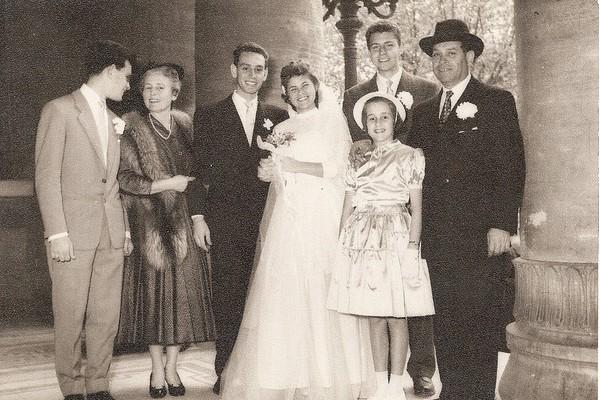
Racheline and Joe Barda at their wedding in Rome in 1957

She was still a schoolgirl, a year away from finishing the Egyptian equivalent of the HSC. “I asked my mother, many years later, how she had allowed me to go on my own to Italy to get married when I didn’t have a passport and had never been outside Egypt before.

“I now know they were scared. The Holocaust was recent history, and they had no idea what was coming next. My father was under house arrest.”

Still, Barda’s parents wanted more than a telegram certifying Joe’s proposal. “Joe’s aunt was still living in Alexandria at that time. So she came to ask my parents if he could have my hand in marriage.”

"Joe’s aunt was still living in Alexandria at that time. So she came to ask my parents if he could have my hand in marriage."

Honour established, the teenager set off - with the wedding dress her mother had made for her - on a terrifying sea voyage to a strange new life.

She had no passport, only a ticket of leave document written in Arabic and French and inspected with much suspicion by Egyptian authorities. “I still have it.”

Today Barda is a lover of “the beautiful Arabic language; we had bad teachers at school”. However, as she left her homeland, the teenager only recognised the French title. 

"Valable pour un seul voyage sans retour,” it read - which Barda translates as: “One way only, never to come back.”

Joining her fiancé in Rome, Barda realised that her once-rich in-laws had lost everything.

Together, the extended family set off by ship for a new life Down Under, following Jewish relatives who had lived in Malta and been allowed to emigrate to Sydney after WW2 because Malta was still “a British colony”.

“We arrived in Australia with just 50 Australian pounds. That was our fortune.”

She left behind a rich, famous history of Jewish life in Egypt. The Book of Exodus relates how the Israelites left slavery under the Egyptian pharaohs thanks to the divinely-inspired leadership of Moses.

“We don’t know if Moses actually led all of the Jews out of ancient Egypt,” the historian admits.  “But we do know there have been Jews in Egypt forever. 

“For a long time, Jews were welcomed in Muslim countries, especially when they were being persecuted by Christians in Europe.

“It was always at the mercy of the Muslim ruler, and the Jews were always second-class citizens. But that was better than being burnt alive in Europe.”

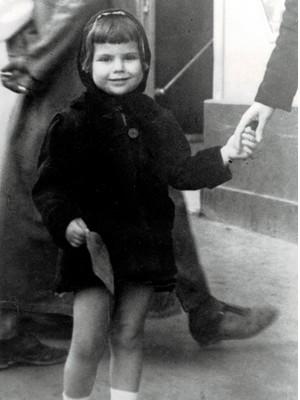
Racheline Barda in Alexandria, aged 3 (supplied)

According to the NSW Jewish Board of Deputies, “nearly one million Jews were expelled from Islamic countries in the 20th century”.

Today, Egypt - once a citadel of Judaic scholarship - has fewer than ten citizens who registered as Jews in the last national census.

Barda’s early years in Sydney were spent raising three kids and working in Snow’s Emporium (a department store on the corner of Liverpool and Pitt streets) and then as a bilingual secretary at the French Chamber of Commerce and other establishments which needed a fluent speaker of French.

Having left school at 17 and arriving as a newlywed in Australia at 19, she always wanted to complete her education. It took many (part time) years at the University of Sydney, studying French and Italian literature, before she earned her doctorate in 2007.

Her academic speciality is documenting the role that Jews have played over the centuries in predominantly Muslim countries on the southern rim of the Mediterranean: Morocco, Algeria, Tunisia and, particularly, Egypt.

Having left school at 17, Racheline always wanted to complete her education. It took many years of part-time study before she earned her doctorate in 2007.

She has also delved into the 1896 uncovering of the 10th century old Cairo geniza and its literary treasures by Solomon Schechter.

Schechter was a professor of Talmudic and Jewish studies at Cambridge University, when two Protestant sisters asked him to decipher scraps of ancient Hebraic documents that they had purchased in Jerusalem, explaining the Jewish antiquarian had said they’d come from the geniza (or storage vault) of Cairo’s main synagogue.

Protected by Egypt’s dry desert air, the documents intrigued the scholar, who realised he was onto the Judaic equivalent of discovering the lost tomb of the “boy Pharaoh” Tutankhamun (which wasn’t revealed for another quarter of a century).

The lion’s share of the geniza's contents were gifted to Cambridge University Library. They have now all been digitalised and are available to scholars and students around the world. “It’s fascinating reading them,” Barda said. “Like history unfolding before you over the centuries.”

The Sydney Jewish Museum holds an annual event, Commemorating the plight of Jews from Arab lands and Iran. This year's event will focus on the 260,000 Moroccan Jews who felt obliged to leave a homeland their ancestors had lived in for centuries.

Commemorating the plight of Jews from Arab lands and Iran, Sydney Jewish Museum, Sunday December 4, 4pm. Free event. Registration essential.

Photo: Racheline Barda with the ticket of leave document that helped her get out of Egypt (Joe Barda)

You might also like
  • From antisemite to ally: the power of friendship
    Elana Benjamin
  • Russia’s campaign against Jewish targets in Europe
    Colin Shindler
  • Tame apologises – but with little grace
    Deborah Stone
logomark.67a07ee3
We believe in the free flow of information

Republish our articles for free, online or in print, by using our Creative Commons licence

You might also like

    Gab
    NewsWorld

    Traditional antisemitic myths dominate online antisemitism: new study

    Deborah Stone
    Eisenkot Herzog
    Israel Votes 2026NewsIsrael

    Diaspora Jews urge Israel’s change bloc to form a Jewish–Arab coalition

    Sharon Offenberger 2
    Blackboard with a hand writing in chalk the words antisemitism, Israel, Holocaust, Zionism, history, culture, religion, bullying
    NewsAustralia

    The first step in antisemitism education: teaching the teachers

    Michael Visontay 4

About the author

Steve Meacham

Steve Meacham

Steve Meacham is a senior features writer whose work has appeared in many Australian and British publications. He has also written several authorised biographies.

More from the author

Australia

‘Never seen anything like this’: Aussies watched war from their balcony

Arts & Culture

Is this show still funny after so many years? Well, it helps if you’re Jewish

FeatureAustralia

Living – and dying – with motor neurone disease: one family’s story

FeatureArts & Culture

A musical about lynching a Jew is striking a new chord