Published: 17 December 2017
Last updated: 4 March 2024
Tripoli-born Dr Rifi, 58, who lives and works in Belmore in Sydney’s western suburbs, says his time in the city was one of great spiritual and emotional nourishment. He visited the Old City, the Souk and prayed at the Al-Aqsa mosque twice. “It is the dream of every Muslim to visit and pray at the mosque,” he says. “I felt like I belonged there, like I had always been there.”
The reason for Dr Rifi’s visit, however, was much more flesh and blood than spiritual. He went to Israel on a fact-finding mission as a member of Project Rozana, an Australian-founded health initiative which also has branches in the US and Canada.
READ Bankstown audience confronted by Muhi’s heartrending story
Founded in 2013 by Melbourne Jewish businessman Ron Finkel AM, Project Rozana was inspired by the story of young Palestinian girl Rozana Salawhi, whose life was saved after her mother took her to the Hadassah Hospital in Jerusalem to treat injuries she sustained after falling from her ninth-floor apartment in her Palestinian village.
It seeks to “build better understanding between Israelis and Palestinians through health”, specifically through three Ts: the training of Palestinian health professionals, the transport of critically-ill Palestinian children from checkpoints in Gaza/West Bank, and their treatment in Israeli hospitals.
“We know we can’t change the system, we try to make a difference,” Dr Rifi explains. “Ordinary people should not sit idle, waiting for politicians to make peace. We need to build civil society and infrastructure so there is a solid foundation for peace.”
I want to send a clear message to my community: let’s go beyond politics to the humanity on the ground. I hope that seeing evidence of this will promote social cohesion in Australia as well.
To this end, Project Rozana has partnered with local Israeli and Palestinian groups, notably Road to Recovery, an acclaimed Israeli NGO that helps patients and their families navigate the logistical hazards of getting to and from checkpoints to cross over into Israel.
The political and logistical challenges are complex, according to Dr Rifi. For example, if a child in Gaza has a condition that requires treatment in Israel, the family must first get permission from Hamas to travel to Israel, then approval from the Palestinian Authority to pay for the costs of their treatment.
After that, the PA has to apply to Israel for security approval. There is a high percentage of rejections at this stage. “Unfortunately, security always takes precedence over medical needs, and Israel is no exception.”
Once they are approved, there are other hurdles. “Sometimes the PA pays for acute care but not rehabilitation care. Rozana will fill the gap between acute and rehab care.”
[gallery columns="2" size="medium" ids="16191,15615"]
Together with delegates from the US and Canada, Dr Rifi met with partner groups including World Vision, the Hadassah Hospital and its Binational School of Psychotherapy, the Augusta Victoria and An Najah hospitals in East Jerusalem and Nablus respectively. Through their meetings, they identified four ways of improving their service:
- arrange for interpreters to be on hand 24/7 for patients - for getting to hospital, negotiating the system, or post-care complications after they return to their village
- more volunteers on the Palestinian side to take carers, typically grandparents, to the checkpoint (the Israelis have 1200 volunteers, including Road to Recovery)
- Training psychologists to treat the specific problems confronting children – PTSD, bullying, anxiety and other psychological issues
- Employing a full-time co-ordinator of Palestinian volunteers to assist parents and carers. Up till now, the role of co-ordinator has been voluntary
For Dr Rifi, this mission carried personal as well as health and community agendas. “I needed to go, to see, to feel what it is like for people and patients.”
I know the political issues are complex but I also know that many Australian are able and willing to assist those sick Palestinian kids.
Thus his visit included meeting a young Palestinian boy Muhi (Muhammad), who had all his limbs amputated due to an auto-immune disease and can only get the treatment he needs at an Israeli hospital. Muhi has had to spend several years living in the hospital with his grandfather, and his heartrending story has been made into a documentary, Muhi - Generally Temporary, which screened to Sydney's Muslim community at Bankstown on December 21, and before that, at the Jewish International Film Festival last month.
[gallery columns="1" size="medium" ids="16291"]
Beyond his physical plight, Muhi’s sense of alienation is complex. He is confused about his identity (he speaks Hebrew not Arabic) and his parents encounter many difficulties in trying to even visit him. “It is a tragedy after tragedy after tragedy,” Dr Rifi says, shaking his head. “But I was struck by the resilience of everyone involved – Muhi’s and his family.”
It is stories like Muhi’s, as well as the broader landscape of co-operation, that Dr Rifi wants to report back to his Australian Lebanese, Muslim and Arab communities, “to show them about the human-to-human interaction over there.
“I want to send a clear message to my community: let’s go beyond politics to the humanity on the ground. I hope that seeing evidence of this will promote social cohesion in Australia as well.
“Friends do not have to agree on everything but they should not fight over trivial matters. I know the political issues are complex but I also know that many Australian are able and willing to assist those sick Palestinian kids.”
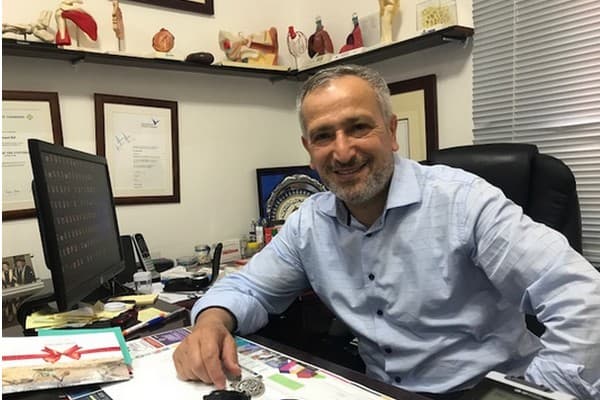
Photo: Dr Jamal Rifi at his Sydney medical practice (Michael Visontay)