Aa
  • Read, Watch, Listen
  • TJI Series
  • Community Action
  • Events
  • Zedi
Follow us and continue the conversation
  • LinkedIn
  • Instagram
  • FaceBook
  • X
  • YouTube
Test yourself with the TJI Quiz!

Adjust size of text

Aa

Follow us and continue the conversation

  • LinkedIn
  • Instagram
  • FaceBook
  • X
  • YouTube

Your saved articles

You haven't saved any articles

What are you looking for?

Original reporting, insightful analysis and diverse views, delivered straight to your inbox

  • LinkedIn
  • Instagram
  • FaceBook
  • X
  • YouTube
Your support fuels our mission to inform, entertain and inspire.

The Jewish Independent is bound by the Standards of Practice of the Australian Press Council. If you believe the Standards may have been breached, you may approach The Jewish Independent or make a complaint to the Australian Press Council in writing at www.presscouncil.org.au. The Council may also be contacted on 1800 025 712.

  • Our Story
  • Contact us
  • Our Team
  • Support us
  • Guidelines
  • Pitch your idea
  • Republishing us
  • Community Action
  • Our Awards
  • LinkedIn
  • Instagram
  • FaceBook
  • X
  • YouTube
Aboriginal FlagTorres Strait Islanders Flag

The Jewish Independent acknowledges Aboriginal and Torres Strait Islander peoples as the Traditional Owners and Custodians of Country throughout Australia. We pay our respects to Elders past and present, and strive to honour their rich history of storytelling in our work and mission.

© The Jewish Independent 2026All Rights Reserved
Website design and development by Your Creative, MelbourneTerms & ConditionsPrivacy Policy
HomeRead, Watch, ListenArts & Culture
FeatureArts & Culture

The house that Lehman built: a saga of family, greed and capitalism unhinged

Miriam Cosic
Print this
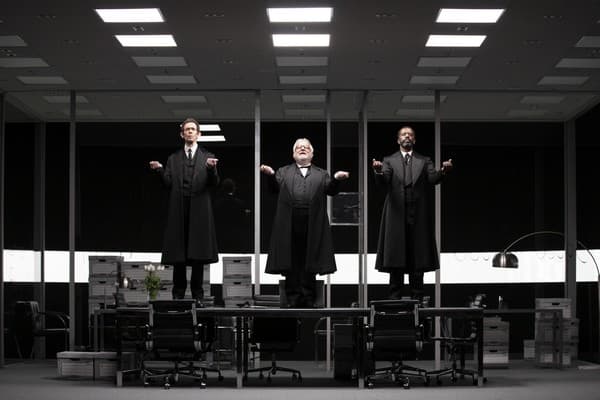
Lehman 2020 production 2

The cast of the 2020 New York production (supplied)

Published: 27 February 2024

Last updated: 21 March 2024

The Lehman Trilogy, a morality tale about the Global Financial Crisis, opens this week in Sydney. MIRIAM COSIC gets a primer on the Jewish roots of a fallen giant.

He had been dreaming of America. Three brothers, travellers, immigrants. They came with nothing. Not even a word of English. And they built an entire universe. – The Lehman Trilogy

One might think that the world of finance – all those dry terms and endless rolls of numbers – would be the last thing to make exciting theatre. Let alone the verbiage of the Great Financial Crisis (GFC) of 2008, with its subprime mortgages, securitisation and credit default swaps.

Yet Italian playwright Stefano Massimo was inspired by the enormity of the GFC itself. He thought long and hard about it and narrowed down on the collapse of the Lehman Brothers investment bank. The result was a five-hour piece of theatre that staggered its public. It took more than three years to write and has since been translated into a dozen languages.

“In the collapse of the bank, Massini, 42, wanted to find answers to how we got to where we are,” Francesca Angelini wrote in The Times of London in 2018. And the foundation story of Lehman, he discovered a devastating catalogue of human ambition and weakness: family, consumerism, the birth of a superpower, neurosis, immigration, religion.

Its pared-down Anglophone version, The Lehman Trilogy, adapted by English playwright Ben Power and directed by the renowned Sam Mendes to rave reviews and multiple awards during the five years it has been touring the world, opens in Sydney this Friday.

The actors who play the brothers are Aaron Krohn, Howard Overshown and Adrian Schiller, switching between dozens of side characters of all ages and with all kinds of accents as they go along.
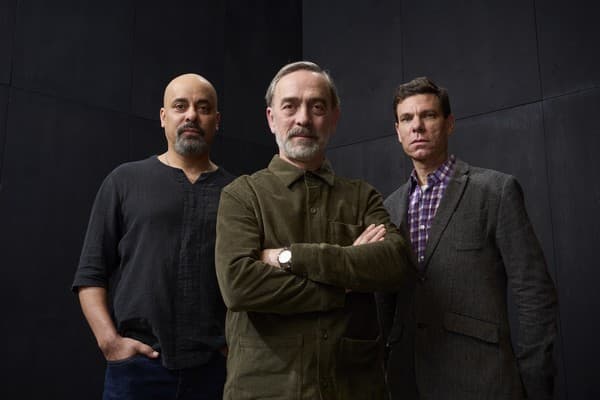
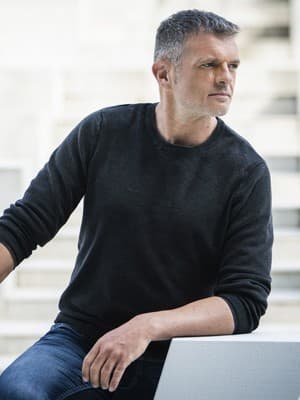
Three key personnel from the production – Power, Schiller, an English Jew, and Daniel Epstein, an Orthodox rabbi from London who advised on everything from the proper pronunciation of 19th century Hebrew to the nuances of Jewish ethics and morality – joined The Jewish Independent for a chat in advance of the opening.

“That’s the bit we don’t do,” Power and Schiller point out in unison when I bring up the staggering events of 2008 at the start of our conversation.

“But it’s the bit I thought of first,” Power continues. “I thought that was going to be it: the financial crisis, the subprime mortgages, the bankruptcy, and the end of the bank. And I think when Stefano Massini began thinking about it back in 2010, he wanted to answer the question ‘What happened in 2008?’ Why is the bankruptcy of this firm in New York causing ruptures around the world? What is this system, so interconnected that a tremor over here can cause ruptures over here.

The Australian production cast: from left, Howard Overshown, Adrian Schiller, Aaron Krohn

“In order to answer that question, he started pulling at the thread of the company and it took him all the way back to 1844, the moment when Henry Lehman, whom Adrian is playing now in Sydney, steps off a boat and onto a dock at New York Harbour and begins a journey into the new country of America and into the founding of these systems of finance and governance that still run the world.”

Repeated themes run through the piece, including the metaphor of fireworks that appeals to Schiller. “In a sense, the story is like a firework,” he says. “It starts off as this beautiful thing, it takes flame, it bursts into the air. Then it just disappears; it’s gone. And that’s sort of what happens with this.

“It starts with something that’s very grounded, very solid, and then the activities, as they progress through the decades, become less and less easy to understand what it is. Until eventually it doesn’t even understand itself and it disappears.”

The story is like a firework. It takes flame, it bursts into the air. Then it just disappears.

That is the story of capitalism too. It has been fireworks all the way, if we look past the deadening pall of the discipline of economics. Its endless growth and momentary explosions: 1929 seemed as deadly as 2008 did, with its stock market crash and run on the banks in the US. And now, after 2008, the highest-flying companies are spiralling into the ether again.

The Greek economist Yanis Varoufakis coined the term which is the title of his latest book: Technofeudalism: What Killed Capitalism. As one unsympathetic entrepreneur has pointed out, Elon Musk was worth $US2 billion in 2012 and $US204 billion today; Jeff Bezos had $18 billion in 2012 and $196 billion today. And the US Federal minimum wage in 2012 was $7.25; in 2024 it’s still $7.25.

Which bring us to the morality tale at the core of The Lehman Trilogy and Epstein’s advisory role on it. “Jonathan Sacks, who was the former chief rabbi of the United Kingdom, has this concept of the morality of the markets,” he says.

Italian playwright Stefano Massini, who wrote the original
Ben Power, who adapted Massini's play into English

“In other words, when you are trading, it has to be on moral grounds. Money is not the goal, it’s the means, and with wealth you have a responsibility to do something for the good of society.

“Judaism has an entire welfare, a free-loan system that still exists within the ultra-Orthodox communities. If you need a house, they will lend you the money for a down payment. You pay it back later and, if you can’t, someone else will,” Epstein explains.

“There’s a constant sense of mutual assistance born out of the centuries of persecution of the Jews in Europe, when they were excluded from guilds and professions. Finance was one way they were allowed to operate, and they excelled at it.

“It was a key way in which you managed to work out how to trade, how to maintain yourself, your family, community, all these things, within all the limitations. You help each other. And you don’t engage with a sense of philanthropy. It's collective assistance.”

when you are trading, it has to be on moral grounds. Money is not the goal, it’s the means.

An example of that breakdown in morality during the 20th century, even within the Jewish business world, came in the distance travelled between 1929 and 2008. In 1929, a lot of banks collapsed completely because their shares were worth nothing. They had reserves and they could have lent to each other: Lehman refused when JP Morgan asked for help.  

Come 2008 and JP Morgan was more stable than Lehman Brothers and Lehman Brothers asked for help.  JP Morgan refused, simply saying, “1929”.

The play is drenched in Jewish culture. Epstein told the Jewish News in London of a particularly moving response of Jewish people in the audience there. All three actors get to say Kaddish, the Jewish memorial prayer for the dead. In the run at the National Theatre, Adam Godley was the only Jewish actor, and had lost his father a few weeks earlier.

“I got very emotional when I heard this and told him that when he recited the Kaddish on stage, it was likely that Jewish audience members would instinctively respond ‘amen.’ In a theatre of more than 1,000, a minyan was virtually guaranteed, which meant Godley would be fulfilling the mitzvah of saying Kaddish for his father, several nights a week.”

And the audience did.

The Lehman Trilogy opens at the Theatre Royal in Sydney on Friday, March 1.

You might also like
  • Antisemitism, homophobia and a radical response to both
    Dennis Altman
  • Facing a new year with the knowledge life can be better
    The Jewish Independent
  • Was the barmi a shemozzle? How Australians use Jewish words 
    Caroline Hendy & Emma Breslow
logomark.67a07ee3
We believe in the free flow of information

Republish our articles for free, online or in print, by using our Creative Commons licence

You might also like

    Article Image
    FeatureArts & Culture

    What to see at the 2026 Jewish International Film Festival

    Kathy Laster
    haredi street guitar
    Photo EssayArts & Culture

    Jerusalemites through the lens

    Sharon Gabay
    Wake main 2nd
    FeatureArts & Culture

    New ‘spoken word’ festival in Sydney offers stories directly from creators

    Miriam Hechtman

About the author

Miriam Cosic

Miriam Cosic

Miriam Cosic is a Sydney-based journalist and a former arts and a former literary editor. She is the author of two books.

More from the author

InterviewArts & Culture

A Jewish writer’s Indigenous ‘everyboy’

World

Jewish museums: from treasure box to forum for dialogue

Arts & Culture

Too much Holocaust fiction – and too loose with the facts

Comments

No comments on this article yet. Be the first to add your thoughts.