Aa
  • Read, Watch, Listen
  • TJI Series
  • Community Action
  • Events
  • Zedi
Follow us and continue the conversation
  • LinkedIn
  • Instagram
  • FaceBook
  • X
  • YouTube
Test yourself with the TJI Quiz!

Adjust size of text

Aa

Follow us and continue the conversation

  • LinkedIn
  • Instagram
  • FaceBook
  • X
  • YouTube

Your saved articles

You haven't saved any articles

What are you looking for?

Original reporting, insightful analysis and diverse views, delivered straight to your inbox

  • LinkedIn
  • Instagram
  • FaceBook
  • X
  • YouTube
Your support fuels our mission to inform, entertain and inspire.

The Jewish Independent is bound by the Standards of Practice of the Australian Press Council. If you believe the Standards may have been breached, you may approach The Jewish Independent or make a complaint to the Australian Press Council in writing at www.presscouncil.org.au. The Council may also be contacted on 1800 025 712.

  • Our Story
  • Contact us
  • Our Team
  • Support us
  • Guidelines
  • Pitch your idea
  • Republishing us
  • Community Action
  • Our Awards
  • LinkedIn
  • Instagram
  • FaceBook
  • X
  • YouTube
Aboriginal FlagTorres Strait Islanders Flag

The Jewish Independent acknowledges Aboriginal and Torres Strait Islander peoples as the Traditional Owners and Custodians of Country throughout Australia. We pay our respects to Elders past and present, and strive to honour their rich history of storytelling in our work and mission.

© The Jewish Independent 2026All Rights Reserved
Website design and development by Your Creative, MelbourneTerms & ConditionsPrivacy Policy
HomeRead, Watch, ListenArts & Culture
FeatureArts & CultureWorld

The Jewish museum in Italy founded and run by non-Jews

There are no Jews left in the Lecce but someone in the city cares deeply about them.
Michael Visontay
Print this
Lecce Jewish museum

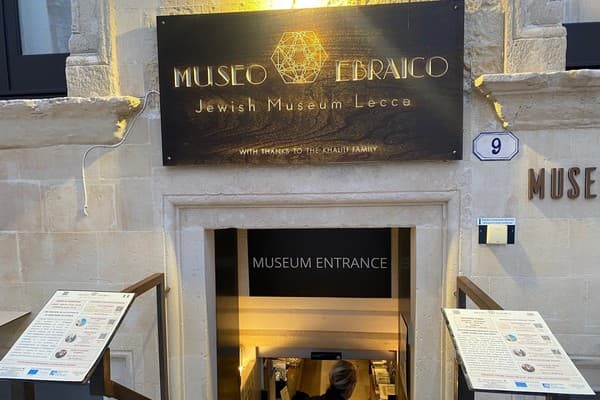
Entrance to the Jewish Medieval Museum of Lecce (Michael Visontay)

Published: 5 December 2024

Last updated: 5 December 2024

In a time when Jews around the world are feeling very unloved, the Italian city of Lecce provides a paradoxical source of comfort.

On one hand, there are no Jews left. Zero. They were driven out in the 15th century and did not return. Yet their presence in this beautiful centre of southern Puglia remains alive and visible thanks to a fascinating Jewish museum that was founded and is run by non-Jews from the city.

The Jewish Medieval Museum of Lecce is the passion project of a local tourist agency owner, Michelangelo Mazzotta, who bought a house in the Via della Sinagoga in 2009. The name of the street intrigued Mazzotta, prompting him to start researching the history of the precinct. After discovering that his new house was located in the old Giudecca (Medieval Jewish district), Mazzotta decided to deepen his involvement with the city’s Jewish past.

Together with his daughter, and a pair of friends, Mazzotta rented part of a building in the old Giudecca and converted its underground area into a museum to preserve and showcase the forgotten Jewish history of medieval Lecce to the hordes of tourists who now flock to Puglia every summer to enjoy its stunning beaches, food and fashion.
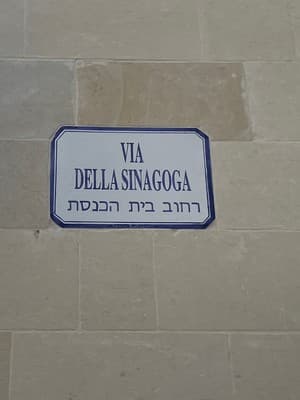
Street sign showing site of the synagogue
<strong>Entrance to Michelangelo Mazzotta's BnB</strong>
Entrance to Michelangelo Mazzotta's BnB

Mazzotta brought in a professor of Hebrew language from a local university to create a permanent exhibition for the new museum, which opened in 2016, adding a new cultural dimension to the city known as the “Florence of the South” because of its beautiful churches and architecture.

One of Lecce’s chief attractions is the Basilica di Santa Croce, a breathtaking example of baroque architecture that draws gasps from tourists through the rich decorations packed onto its brilliant white stone façade. When the afternoon sun bathes the facade in a warm yellow light, it is spellbinding.

Few of them would realise, however, that the church was built on the site of what once was the Giudecca synagogue, a deliberate decision by Lecce’s Catholic 16th-century leaders to obliterate any vestige of the Jewish community’s presence in the city.

The museum sits adjacent to the cathedral, attracting up to 200 tourists each day during summer, our guide told us, for a tour that combines virtual reality exhibits with an exploration of the old Jewish precinct, delivering a familiar tale of prosperity and victimisation, warts and all.

Lecce had one of the most prominent Jewish settlements in the Kingdom of Naples before the expulsion of the Jews. Their occupations were mostly textile dyeing (silk and wool), cattle-raising and moneylending, as they were not allowed to own real estate or engage in occupations closer to the court.

The first documented proof of a Jewish community in the city dates back to the 14th century, and their number increased between 1384 and 1446 under the protection of Lecce’s ruling countess, Maria d’Enghien. But around 1440 the countess hardened her attitude towards the Jews, in line with the Pope’s Fourth Council of the Lateran.

Basilica of Santa Croce, deliberately built on the site of the synagogue

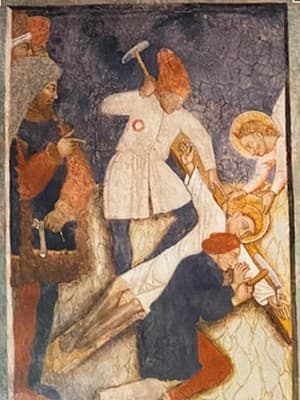
One of the results of this change was that in 1445 the Jews of Lecce were forced to wear a small red cloth badge, in the shape of an “O”, to distinguish them from other citizens. The “badge” can be seen on several 15-century Salentine (local Salerno) paintings. In today’s parlance, it was an early form of what we now call doxing.

Painting showing the red O the Jews were forced to wear

However, the Jews still enjoyed protection under the law and appeared to have avoided persecution until the last Count of Lecce, Giannantonio del Balzo-Orsini, died in 1463. With his death, the city came under the direct rule of Ferdinand the 1st, King of Aragon, there was an outbreak of violence against the Jews. During this time the ghetto was sacked, a number of Jews were killed, and the remainder driven away.

All of this is explained in the museum, which explores the everyday life of the Jewish community in Puglia between the ninth and fifteenth centuries. Some elements were excavated from the ghetto - such as a mezuzah or scriptures in Latin or Hebrew. The museum also contains the remnants of a  mikveh, which was discovered under the building.

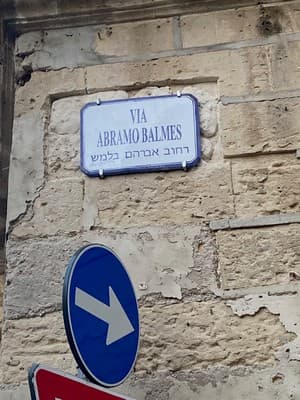
Sign showing where Jewish physician Abramo Balmes lived
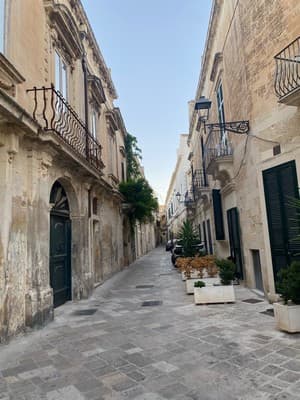
The medieval Jewish quarter's main street
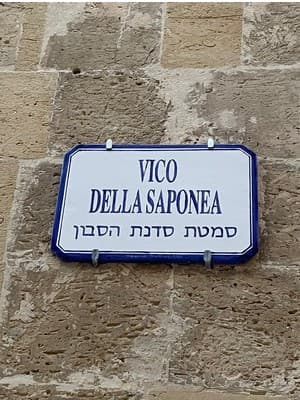
Where Jewish soap-makers worked

In In the city itself, the only obvious signs of the community’s existence from medieval times are the names of nearby streets. Via della Sinagoga, Via Abramo Balmes (in homage to the Jewish physician born in Lecce) and Vico della Saponea (soap makers, the principal activity of Jews in Lecce).

Lecce did have some more recent Jewish residents, albeit briefly, during World War 2, when a Displaced Persons camp was set up in the city. Some who later migrated to Israel returned to the city and their stories, together with clips from a documentary about them, provide a moving reminder of another chapter in Lecce’s Jewish history.

All of this history would have remained buried under the church had it not been for Michaelangelo Mazzotta, who looks for any opportunity to remind visitors of the city’s Jewish roots. In addition to the museum, he runs a bed and breakfast in the Via Sinagogia, and the sign carries his name in Roman and Hebrew lettering.

There may be no Jews left in Lecce but it is comforting to know someone in the city is looking out for them.

All photos by Michael Visontay

You might also like
  • Antisemitism, homophobia and a radical response to both
    Dennis Altman
  • Facing a new year with the knowledge life can be better
    The Jewish Independent
  • Was the barmi a shemozzle? How Australians use Jewish words 
    Caroline Hendy & Emma Breslow
logomark.67a07ee3
We believe in the free flow of information

Republish our articles for free, online or in print, by using our Creative Commons licence

You might also like

    Article Image
    FeatureArts & Culture

    What to see at the 2026 Jewish International Film Festival

    Kathy Laster
    Ms. Foundation Women of Vision Awards: Celebrating Generations of Progress & Power
    ReflectionWorld

    My memory of Gloria Steinem

    Michael Visontay
    bialik Jewish schools shabbat
    OpinionAustralia

    Jewish schools are the marinade that infuses continuity

    Jeremy Stowe-Lindner

About the author

Michael Visontay

More from the author

NewsAustralia

Matt Chun’s hate speech prompts change in arts funding policy

AnalysisAustralia

Mishandled antisemitism education is not just ineffective, it’s dangerous

FeatureLifestyle

Where Shtisel meets The Jetsons

ReviewIsrael

Beinart’s utopian vision ignores awkward truths

Comments1

  • Avatar of Fred Morgan

    Fred Morgan5 December at 10:57 pm

    Fascinating ethnographic article, Michael. It’s quite uplifting. I’m leading a “Shalom Mediterranean Isles” tour next year which includes Sicily and also Puglia. We’ll be sure to visit this museum!