Aa
  • Read, Watch, Listen
  • TJI Series
  • Community Action
  • Events
  • Zedi
Follow us and continue the conversation
  • LinkedIn
  • Instagram
  • FaceBook
  • X
  • YouTube
Test yourself with the TJI Quiz!

Adjust size of text

Aa

Follow us and continue the conversation

  • LinkedIn
  • Instagram
  • FaceBook
  • X
  • YouTube

Your saved articles

You haven't saved any articles

What are you looking for?

Original reporting, insightful analysis and diverse views, delivered straight to your inbox

  • LinkedIn
  • Instagram
  • FaceBook
  • X
  • YouTube
Your support fuels our mission to inform, entertain and inspire.

The Jewish Independent is bound by the Standards of Practice of the Australian Press Council. If you believe the Standards may have been breached, you may approach The Jewish Independent or make a complaint to the Australian Press Council in writing at www.presscouncil.org.au. The Council may also be contacted on 1800 025 712.

  • Our Story
  • Contact us
  • Our Team
  • Support us
  • Guidelines
  • Pitch your idea
  • Republishing us
  • Community Action
  • Our Awards
  • LinkedIn
  • Instagram
  • FaceBook
  • X
  • YouTube
Aboriginal FlagTorres Strait Islanders Flag

The Jewish Independent acknowledges Aboriginal and Torres Strait Islander peoples as the Traditional Owners and Custodians of Country throughout Australia. We pay our respects to Elders past and present, and strive to honour their rich history of storytelling in our work and mission.

© The Jewish Independent 2026All Rights Reserved
Website design and development by Your Creative, MelbourneTerms & ConditionsPrivacy Policy
HomeRead, Watch, ListenIsrael
Israel Hamas WarFeatureIsrael

The Palestinians and Israelis who won’t give up on one another

Now more shared trauma therapy than dialogue, the Sulha Peace Project in Jerusalem is one of the few interfaith projects that has survived October 7 and the Israel-Hamas War.
Ittay Flescher
Print this
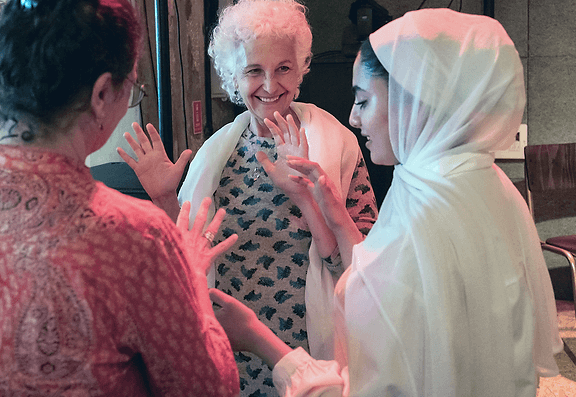
Women, one wearing a hijab, reaching out to one another

Participants in the Sulha Peace Project (Sulha)

Published: 18 March 2024

Last updated: 21 March 2024

At a time when interfaith dialogue programs bringing together Jews, Muslims and Christians have collapsed in so many places from Melbourne to Manhattan, there is one city where it’s still possible to bring people together who care deeply about the wellbeing of both Israelis and Palestinians. That place is Jerusalem.

Since October 7, the Sulha Peace project has brought together hundreds of people at regular bi-weekly meetings for an experience that goes far beyond dialogue. Having attended several of the meetings myself, it’s more accurate to describe these gatherings as a cross between trauma therapy and collective healing than interfaith dialogue.

Our primary aim is to humanise everyone. Our listening circles are not about arguments, and we have strict rules to prevent that

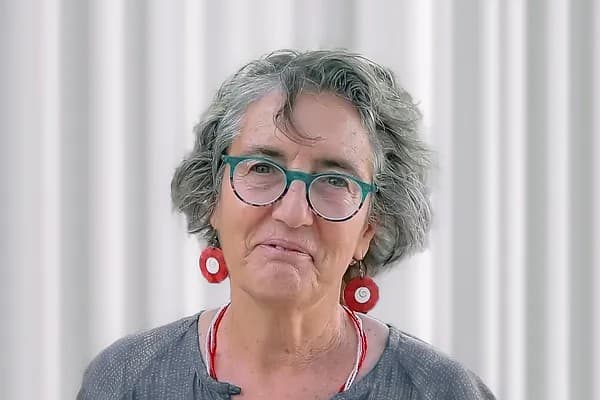
Dr Melila Hellner-Eshed

Each gathering opens with gentle music played on an acoustic guitar, a candle lighting ritual where all are welcome to make blessings or intentions for the coming hours, and a facilitated dialogue space in both a large circle and small groups. Topics include:

Name one person whose memory you would like to honour tonight.

What is deepest prayer, and deepest sadness?

What is something new that you have noticed in yourself?
When did you first meet “the other”?

And most simply, “why did you come here tonight?”

In one activity, participants where asked, “What does that dark place you afraid of look like?” They were then given plasticine to build the dark place, and then had to work with a partner on building a bridge to get out of the dark place together.

Every person is welcomed to speak in the language most comfortable to them, followed by a translation into either Arabic or Hebrew for the rest of the room. The Sulha is a place where the enmity and hatreds that are so prevalent in Jerusalem can disappear for two hours.

Sulha is a traditional Arab method of solving violent dispute. The word means “to make peace” or “reconciliation” in Arabic. It is a term signifying an agreement or settlement.

The Sulha was founded in the early days of the Second Intifada by Gabriel Meyer Halevy and Elias Jabour. Gabriel, a Jewish Argentinian-born Israeli, was devastated by the eruption of violence across his new homeland in 2000 and reached out to Elias – a veteran Palestinian Israeli peacemaker and author.

Gabriel shared with Elias his thoughts about creating a new initiative inspired by the age-old Sulha process with the aim of rebuilding trust, restoring dignity, and moving beyond the political agenda.

Dr Melila Hellner-Eshed, a professor of Jewish Mysticism at the Hartman Institute in Jerusalem and the current chair of the Sulha steering committee, spoke to The Jewish Independent about the state of the Sulha since the war. I began our conversation by asking her why Sulha was able to keep meeting when so many other interfaith dialuage groups had fallen apart.

Dr Melila Hellner-Eshed

“The reason we were able to continue meeting was because we had built years of trust between one another before October 7,” she said, adding that it was the strength of the personal connections that gave them the resilence to stay together.

In times of crisis, people feel an even greater desire to come together and create  an island of normality in  societies that can only see violent solutions as their path to a secure and peaceful future.

“The Sulha is about spiritual activism, not narratives,” Hellner-Eshed explained. “It’s centred around our ability to meet as humans created in image of God. The encounter is not about justice or trying to write some kind of political statements. Our primary aim is to humanise everyone. Our listening circles are not about arguments, and we have strict rules to prevent that.”

In one of the circles I attended, an Arab woman shared her fear that after October 7, the Israeli government may be expel her from her home in Jabel Mukaber, a Palestinian neighbourhood in East Jerusalem. An Israeli man then expressed concern for his child serving as a soldier in the IDF. Neither asked questions of one another, but both held the space for their fears.

An elderly woman wearing a hijab told the group that five members of her husband’s family had been killed in Gaza that week. She spoke slowly and from her heart about how she asked the survivors of the attack if they were ok with her coming to meet with Jews the following night. “Yes” they said. “Please do anything you can to help us have a better future.” Her story left many people in the room visibly moved.

Over the years, both the physical and metaphorical walls have grown higher between Israelis and Palestinians. Sulha helps make small cracks in these walls. That said, no one in the Sulha thinks the movement will bring peace, as they all know that this can only come through a political process, not friendship or empathy.

Political solutions will only happen when leaders feel they serve both their own personal interest and those of the people they represent. Sadly, such leaders are nowhere in sight. In the meantime, the Sulha is trying to lay the groundwork for the day when they emerge. It continues to cultivate hearts, to be a place where people can come together, in sadness and in love, celebrating and mourning both the holy and the broken.

You might also like
  • ‘Israel is systemically eliminating Palestinian collective life’:  B’Tselem
    Deborah Stone
  • Tame apologises – but with little grace
    Deborah Stone
  • Confronting Richard Flanagan and the myth of the Israel lobby
    Mary Garden
logomark.67a07ee3
We believe in the free flow of information

Republish our articles for free, online or in print, by using our Creative Commons licence

You might also like

    Segalovitz Abbas
    Israel Votes 2026AnalysisIsrael

    Segalovitz decision to join Arab party is a paradigm change for Israel

    Eetta Prince-Gibson
    Yoav Segalovitz Mansour Abbas
    Israel Votes 2026OpinionIsrael

    Because of my Zionist values, I’m joining an Arab party

    Yoav Segalovitz 1
    haredi street guitar
    Photo EssayArts & Culture

    Jerusalemites through the lens

    Sharon Gabay

About the author

Ittay Flescher

Ittay Flescher

Ittay Flescher is the Jerusalem Correspondent for The Jewish Independent. For over twenty years, he has worked as an educator, journalist, and peacebuilder in Melbourne and Jerusalem. His book, The Holy and the Broken: A Cry for Israeli-Palestinian Peace from a Land that Must Be Shared, was longlisted for the 2025 Walkley Book Awards.

More from the author

AnalysisIsrael

What ‘Zionism’ means in Israel:  it’s not what you think

AnalysisIsrael

From haven to hotbed: how Israel’s perception of Australia has changed

FeatureIsrael

New wave of Russian-speaking migrants may be key to Israel’s future

AnalysisIsrael

How a new International Peace Fund could make a tangible difference

Comments

No comments on this article yet. Be the first to add your thoughts.