Aa
  • Read, Watch, Listen
  • TJI Series
  • Community Action
  • Events
  • Zedi
Follow us and continue the conversation
  • LinkedIn
  • Instagram
  • FaceBook
  • X
  • YouTube
Test yourself with the TJI Quiz!

Adjust size of text

Aa

Follow us and continue the conversation

  • LinkedIn
  • Instagram
  • FaceBook
  • X
  • YouTube

Your saved articles

You haven't saved any articles

What are you looking for?

Original reporting, insightful analysis and diverse views, delivered straight to your inbox

  • LinkedIn
  • Instagram
  • FaceBook
  • X
  • YouTube
Your support fuels our mission to inform, entertain and inspire.

The Jewish Independent is bound by the Standards of Practice of the Australian Press Council. If you believe the Standards may have been breached, you may approach The Jewish Independent or make a complaint to the Australian Press Council in writing at www.presscouncil.org.au. The Council may also be contacted on 1800 025 712.

  • Our Story
  • Contact us
  • Our Team
  • Support us
  • Guidelines
  • Pitch your idea
  • Republishing us
  • Community Action
  • Our Awards
  • LinkedIn
  • Instagram
  • FaceBook
  • X
  • YouTube
Aboriginal FlagTorres Strait Islanders Flag

The Jewish Independent acknowledges Aboriginal and Torres Strait Islander peoples as the Traditional Owners and Custodians of Country throughout Australia. We pay our respects to Elders past and present, and strive to honour their rich history of storytelling in our work and mission.

© The Jewish Independent 2026All Rights Reserved
Website design and development by Your Creative, MelbourneTerms & ConditionsPrivacy Policy
HomeRead, Watch, ListenAustralia
Australia

Vale Brian Sherman, “an exemplary human being”

Steve Meacham
Print this

Published: 16 September 2022

Last updated: 5 March 2024

Brian Sherman was a man for all seasons: immigrant, multi-millionaire, company director, philanthropist and finally, a victim of Parkinson’s Disease.

Sherman, who died last weekend aged 79, arrived in Australia with his wife Gene in 1976 from Apartheid-era South Africa with just $5000 between them. A few years later, with his cousin Laurence Freedman, founded EquitiLink, in 1981, parlaying a $5000 investment into a $5.5 billion funds management business.

As a company director, he later helped save the Ten Network when it seemed doomed.

And as a philanthropist, for which he was perhaps best known in the latter stages of his rich and varied life, Sherman revived the fortunes of the Australian Museum - the oldest institution in the country - while he and Gene “gave away” some of the ground-breaking contemporary paintings, sculptures and ceramics they had collected.

In recent years, Sherman fought a long and public battle with Parkinson’s Disease. His memoir about the experience, Walking Through Honey, remains arguably the best page-by-page epistle into a degenerative disease written by a sufferer of that disease.

Lastly, but by no means least, Brian Sherman was a husband, father and grandfather.

Sherman’s funeral service was held at the Emmanuel School (which he helped found) on Tuesday, followed by a private burial at Macquarie Park cemetery.

In May, Gene talked to the Australian Financial Review about how they had met in South Africa as students. At the time Brian was the beau of one of Gene’s cousins. But in those days - in the wake of the Soweto uprisings and before Nelson Mandela was released from Robben Island - they forged a romantic relationship which lasted a lifetime, though it meant fleeing the country of their birth.

“We gather here to honour an exemplary human being,” said Rabbi Jeffrey Kamins at the funeral oration. "Brian embraced this work to improve the world with a fullness of heart, mind and body, spurred on (by) …his fabulous success in business, achieved with his incredible physical and mental stamina, his strategic insight, self-assurance and dogged determination.”
Brian and Gene have two extraordinarily successful children. Emile is one of Australia’s most lauded film producers (The King’s Speech, Lion, The Power of the Dog), while Israeli-based daughter Ondine is co-founder (with her late father) of Voiceless, the “vegetarian” charity devoted to humane animal husbandry.

Brian was a husband of enormous passion and energy. Wife Gene was a linguist and scholar when they arrived in Sydney, but later embraced her greater love, contemporary art, thanks to Brian’s enormous wealth and his shared passion. 

Together they opened the Sherman Galleries in Sydney’s Eastern Suburbs, championing some of first Australian exhibitions by the likes of performance artist Stelarc and Chinese dissident Ai Weiwei.

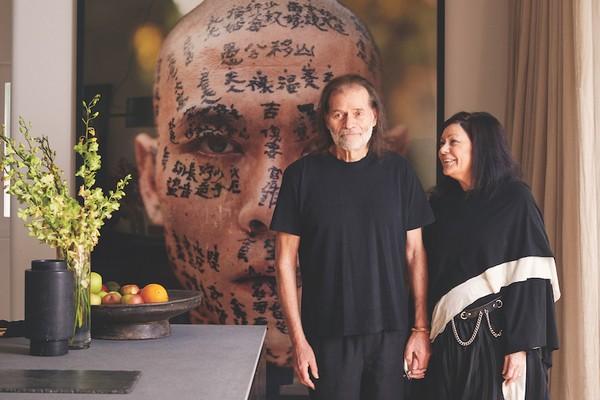
“Brian always had a great eye”, Gene told the AFR. It was never better demonstrated than in 2004 when the couple walked into Sydney’s Museum of Contemporary Art and saw Zhang Haun’s nine-piece Family Tree series - monumental photo media images of the artist’s head increasingly covered in calligraphic marks - for the first time. 

Brian and Gene Sherman (Nick de Lorenzo)

“Brian whispered, ‘We should buy the entire show,” Gene said, gesturing towards the striking images which adorn the "kitchen/diner" at their final home in Centennial Park. 

“Years later, the Pompidou Centre bought another set from the same edition. He’s now had a solo exhibition at the legendary Hermitage Museum in St Petersburg.”

Apart from his many other accomplishments - including playing highly competitive weekly tennis with friends Edmund Capon (the late director of the Art Gallery of NSW) and Jim Spigelman (the former chief justice of NSW) - Brian also chaired the board of the Australian Museum.

Having served as the financial director of the 2000 Sydney Olympic Games, helping to make it the least lasting debt in Olympic history, Brian then took an equally poisoned chalice. 

(He’d also ensured the 11 Israeli athletes murdered in the Munich Olympics by Palestinian terrorists in 1972 were paid due respects.)

Brian and Gene Sherman

The oldest cultural institution in the country, the Australian Museum, was in a poor shape when its new chairman walked in. In 2020, already suffering from Parkinson’s Disease though he didn’t know it, Brian told the Sydney Morning Herald he was disgusted by the “Dickensian state” world-class scientists had to work in.

"Offices with no windows” he told the Herald. “No ventilation. It wasn't a museum of any panache.”

Three terms later, Sherman had overseen a complete transformation. Panache the Australian Museum now has in spades.

Museum director and chief executive Kim McKay named the museum’s Crystal Hall after the Shermans, citing at least $1 million in family donations plus around $100 million in government and corporate contributions during Brian’s watch.

For all of that, perhaps Brian Sherman’s most unique contribution to Australian society was his heroic struggle against Parkinson’s Disease.

The diagnosis was many years in the making. He knew something was seriously wrong, but doctors digressed. By the time Parkinson’s was diagnosed, it was too late.

Like everything else in his life, Brian confronted the challenge head-on. He named his best-selling memoir Walking Through Honey - a phrase Gene’s father had used to explain how he felt when he, too, was fighting Parkinson’s back in South Africa.

You might also like
  • Vale Jeremy Jones, Jewish communal and interfaith leader
    Deborah Stone
  • A tribute to Mark Baker
    Ralph Genende
  • Meir Shalev, beloved Israeli novelist, dies at 74
    TJI Pick
logomark.67a07ee3
We believe in the free flow of information

Republish our articles for free, online or in print, by using our Creative Commons licence

You might also like

    Eisenkot Netanyahu
    AnalysisAustralia

    Could the West be regained by an Eisenkot coalition?

    Dean Sherr 2
    Eva Geller
    Australia

    Bondi victim dies after almost 11 months fighting

    The Jewish Independent
    Yitzhak Yedid
    InterviewArts & Culture

    Finding hope in the Valley of the Dry Bones

    Jarod Rhine-Davis

About the author

Steve Meacham

Steve Meacham

Steve Meacham is a senior features writer whose work has appeared in many Australian and British publications. He has also written several authorised biographies.

More from the author

Australia

‘Never seen anything like this’: Aussies watched war from their balcony

Arts & Culture

Is this show still funny after so many years? Well, it helps if you’re Jewish

FeatureAustralia

Living – and dying – with motor neurone disease: one family’s story

FeatureArts & Culture

A musical about lynching a Jew is striking a new chord