Aa
  • Read, Watch, Listen
  • TJI Series
  • Community Action
  • Events
  • Zedi
Follow us and continue the conversation
  • LinkedIn
  • Instagram
  • FaceBook
  • X
  • YouTube
Test yourself with the TJI Quiz!

Adjust size of text

Aa

Follow us and continue the conversation

  • LinkedIn
  • Instagram
  • FaceBook
  • X
  • YouTube

Your saved articles

You haven't saved any articles

What are you looking for?

Original reporting, insightful analysis and diverse views, delivered straight to your inbox

  • LinkedIn
  • Instagram
  • FaceBook
  • X
  • YouTube
Your support fuels our mission to inform, entertain and inspire.

The Jewish Independent is bound by the Standards of Practice of the Australian Press Council. If you believe the Standards may have been breached, you may approach The Jewish Independent or make a complaint to the Australian Press Council in writing at www.presscouncil.org.au. The Council may also be contacted on 1800 025 712.

  • Our Story
  • Contact us
  • Our Team
  • Support us
  • Guidelines
  • Pitch your idea
  • Republishing us
  • Community Action
  • Our Awards
  • LinkedIn
  • Instagram
  • FaceBook
  • X
  • YouTube
Aboriginal FlagTorres Strait Islanders Flag

The Jewish Independent acknowledges Aboriginal and Torres Strait Islander peoples as the Traditional Owners and Custodians of Country throughout Australia. We pay our respects to Elders past and present, and strive to honour their rich history of storytelling in our work and mission.

© The Jewish Independent 2026All Rights Reserved
Website design and development by Your Creative, MelbourneTerms & ConditionsPrivacy Policy
HomeRead, Watch, ListenArts & Culture
FeatureArts & CultureZedi

Hip hop Anne Frank ignites debate over taste and trauma

An off-Broadway show that reimagines Anne Frank as a Latin pansexual can be seen variously as a comment on antisemitism or as antisemitic itself.
Tori Greene
Print this
Slam-Frank

(Credit: Jasper Lewis/Slam Frank)

Published: 21 January 2026

Last updated: 17 February 2026

Slam Frank is a new off-Broadway Afro-Latin hip hop musical about Anne Frank. Yes, you read that right. Slam Frank. Anne Frank. Hip hop. Are you offended? Many people are. The show is brilliant, offensive, jarring, Jewish, chaotic, and triggering, and it has ignited a fierce debate across Jewish communities about taste, trauma, and who gets to decide what is sacred, at a moment when simply being Jewish already feels fraught. 
 
The idea for the show emerged from a viral Twitter thread in 2022, where users debated whether Anne Frank ever acknowledged her “white privilege.” Jews were not white to the Nazis; quite the opposite. Slam Frank takes that collapse seriously, building an entire theatrical world out of contemporary absurdity.  

The show imagines how a progressive community theatre company obsessed with identity politics might reimagine Anne Frank’s story into something intersectional, multiethnic, genderqueer, decolonized, and empowering. Except for the first few minutes, when the director of the fictional theatre company steps onstage to introduce the production, the entire performance unfolds as a show within a show. Slam Frank is ultimately less about Anne Frank herself than about the contemporary frameworks through which her story is retold and sometimes distorted. 

This is not a show for the easily offended. The program explicitly acknowledges Trey Parker and Matt Stone, the creators of South Park and The Book of Mormon, situating Slam Frank firmly within a comedic tradition where everyone is a target. In this kind of satire, the more sacred society deems something to be, the more likely it is to be mocked. 

The Jewish community controversy surrounding the show makes sense. Many Jews worry about how non-Jewish audiences will experience it.

Anne Frank is no longer Anne but Anita Franco, a radically reimagined version of the diarist shaped by contemporary identity politics. In keeping with the show’s origins, Anita is emphatically not “white”: she is a Latina pansexual from the barrios of Frankfurt. Anita’s sister Margot, by contrast, is the only character costumed to fit the historical era and the only one who performs recognizably Jewish rituals, including lighting Shabbat candles and celebrating Hanukkah. 
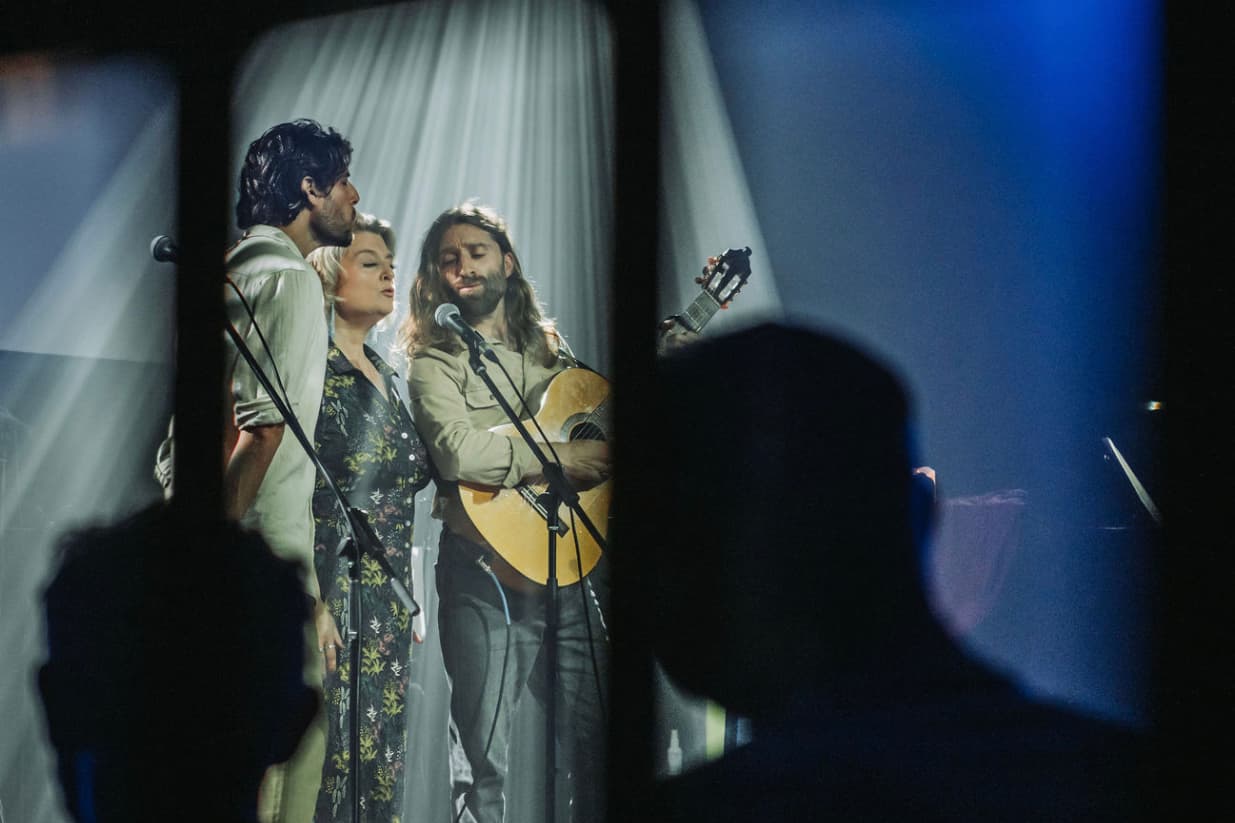
In the opening number, many Jewish audience members feel immediate resonance with Margot as she sings, “Do you ever fear that the world’s on fire, like there’s a war inside your heart and you feel like you have to hide who you are.” That vulnerability is almost instantly undercut by Anita’s lighthearted rap about life in Nazi Germany: “Back when I was on the block down in Germany -- in Frankfurt they didn't like diversity-- and I heard-- 'cause the Germans think they rank first-- that they gave word-- they gon' murder me—because I’m Jewish!”  

Anita’s air of nonchalance captures one of the show’s central satirical moves. Rather than warning the audience that something might be too sacred to laugh at, Slam Frank places viewers directly inside the discomfort. Only by experiencing that unease are we forced to confront where our own red lines lie. 

The Jewish community controversy surrounding the show makes sense. Many Jews worry about how non-Jewish audiences will experience it. Will they laugh at the “right” moments? Will they understand what, or who, is being satirized? Inside the theatre, audience reactions range widely: jaws drop, nervous laughter ripples through the room, moments of deep discomfort give way to bursts of genuine, belly-deep laughter, and some people simply walk out.  

Rather than seeing those walkouts as failure, the show’s creators view them as evidence that the work is doing exactly what it intends. As writer-composer Andrew Fox said, “When people walk out, I find it very affirming. If nobody’s disgusted by what you’re doing, you’re not hitting enough nerves.”  

Producer PJ Adzima expressed immense pride in being part of a work that provokes such responses, noting that “when the medium of musical theatre is boring, tame, and culturally insignificant, our little Off-Broadway show has ignited conversations around the world.” 

For Jewish audience members, there are moments when the experience feels genuinely unsettling. Olivia Bernabe who plays Anita, acknowledges “A lot of people believe it’s antisemitic, and there are aspects of the show that definitely are. But that’s the point. It’s a satire meant to magnify things and take them to the extreme so that we can get a good look at ourselves and the ways in which we engage in identity politics and global political landscapes.”  

The claim is that by exaggerating antisemitic tropes, audiences may become more aware of the subtler ways they participate in sustaining them. Actor Alex Lewis, who plays Peter, believes “the way we deal with antisemitism in this show is better than how anyone else is doing it.” 

Antisemitism is undeniably on the rise, and Slam Frank is not going to fix the world. But if the show sends audiences out of the theatre talking, arguing, and questioning the ideological frameworks they take for granted, then it may be succeeding in the way art sometimes can: not by offering comfort or consensus, but by unsettling us enough to force reflection. 

You might also like
  • Antisemitism, homophobia and a radical response to both
    Dennis Altman
  • Confronting Richard Flanagan and the myth of the Israel lobby
    Mary Garden
  • Court decision fails to understand when ‘Fuk Israel’ becomes antisemitic
    Jeremie Bracka
logomark.67a07ee3
We believe in the free flow of information

Republish our articles for free, online or in print, by using our Creative Commons licence

You might also like

    Eden Bahar
    InterviewArts & Culture

    ‘L’chaim for the next 1,500’: Israeli drummer celebrates Cirque Du Soleil milestone

    Gideon Cohen
    Generation Change: Rachel Moshel
    Generation ChangeInterviewArts & Culture

    Rachel Moshel: Creating a space for Jewish art and joy

    Gideon Cohen
    Wake main 2nd
    FeatureArts & Culture

    New ‘spoken word’ festival in Sydney offers stories directly from creators

    Miriam Hechtman

About the author

Tori Greene

Tori Greene is a rabbi-in-training and content creator currently based in Los Angeles. You can stream her song Adiel (Shelter Us in Peace) on Spotify and Apple Music. 

Comments2

  • Avatar of susan stetzer

    susan stetzer8 September at 08:16 pm

    there are some things that cannot be satirized or joked about. The death in a concentration camp of a young teenage can never be a joke. She was murdered in an oven because she was Jewish

  • Avatar of Sam

    Sam22 January at 11:23 pm

    Great article! You mentioned how the show attempts to use satire to exaggerate tropes to illuminate the subtler ways we participate in them. I would be curious to hear some more solid examples of how they try and accomplish this in the actual show! It’s one thing to claim intention, and another to successfully pull it off!