Published: 29 October 2017
Last updated: 4 March 2024
Instead of basing our identity on a failed campaign in which the British sent 8,709 Australians to their unnecessary deaths, we should use the 100th anniversary to replace that tragic base with the stunningly successful series of Australian-led victories in the Middle East, culminating in Beersheba.
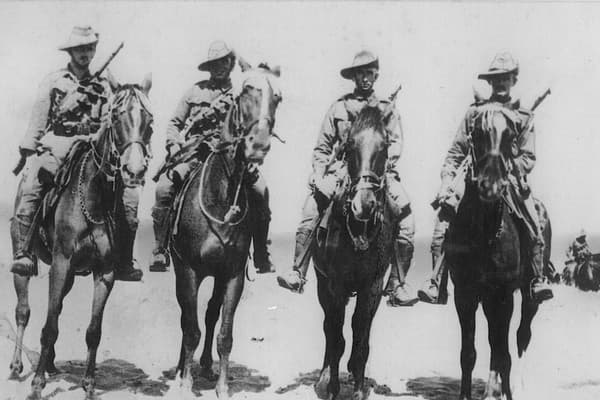
Nothing could be more Australian than young country bushmen riding Australian-bred stock horses (Walers) to defeat an enemy; it should appeal much more to Australians than honouring the deaths of our foot soldiers trapped in the trenches of Gallipoli.
When World War One Prime Minister Billy Hughes claimed, ‘Australia was born on the shores of Gallipoli’, he was praising the bravery and sacrifice of that disastrous 1915 campaign. When he told Parliament, in 1919, ‘In the history of the world, there never was a greater victory than that which was achieved in Palestine, and in it (also as in France) the soldiers of Australia played a great part’, he was talking about horsemanship, intelligent and skilled military tactics, and fierce fighting.
It is time, 100 years later, to hold our national head up proudly, knowing our identity can be based on success instead of failure. From 2018 onwards, to mark the anniversary of the end of the war these Light Horsemen helped win, the Australian government should organise a new annual commemoration day, like Anzac Day, but on October 31, to be called Beersheba Day, to build up the importance of this new foundation stone for our national identity.
The words those brave troopers wrote after charging Beersheba collectively tell the story of all the main battles fought by the Australian Light Horse, led by Lieutenant-General Harry Chauvel, serving with Britain’s Egyptian Expeditionary Force as it drove the Turks out of Palestine and dismantled the centuries-old Ottoman Empire.
I was lucky enough to interview one of the last surviving Light Horsemen just before he died: the heroic trooper Len Hall, from Western Australia, who served mainly as a Gunner with the 10th Light Horse Regiment.
From 2018 onwards, the Australian government should organise a new annual commemoration day, like Anzac Day, but on October 31, to be called Beersheba Day.
Hall had landed at Gallipoli, been involved in the bloody Battle of The Nek, served throughout the Palestine campaign where he met Lawrence of Arabia, and then ridden with the Light Horse into battles like Beersheba. He died in 1999 but is remembered each year in the Len Hall Tribute Game, an Anzac Day AFL football match played by the Fremantle Dockers against various other clubs.
[gallery columns="1" size="large" ids="15070"]
I also interviewed the last Light Horseman to die, Albert Whitmore, who passed away in Barmera, South Australia, in 2002 at the age of 102. He was Australia’s last living link with the Light Horsemen, that legendary mounted force that had captured Beersheba in 1917. He was lucky to survive, let alone live to 102, as he caught malaria during a record-breaking heat wave in Jordan: ‘When one of my fellow troopers saw me lying on the ground sick as a dog he said, “We’ll never see old Whit again”; but they carted me off to hospital and I pulled through’, he said. Such was the resilience of the Light Horsemen.
My interest in the Australian Light Horse was really aroused by Lieutenant-General Harry Chauvel’s daughter, Elyne Mitchell, who had me to stay at her homestead in 1995 at Towong Hill, near Corryong, while I was directing the centennial celebrations for an event I conceived to celebrate great Australian horsemen — Banjo Paterson’s Man From Snowy River.
The popularity of this fabulous ballad (which is printed on the $10 note with Paterson’s portrait and a picture of the Man From Snowy River) confirms the importance of horse riding in our culture.
Elyne proudly showed me her father’s memorabilia from World War I and gave me a copy of the book she wrote based on her father’s letters to her mother about his campaigns, Light Horse: the story of Australia’s mounted troops. After I appointed her Patron of the 1995 Man From Snowy River Centennial Celebrations, she wrote an introduction to the brochure that recalled the days of Banjo Paterson and also the Light Horse:
‘Those were the days of great horses and great horsemen. Everyone rode a horse: the cantering rhythm of a horse was the rhythm to which Australia moved. This was the rhythm which Banjo caught’.
Major Paterson, Commander of the Remount Squadron, a great horseman himself, also took that rhythm with him as the officer in charge of the horses in Palestine, on whose backs history’s last successful cavalry charge too place.
This is an edited version of the Preface to Palestine Diaries, by Jonathan King, published by Scribe
Photo: Light Horsemen (courtesy Scribe/Australian War Memorial)