Published: 11 September 2017
Last updated: 5 March 2024
Proliferation of debate regarding the ethics of neonatal male circumcision allows us to reflect on commitments and values. Consider, for example, those who oppose circumcision from a moral standpoint. To them, the key issue is that circumcision is immoral since the infant cannot consent. Situating their argument in these terms provides a problem for Jews, as the Jewish ritual must generally be conducted at eight-days old.
There is a growing movement of activists who campaign against involuntary, nontherapeutic genital modification of all forms. This group goes by the name ‘intactivists’ – which is a combination of the words ‘intact’ and ‘activism’ or ‘activist’. This language already indicates something of the movement’s self-perception: activists who promote intact genitalia. It is worth noting that the intactivist movement is prolific in the USA, since routine neonatal male circumcision has been common there for several decades.
While circumcision in the USA is primarily conducted for health reasons (although dispute on the merits of circumcision as a medical procedure persists), the ritual of circumcision in Judaism serves as a rite of passage. For the most part, rites of passages signal a transition from childhood to adulthood. The Jewish ritual of circumcision, however, takes place when the child is an infant. To this end, we can think of the ritual as marking passage into Jewish male lineage. If we think of this together with the religious ontology of circumcision, we can begin to understand the significant place it occupies in Judaism.
Jewish circumcision is generally attributed to the events told in Genesis 17. There, God spoke to Abraham and proposed a Divine Covenant on the condition that he and his wife Sarai change their names (from Abram to Abraham, from Sarai to Sarah). Next, God requested that Abraham commit to circumcision – of himself and his entire male household for generations to come. Thus, circumcision is a practice that dates back to the origins of Judaism: it was to Abraham – the first Jew – that God spoke. In a sense, the genesis of the first Jew commences with the first circumcision.
While for observant Jews this story outlines the ontology of circumcision in Judaism, I suggest that it allows us to think of circumcision in terms of identity. Specifically, the identity of the male Jew. To this end, circumcision is not only a mark symbolising God’s Divine Covenant, but it also serves as a marker of Jewish community. Granted, many non-Jews practice circumcision too. However, for Jews, circumcision was never about health or medicine. It served a function of community and identity. To this end, a debate about the ethics of circumcision as a medical procedure is out of the question for Judaism, since medicine or health wasn’t a key driving factor. The question of autonomy and consent, however, remains.
Addressing the problem of consent, intactivists generally put forward a typical argument for deferral: wait until the child grows up to be an adult, so that he may make this decision for himself. But such a view considers circumcision in isolation, whereas in Judaism circumcision is a matter of relation. It is a sign of membership to community and ethnicity. It is important to note that circumcision is not a precondition to be Jewish. A man is Jewish if born to a Jewish mother, regardless if he is circumcised. With this in mind, there is an increasing number of intactivist Jewish parents who choose not to circumcise. Instead, they hold a Brit Shalom – an alternative non-cutting naming ceremony for newborn Jewish boys.
This shift in approaches to circumcision coincides with younger generations of Jews moving away from conventional orthodox practices. Jews in the Diaspora – as well as Israel – are increasingly practicing Judaism in a way that is more cultural than religious. As questions about the ethics of circumcision permeate Jewish discourse, we need to be mindful of what the ritual symbolises, so that we may consider whether we can leave it behind.
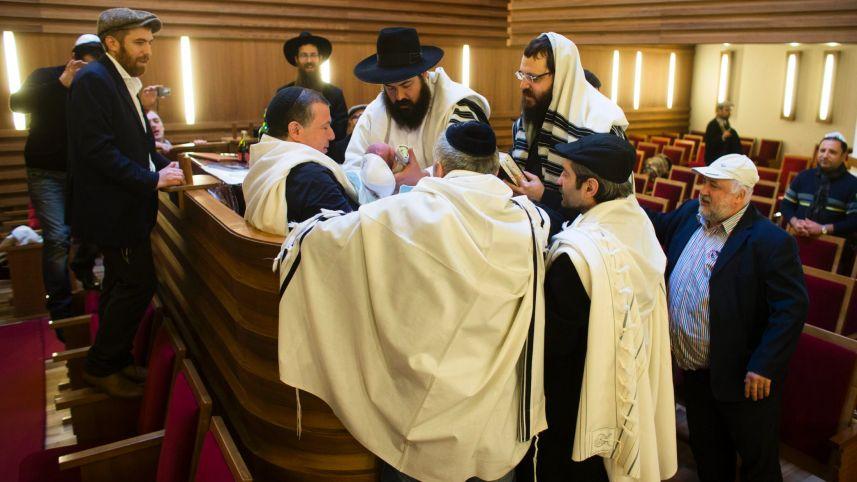
Photo: A mohel is surround by other rabbis and relatives as he holds a boy at his circumcision (AP)
This The Jewish Independent article may be republished with this acknowledgement: ‘Reprinted with permission from www.thejewishindependent.com.au ’