Aa
  • Read, Watch, Listen
  • TJI Series
  • Community Action
  • Events
  • Zedi
Follow us and continue the conversation
  • LinkedIn
  • Instagram
  • FaceBook
  • X
  • YouTube
Test yourself with the TJI Quiz!

Adjust size of text

Aa

Follow us and continue the conversation

  • LinkedIn
  • Instagram
  • FaceBook
  • X
  • YouTube

Your saved articles

You haven't saved any articles

What are you looking for?

Original reporting, insightful analysis and diverse views, delivered straight to your inbox

  • LinkedIn
  • Instagram
  • FaceBook
  • X
  • YouTube
Your support fuels our mission to inform, entertain and inspire.

The Jewish Independent is bound by the Standards of Practice of the Australian Press Council. If you believe the Standards may have been breached, you may approach The Jewish Independent or make a complaint to the Australian Press Council in writing at www.presscouncil.org.au. The Council may also be contacted on 1800 025 712.

  • Our Story
  • Contact us
  • Our Team
  • Support us
  • Guidelines
  • Pitch your idea
  • Republishing us
  • Community Action
  • Our Awards
  • LinkedIn
  • Instagram
  • FaceBook
  • X
  • YouTube
Aboriginal FlagTorres Strait Islanders Flag

The Jewish Independent acknowledges Aboriginal and Torres Strait Islander peoples as the Traditional Owners and Custodians of Country throughout Australia. We pay our respects to Elders past and present, and strive to honour their rich history of storytelling in our work and mission.

© The Jewish Independent 2026All Rights Reserved
Website design and development by Your Creative, MelbourneTerms & ConditionsPrivacy Policy
HomeRead, Watch, ListenAustralia
Australia

Friday nights, Covid and Caulfield: the thoughts of president Daniel

Julie Szego
Print this

Published: 21 May 2021

Last updated: 4 March 2024

Daniel Aghion, the new head of the JCCV, speaks candidly with Julie Szego about his unusual background, school fees and other challenges facing Victoria’s Jewish community

FOR A GOOD CHUNK of his childhood, the newly appointed de-facto head of Melbourne’s 52,000-strong Jewish community lived somewhat un-Jewishly.

“We didn’t do anything for Friday nights,” explains Daniel Aghion, 48, who in March became president of the Jewish Community Council of Victoria, the roof body for  major community organisations.

“We’d have a bacon fry-up Sunday morning and this being the 80s, when mum and dad went out for a flash dinner, it would lobster.”

His parents ran an insurance brokerage in suburban Moorabbin. They had migrated to Australia in the 1950s as children — his father was born in Alexandria, Egypt, his mother, a daughter of Holocaust survivors, in Ramat Gan. 

While the couple encouraged the boys to engage with the community — Aghion attended Bentleigh Progressive Synagogue (he’s still “proudly Reform”) Jewish scouts and dabbled in youth movements — they enrolled Aghion and brother Gab at private school Haileybury, figuring the sooner their children grappled with the reality of belonging to a minority comprising less than one per cent of the population, the better.

And the Aghions’ home life was short on Jewish rituals. 

All this changed when Aghion was about 11, and his maternal grandparents moved from their home in Sydney to Melbourne so they could be closer to their only daughter in retirement. Then his parents made a conscious decision to start Shabbat dinners as a way of cementing family bonds.

Aghion’s parents have long since divorced and remarried. But were it not for the Shabbat dinners, and the intergenerational bonds they cemented, perhaps Aghion’s maternal grandfather, Arthur Lehner, would not have said what he said the day his grandson, by then a young man, drove him, and wife Eva, to Spencer Street train station.
We’d have a bacon fry-up Sunday morning and this being the 80s, when mum and dad went out for a flash dinner, it would lobster.

“It’s a bit off-topic,” he says about the episode, as we chat, one tranquil morning last month, in the study of the home he shares with wife Jenny and three school-aged children.

I disagree. Fleeting moments can play an outsize role in life’s journey, which in Aghion’s case brought him to a juncture where, at the urging of his friend and former Council president, Anton Block, he volunteered to steer the Council at a tumultuous time.

Tumultuous internally - in December, president Andre Oboler resigned after just a few weeks in the job - and externally, as Victoria’s close-knit community grapples simultaneously with the impact of Covid and the existential challenges of the future.

So bear with me.

Arthur, Aghion’s late grandfather, hailed from Hungary’s Szatmár region. During the war he was interned in the concentration camp, Mauthausen. On liberation, as a 20-year-old, he weighed 30-something kilos. Arthur never spoke of his time at the camp.

“He’d talk about before and after (internment) but never during,” Aghion says. “Even during his interview for the Spielberg project. The video is just fascinating to watch, he goes up to that point. Stops. And then picks up the story again about two or three years later. There’s just this gap.”

But on this day, as Aghion approached the station, something triggered his grandfather. “He had retired but he was going back to Sydney because he’d worked on the line at Eli Lilly the pharmaceutical company - he’d been a blue-collar worker - and they were having an employee reunion,” Aghion recalls.

“I was about 19 or 20 and had my (driver’s) Ps.

“And I’ve turned into Spencer (Street), I’m in the old ’78 Chrysler, trying to find a place to park, and all of a sudden, he looked down at his hands. He was sitting in the front passenger seat, and he looked across at me and said, ‘you know, when I was in the camp I came around a corner, round a barrack, and there were some German soldiers and there was a pile of bodies and they’d just been shot.’

“One of the soldiers called him over and said, ‘hey you, move these bodies.’ So he did. And he said they were still warm. And then ... he looked down at his hands again which he’d held out in front of the passenger side dashboard and he said, ‘das Blut..’

“Which is German for ‘the blood’.” 

Then Aghion pulled up outside the station, and Eva told her husband to be quiet.

Arthur died in 1996. Eva, herself an escapee from the Warsaw ghetto, and a former employee of a shirt-making company, passed away in an aged care facility, Gary Smorgon House, last April while Victoria was in lockdown.

“For the last month we didn’t even get to see her,” Aghion says of his late grandmother. “All we could do is put notes through the front door, which would then be put through the first door, and I don’t even know if she read my last note.”

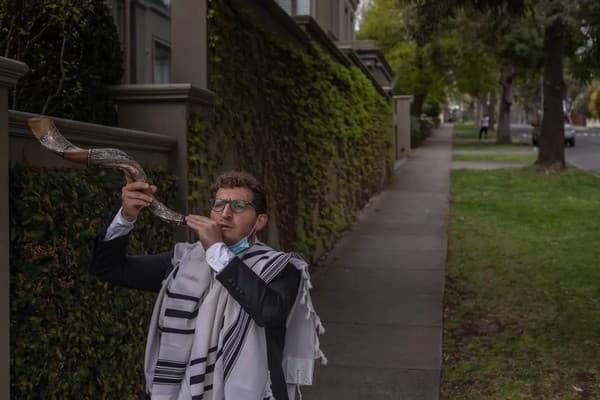
Rabbi Gabi Kaltmann blows the shofar on a Melbourne street corner during Covid lockdown (Asanka Brendon Ratnayake/The Guardian)

Apart from the loss of life, Covid’s economic toll on the community is significant. Kosher caterers, for instance, are “in big trouble,” as large functions stopped. And the isolation that came with Victoria’s protracted lockdowns was all the tougher in a communal culture where even a synagogue service needs a quorum of 10.

There were, however, innovative responses to the coronavirus. For instance, Aghion’s shule, Temple Beth Israel, began putting more of its religious services online, including last Yom Kippur when only 10 people out of their 1000-plus membership could attend. Even some people who ordinarily attend Orthodox synagogues during the high holidays logged on so they could still participate in a shule service.

“I see this is a good example of how pluralism can bring the community together,” he says. “How we can have less carping about ‘this is my turf, this is yours’.”

Aghion is wasting no time in exploring this ideal, judging by the appointments in his diary for the week. He scrolls through a calendar on his computer screen.

“OK, so let’s see what I’ve got.”

Apart from the round of meetings with politicians and bureaucrats eager to “touch” the new president, there’s a tour of bushfire-relief projects in Gippsland— the community raised millions in last year’s appeal and the Council’s administering the funds. A wreath-laying service for fallen Jewish soldiers. A debrief after a horrid year with the top brass from aged and disability services provider, Jewish Care.

There’s blissfully few day-job commitments. Aghion, a barrister, is taking a breather from his practice after spending nearly three months litigating a $35 million dispute about clean-up costs in the asbestos-contaminated Alphington paper mill.

Instead, he has a meeting with the Community Security Group, “at the operational and board level”— whose reportedly toxic relationship with Oboler explains last year’s Council turmoil. About this falling out Aghion says he has scant information and no interest in dredging up the details.

While he speaks warmly of Oboler, his impression of what transpired is that a personality clash surfaced over a dispute about governance. The CSG, which patrols Jewish schools, synagogues and community events, is part of the Council but operates independently of it.

Aghion’s visit is about repairing the relationship between the organisational parent and child.

Another appointment is with Alan Schwartz one of a number of influential community figures beavering away at the Jewish Schools Project, a long-standing, if largely unpublicised, plan to tackle the exorbitant and increasingly prohibitive cost of Jewish education.

We can hardly accuse Aghion of starting with the easy stuff, even if he’s been partially broken in through his position as honorary secretary of the Executive Council of Australian Jewry, the Council’s federal counterpart.

Few issues are more vexed and contentious than where Jewish children get educated and at what cost.

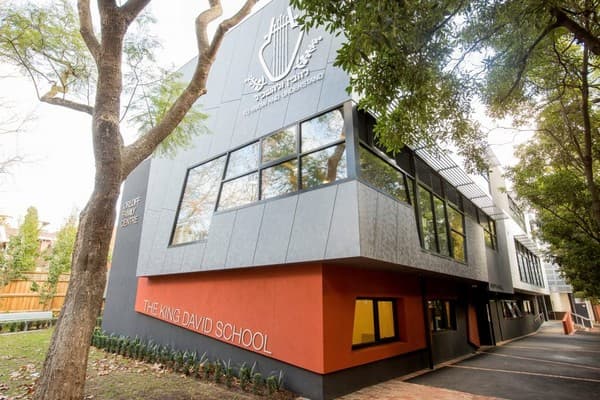
King David School in Melbourne

With three kids at King David School, Aghion more than feels the pain. He remembers receiving his first ever account when oldest child, Michelle, started school, “and I said, ‘gee, that’s not too bad.’”

“And then Jenny said, ‘you realise that’s just for the first term?’” He grins. “I thought it was for the year.”

So what shape is the solution is taking? “Put it this way: I’ve only been in this job a week or two and I’ve already heard three proposals. One is basically “a huge pot of money” and subsidise (fees). Two is merge Jewish schools. Three is expand the UJEB (United Jewish Education Board) -type offering so that kids can go where they want but there’s a bigger offering of Jewish education outside schools.”

“Can I put my hand up for number three?” I ask, overstepping my journalistic remit.

I’ve only been in this job a week or two and I’ve already heard three proposals [about schools fees].

Option three is neutral on parental choice, I argue. It avoids pitting the private and public sectors against one another and creating winners and losers. I explain that as a public education zealot, I’m worried about a “super” Jewish day school luring families out of government schools to the detriment of local communities. (And, I might have added, the national interest.)

He nods slowly. Pauses.

“There is actually a theme in there which I think we can return to,” he answers, carefully. “And I say this partially because we’re members of the Reform community. I’m acutely aware of the fact that this (Victorian) community is vibrantly and proudly diverse and pluralistic. The idea of ‘the Jewish community’ as this monolith is just wrong.. That’s harder to see from the inside, but we know this from the inside.

“I’m not in favour of the concept of ‘the Caulfield ghetto’ as such. I’m acutely aware that the JCCV is representative of the Jewish community wherever it is in Victoria, and that does tell against things like a ‘super school’ because that doesn’t allow for the pluralism of thought and practice.”

Part of the problem, Aghion says, is a lack of strategic planning in the community generally, which means major decisions are taken ad-hoc, with everyone pursuing their own vested interests, and lots of overlap.

“So, for instance, there’s no one at the top saying ‘hang on, before we go buy a big property and put up a super-school, before we spend millions of dollars on an outreach program that we roll out because someone in Point Cook still wants their kids to have a connection to the community ... let’s first ask ‘what’s in the best interests of the community?’

NSW manages to run a communal appeal through the JCA, Aghion says. Were Victoria able to communally fund, “then we could be a lot smarter about the way we work and act communally. It would open up a mechanism for the community to be so much more than it is.”

The community is preoccupied with the challenge of assimilation, “which is not only a concern, it’s a fact”

And for now, Aghion explains, the community is preoccupied with the challenge of assimilation, “which is not only a concern, it’s a fact.”

“So the question is what does our community look like two, three generations from now? What does it mean to be a modern Jewish community?”

Answering those questions might be a work-in-progress but Aghion draws some inspiration from his own childhood; the honouring of rituals that enabled the passing down of stories to the younger generation.

“Now we have Friday nights here. My brother comes over with his wife, who is not Jewish, and their two girls.

“And I actually relax, I feel the whole week just come off me. I watch my nieces say the blessing over the challah which they’ve learnt at the table on Friday night. And then I go watch them play with their cousins, my kids.

“And I look at that and I think, ‘this community’s going to be okay’.”

You might also like
  • Antisemitism, homophobia and a radical response to both
    Dennis Altman
  • The evidence gap: how do we know what works in antisemitism education?
    Andrew Jakubowicz
  • Security challenges on the road back to safety
    Peter Kohn
logomark.67a07ee3
We believe in the free flow of information

Republish our articles for free, online or in print, by using our Creative Commons licence

You might also like

    Generation change Template
    Generation ChangeInterviewAustralia

    Ash Densham: Building community through Humanistic Judaism

    Gideon Cohen
    tame kostakidis west
    AnalysisAustralia

    How not to apologise

    Zac Klugman
    chai necklace copy
    ReflectionAustralia

    Facing my mortality, the Book of Life is no metaphor

    Talia Slonim 4

About the author

Julie Szego

Julie Szego

Julie Szego is a freelance writer and columnist for The Age/SMH. Her non-fiction book, The Tainted Trial of Farah Jama, was shortlisted for the Victorian and NSW Premier’s Literary Awards for 2015.

More from the author

AnalysisAustralia

Focus Goldstein: Libs run hard on antisemitism against Teal incumbent

OpinionIsrael

The cost of ending the Israel-Hamas war is too high

FeatureIsrael

On Israel-Palestine, Australian journalists have abandoned their professional duty

Arts & Culture

The tormented Jewish heart buried inside Gudinski’s frenetic ego