Published: 27 January 2017
Last updated: 4 March 2024
Yosl Bergner never wanted to visit the places of his imagination. Many years ago, when I suggested a trip together to retrace the travels of his poet father, Melech Ravitch, across the Australian outback – a 1933 search for a homeland for German Jewish refugees - Yosl refused to go, saying it would destroy the magic of the story for him. “I don’t want to ruin the images I have carried around in my head for so long, by seeing the reality of the place.” Instead, he wove those rich dream-like visions into the most riveting visual narratives in his Kimberleys series.
A wonderful raconteur, Yosl’s paintings combined his dreams, experiences and the literature he adored – first and foremost, Kafka - into a fascinating blend of painted stories about the human condition. And for those in the know, a secret was etched into the corner of most of his canvases – a childhood drawing of a tram accident, where a mother stands beside her child looking upon the injured victim, asking ‘Vos zol ich ton?’ (what will I do now?) Yosl took deep offence when people referred to him as an artist. He scoffed: “I’m a painter, not an artist. It’s a job – I come to work every day, I schmear and something comes out.” His paintings danced with sad, old graters, fire hydrant ‘monsters’ and earthly angels, imploring us to challenge what we see in the world, to always question reality.
 Aboriginals in Fitzroy - collage
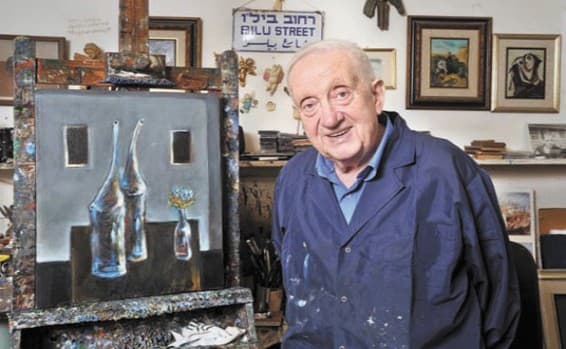
I first met him in 1974, when I was a reluctant teenager on my first trip to Israel, my father dragging me along to visit his old friends. Yosl and my father had met in 1939, when they were both drafted into the 6th Australian Employment Corps – a unique collection of Jews, Greeks and Italians posted on the railway switching station near the NSW-Victorian border. Yosl didn’t remember him at first, but when my father reminded him on the phone that he was “Menachim Kaminsky, Menachim, Menachim – you know, the one with the ‘farkrimteh foos’ (crooked foot)”, referring to his left foot crippled by polio as a child, Yosl immediately jumped to console him: “It’s not so crooked.” That first visit to Yosl’s studio on Bilu Street in Tel Aviv was a portal into the world of imagination and story for me. Yosl became my lifelong mentor, always ready to talk about anything from seeing the world through a fringe of curls, our thoughts when sitting around in waiting rooms and often asking my medical advice about a krechtz here, an ache there. He gave me his 8mm projector and introduced me to The Good Soldier Schweik and Bride of Frankenstein. He and his wife Audrey offered marital advice, made me omelettes and fed me choc chip cookies and tea. Their door was always open and a ten-minute visit would inevitably turn into several hours of stories and laughter. Yosl made everyone feel special. At the end of our last phone call, a couple of weeks before he died, neither of us, as usual, wanted to be the last to say goodbye:
“I love you!” I said.
“And I love you too.”
“But Yosl, you say that to everyone.”
He paused for a moment to think: “Yes, but with you, I really mean it!”
Yosl will never leave me - I prefer to think he’s wandering somewhere, and his death last week, at the age of 96, is only an illusion. Since losing my wonderful mentor and friend I keep asking myself the same question Yosl loved to repeat: “What will I do now?”
This The Jewish Independent article may be republished if acknowledged thus: ‘Reprinted with permission from www.thejewishindependent.com.au’


Comments
No comments on this article yet. Be the first to add your thoughts.