Published: 1 October 2020
Last updated: 4 March 2024
SEVEN YEARS AGO, Jewish mother Savannah Rowland was faced with a difficult choice. Keep her two children in Melbourne’s Jewish day school system – at great financial cost – or move them to a free public high school.
Her children thrived at Sholem Aleichem College; a primary school and one of the last remaining secular Yiddish-speaking schools in the world.
“It was a very welcoming atmosphere, very nurturing environment.”
“The values of the school really resonated with our family. And we loved the Yiddish aspect.”
Sholem Aleichem College ends at year 6. As high school approached, Savannah knew the family couldn’t afford the base fees at either Mount Scopus Memorial College, Bialik College or King David School (ranging from $32,000 in Year 7 to $37,000 in Year 12). All three are among the most expensive schools in Victoria.
Savannah determined it was significantly cheaper to buy a more expensive home, within the enrolment zone of the highly regarded McKinnon Secondary College, than keep her children in the Jewish day school system.
We have reached a situation where unless you have wealthy parents or unless you are earning huge money, it is beyond reach.
It was a decision motivated by finances – and values.
“For us, it was important that our children gained a Jewish education and knowledge,” she says. “We felt in the formative and younger years, we wanted to expose them to that education – a bit of Yiddishkeit, Judaism and Jewish identity.
“As they grew older, I wanted them to develop their own sense of identity. To learn to mix and communicate with different people – people from outside the Jewish community.”
Today, Savannah’s children (now in Years 10 and 12) are among a growing proportion of secondary school-aged Jewish students in Victoria attending a Government school – 24% in 2018, up from 20% in 2006.
Jewish Education in Melbourne, a new report authored by Monash University’s Australian Centre for Jewish Civilisation (in partnership with the Australian Jewish Funders), sheds light on Savannah’s choice – as well as the choice of hundreds of Jewish families who opt for the Melbourne’s Jewish day school system.
Led by Emeritus Professor Andrew Markus and supported by Tanya Munz and Dr Miriam Munz, the Centre analysed survey data results of 4,109 Victorian Jewish people. The results were captured three years ago through the Gen17 Australian Jewish Communal Survey, and while many of the results were made public two years earlier (in the Gen17 report), the analysis in Jewish Education in Melbourne goes considerably deeper.
The report also contains 29 interviews with school administrators, teachers and parents, conducted by Dr Miriam Munz, who is a veteran Jewish day school administrator and researcher.
What emerges is the first comprehensive picture of school-aged education for Melbourne Jewry – everything from the differences in attitudes between Orthodox to non-Orthodox school graduates, to the reasons why parents opt for non-Jewish education, is explored.
Cost and affordability, not surprisingly, emerge as the key theme across the survey results and interviews. The quantitative results are especially stark.
Around 50% of parents aged 18-49 with school aged children, consider high cost of school fees to be the main disadvantage of full-time Jewish day schools.
Tanya Munz says some parents are unconvinced it is a necessary investment. “Even if financial sacrifices were made, there was always this cost benefit analysis in their mind.
Of those parents aged 18-49, with children in Jewish day schools, 86% said school fees ‘entailed either some or a major financial sacrifice for their household.’ Many relied on external support: one in four (25%) were on means-tested subsidies and almost one in five (19%) received support for school fees from other family members such as grandparents.
The report captures the typical voice of a financially-stretched parent: “[We have] three kids. Even at half price it’s about seventeen to eighteen grand per kid, [and that is after tax]. Where am I going to find a spare $75,000? Where? We have reached a situation where unless you have wealthy parents or unless you are earning huge money, it is beyond reach.”
Dr Miriam Munz says a Jewish day school education has never been cheap. Parents of children generations prior, were willing to make a financial sacrifice – no matter the price.
“I did my high school at Mount Scopus, and when I went to school you had parents who came in with cash in a dirty brown paper bag to pay for the school fees.
“Some didn’t have much money; they were all Holocaust survivors. But they wanted their children to have a Jewish education. It was so important to them, they just eked it out and put it together.
“Today, you're seeing different priorities among parents.”
Tanya Munz agrees, and says some parents are unconvinced it is a necessary investment. “Even if financial sacrifices were made, there was always this cost benefit analysis in their mind.
“They would ask, “’Is it really worth it? What is my kid going to get out of it’? Or what can I do instead to try and give them a Jewish education? What else can I do so my child doesn't miss out, but I can save on not paying those fees?”
Emeritus Professor Markus points out that for Orthodox families there is no alternative. A commitment to a Jewish education overrides all considerations. “There's no direct correlation between income and decision to send a child to a Jewish day school.
“People on a low income who are Orthodox will put a much higher priority on a Jewish education. Whereas someone who is quite well-off but not Orthodox might be more prepared to send their child to a non-Jewish school.”
Indeed, on many indicators – from religious observance and religious practices to attitudes to intermarriage and Israeli connectedness – there is a large difference in the views from Orthodox school and Mount Scopus College graduates to those from non-Jewish schools.
Tanya Munz explains graduates of non-Jewish schools typically are not as engaged or connected to their community, as their counterparts from Jewish schools.
“The fact that 39% of those aged 18-29, who didn't attend a Jewish day school, have no connection whatsoever to the community, says a lot.
“When it comes to close friends, up to 53% of that same age group say that none or less than half are Jewish. On average less than a third (27%) of that cohort had a Jewish education experience outside of school, such a Bar/Bat Mitzvah, going to a youth movement, going on a trip to Israel. I would have thought that was significant.
[gallery columns="1" size="large" ids="38504"]
Unlike some of her contemporaries from non-Jewish day schools, Lily Tamir Regev, 20, feels closely tied to her Jewish community and identity.
Lily serves as Merakezet (co-ordinator) of the Zionist youth movement Hashomer Hatzair. She’s proud to be Jewish, has mostly Jewish friends and holds a deep ideological connection to Israel.
But that wasn’t always the case. Born to Israeli migrants in the city’s inner north east, Lily had no connection to Jewish communal life; synagogues, clubs or schools. “It wasn’t until I was in year 8 that I learned about Jewish day schools.
“There had only been a couple of other Jewish kids in my first primary school. Up until then, I didn’t even really know there was a Jewish community (in Melbourne).”
Except for a year in primary school when Lily’s family returned to Israel, her education was in Victorian public schools.
She dreamed of attending an elite private school in Melbourne’s east; either Carey Baptist Grammar or Methodist Ladies College.
She ended up attending McKinnon Secondary College, a school with a sizable minority of Jewish students. But it was Lily’s experience outside school, attending Hashomer Hatzair, that heightened her Jewish connectedness.
“I started going to Hashy when I was 11 and 12. I wasn’t proud to be Jewish, up until that point. But going to Hashy and attending Jamboree (an annual inter-movement camp), I developed a new understanding.
“I feel like Hashy made me smarter, more Jewish, more passionate. I will always identify as a shomeret (member of Hashomer Hatzair).
Not going to a Jewish day school has meant the kids have had to work maintain their Jewish identity. I think it’s broadened their experiences. It’s made them more resilient and to look out for more opportunities.
“Hashy offered all of that Jewish education and more – for free – and also I could go to a state school. I believe you can have the best of both worlds.”
Lily’s story might be an isolated case, but it speaks to the need to consider all inputs into a child’s Jewish development – not just schooling.
That’s the view of Simone Szalmuk-Singer, Co-Chair of Australian Jewish Funders – the organisation that initiated and partnered with the Australian Centre for Jewish Civilisation on the report. “I would like to be clear – the schools are one piece of our communal puzzle, albeit a very large piece,” Szalmuk-Singer explained at the report’s launch in September.
“Our community’s success also emanates from the broad educational infrastructure, which includes our Zionist youth movements, shule youth programs, Maccabi and UJEB.”
For their part Savannah Rowland’s children have integrated their Jewish background with life at a big state high school.
“Not going to a Jewish day school has meant the kids have had to work to maintain their Jewish identity. “They’ve maintained their friendships from Sholem, and they’ve had to look for other ways, whether it be through the youth groups or going to Kehilat Koleinu (a humanist congregation).
“I think it’s broadened their experiences. It’s made them more resilient and to look out for more opportunities.”
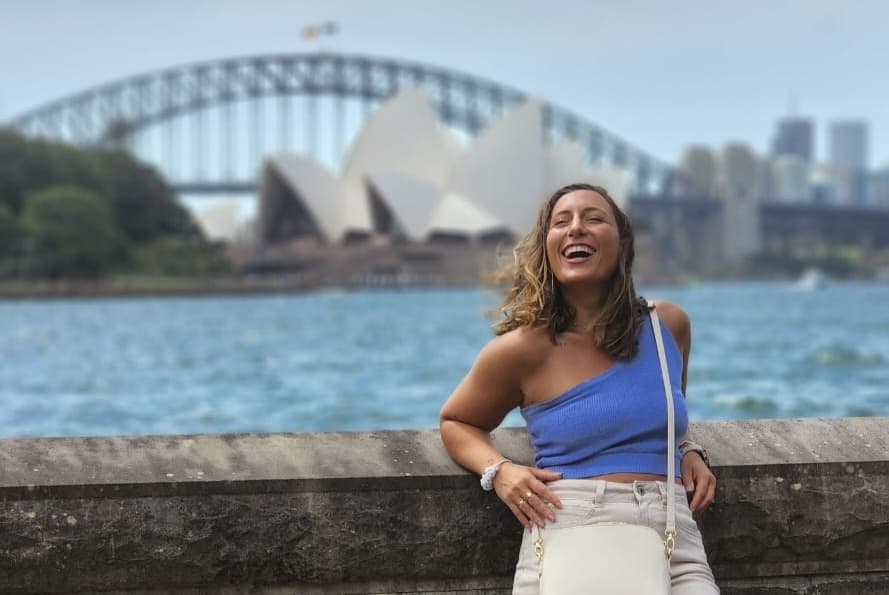
Main photo: Savanah Rowland with her children Mia and Ryan Borowitz (supplied)