Aa
  • Read, Watch, Listen
  • TJI Series
  • Community Action
  • Events
  • Zedi
Follow us and continue the conversation
  • LinkedIn
  • Instagram
  • FaceBook
  • X
  • YouTube
Test yourself with the TJI Quiz!

Adjust size of text

Aa

Follow us and continue the conversation

  • LinkedIn
  • Instagram
  • FaceBook
  • X
  • YouTube

Your saved articles

You haven't saved any articles

What are you looking for?

Original reporting, insightful analysis and diverse views, delivered straight to your inbox

  • LinkedIn
  • Instagram
  • FaceBook
  • X
  • YouTube
Your support fuels our mission to inform, entertain and inspire.

The Jewish Independent is bound by the Standards of Practice of the Australian Press Council. If you believe the Standards may have been breached, you may approach The Jewish Independent or make a complaint to the Australian Press Council in writing at www.presscouncil.org.au. The Council may also be contacted on 1800 025 712.

  • Our Story
  • Contact us
  • Our Team
  • Support us
  • Guidelines
  • Pitch your idea
  • Republishing us
  • Community Action
  • Our Awards
  • LinkedIn
  • Instagram
  • FaceBook
  • X
  • YouTube
Aboriginal FlagTorres Strait Islanders Flag

The Jewish Independent acknowledges Aboriginal and Torres Strait Islander peoples as the Traditional Owners and Custodians of Country throughout Australia. We pay our respects to Elders past and present, and strive to honour their rich history of storytelling in our work and mission.

© The Jewish Independent 2026All Rights Reserved
Website design and development by Your Creative, MelbourneTerms & ConditionsPrivacy Policy
HomeRead, Watch, Listen

Jews shoulder their historical responsibility to help Afghan refugees

Colin Shindler
Print this

Published: 24 August 2021

Last updated: 4 March 2024

COLIN SHINDLER: The lessons of history have driven many Jewish organisations worldwide to call on their governments to bring desperate Afghanis to safe shores

TWO WEEKS AGO, Jews in the Diaspora were instructed in the Torah reading of Parashah Shoftim: “Justice, justice, shall you follow”. Then the reality in Afghanistan intervened.

Joe Biden's long-held belief that US troops should not be in Afghanistan was implemented by an incompetent US military who had not taken into account the worst-case scenario that the Taliban were in fact simply pushing at an open door.

The sudden disappearance of the Americans from Bagram airbase further demoralised the underpaid, undervalued Afghan military whose leaders were deeply mired in corrupt practices.

In addition, the Taliban were presented in the West as solely a terrorist movement rather than as one which had considerable political support in the country — otherwise why would they have been able to survive two decades of a subterranean existence?

America's indecision as to whether it should try to change societies for the better or simply not even contemplate the idea has not been resolved. The question is still blowing in the wind — after the Bay of Pigs invasion in Cuba (1961), Vietnam (1965), Afghanistan (2001) and Iraq (2003). The scenes at Kabul airport last week are not unprecedented.

The Europeans proved incapable of creating a rival military force to replace the departing Americans. Global Britain was shown to be a fiction and remained as impotent as it was during the Suez crisis in 1956 when it invaded Egypt with France, in collusion with Israel - and was then forced to swiftly retreat in the face of Eisenhower's opposition.

Jews therefore — and particularly those in Israel — reason today that in the final analysis they can only depend on themselves. This is the profound significance of the existence of a Hebrew republic in the Land of Israel.

Jews, of all peoples, can certainly relate to these terrible scenes of desperate families, attempting to escape from a vengeful enemy. UK Chief Rabbi Mirvis said recently that “our heritage must inform the way that we respond” while the late Chief Rabbi, Jonathan Sacks, recalled in September 2015, the plight of the kindertransport children, in referring to the crisis of the Syrian refugees.
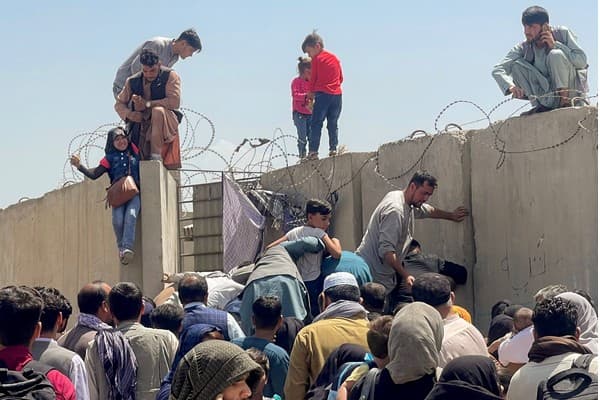

It is, for this reason — the lesson of Jewish history — that many Jewish organisations worldwide have called upon their governments to save the Afghan refugees and bring them to safe shores.  In Britain, faith communities have welcomed the first of the Afghan refugees to arrive and are working practically to assist them in their temporary accommodation.

Chaos at Kabul airport, August 16 (Reuters)

Jews, of all peoples, can certainly relate to these terrible scenes of desperate families, attempting to escape from a vengeful enemy.

The Jewish Council for Racial Equality in the UK which has been campaigning for refugees and asylum seekers since 1976, has called upon Boris Johnson to scrap the proposed Nationality and Borders Bill, which penalises those not using official channels. It also asked the UK government to allow in more refugees than the stipulated quota of 20,000 over the next five years.

In 1979, Menahem Begin instructed the Israeli navy to give sanctuary to the Vietnamese boat people — refugees from the Communist takeover of Vietnam following the rooftop escape of the last Americans from Saigon. As someone who had fled before the Nazi advance on Warsaw in 1939, Begin knew what it meant to be a refugee.

Therefore, as Israel leads the Jewish world, how many Afghan refugees will it take in? This was the question which the Meretz representative, Gaby Lasky, asked in the Knesset at the start of the crisis. She inferred that “Israel has been built because we were refugees”. This question was met with a studied, embarrassed silence.

Even if Israel became a staging post for the refugees en route to America, no official dared to utter an opinion. Even Herzl understood the meaning of a nachtasyl — a night shelter — when he put forward his Uganda plan as a stepping-stone to the Promised Land of Israel.

The Israeli government could have clearly demonstrated that its values were the polar opposite of Hamas, which published an official statement. This read:

“We congratulate the Muslim Afghan people for the defeat of the American occupation on all Afghan lands and we congratulate the Taliban movement and its brave leadership on this victory which culminated its long struggle over the past years.”

While Hamas has an interest in spreading Islamism throughout the Muslim world, the statement recalled the opportunism of the Palestinian leadership in the past. Exactly 30 years ago, in 1991, Arafat congratulated the hardline coup plotters who temporarily overthrew Gorbachev in the Soviet Union.

This followed Arafat's salutations to the Chinese leadership two years earlier, in slaughtering the protesters in Tiananmen Square in Beijing.

Too many will deliberately ignore Hamas's support for the Taliban because it might damage the Palestinian cause in Western eyes.

Too many will deliberately ignore Hamas's support for the Taliban because it might damage the Palestinian cause in Western eyes. An inconvenient truth, perhaps, but is human rights not a universal concern?

Naftali Bennett's government is attempting to be a new broom after the cronyism of the Netanyahu years. Taking in Afghan refugees would have been in line with its broad philosophy and would undoubtedly have paid dividends for Israel in the international arena.

The Jewish press instead became fixated on the tale of Zebulun Simantov, the last Jew in Afghanistan. An interesting story certainly, especially on the question of agunah (“chained wives”) when estranged husbands such as Simantov refuse to allow a "get”, a divorce, according to Jewish law. Despite this, no one thought to ask the question: Why is there only one Jew in Kabul today?

It is therefore ironic to learn that past Afghan governments actually wished to deport Jewish refugees. In the 1930s, Stalin's lethal collectivisation policies led to widespread starvation and the deaths of millions in the USSR. Some Jews were able to cross the Soviet border into Afghanistan.

Sara Koplik, in her recent book A Political and Economic History of the Jews of Afghanistan, reveals that the Afghan government in 1934 wanted to deport not only these Jewish refugees, but also the indigenous Afghani Jews. They were only stopped by the British, who did not want such “Jewish Bolsheviks” moving to India and polluting the population with Marxist ideas.

Even so, Dr Koplik reports that there were attacks on Jews in Herat in 1935 and they were expelled from Mazar-i-Sherif. They were stripped of their passports and forced to pay the jizya, the head tax on non-Muslims. Afghanistan declared its neutrality in the war against Nazism in September 1939. Jews gradually left Afghanistan for other lands after 1949 when they were permitted to emigrate.

How many Afghan refugees will Israel take in? This was the question which the Meretz representative, Gaby Lasky, asked in the Knesset.

Young Israelis from the African Refugee Development Centre, 2108 (ARDC)

Yet there was some form of protection for Afghan Jews because many Pashtuns, the tribe to which many of the Taliban belong, believe that they are descended from the ancient Israelites. The noted Israeli academic, Shalva Weil, has written extensively about this belief — that the Pashtuns might be descended from the ten lost tribes.

She mentions that this remnant of Israel was exiled to “Halah, Habor, the cities of Medes and the River Gozan” — which is the territory of the Pashtun. This belief — myth or not — persuaded Afghan army leaders to protect the Jewish community in Afghanistan in 1948, the birth of Israel and in 1967, the Six Day war.

Today's Taliban fighters are eager to suppress such notions despite the fact that they are common amongst the Pashtun older generation. It is easier to align with the anti-Israel attitudes of Palestinian Islamic Jihad.

The Taliban are not known for keeping their promises. Their ideological mission is still to build a society in their own image — albeit with more convincing public relations compared to their last period in power. If ISIS and al-Qaeda are allowed to root themselves on Afghan soil, then Jewish institutions in Europe and elsewhere will once more become targets of Islamist gunmen and bombers.

Even if this is not the case, the Taliban takeover of Afghanistan will act as a recruiting sergeant for Islamism. It will be seen as an inspiring example of what is possible if you remain a patient believer.

PETITION TO HELP AFGHANIS BY STANDUP

READ MORE
"Overwhelming" support for shul Afghan appeal
(Jewish Chronicle)
Rabbinic human rights group urges US gov't to take more Afghan refugees (Jerusalem Post)

Photo: A US soldier checks a child arriving at an Evacuate Control Centre at Kabul airport on August 19 (Centcom-Balkis)

You might also like
  • When security clashes with hospitality
    Jarod Rhine-Davis
  • NDIS changes threaten disabled participation in community life
    Jarod Rhine-Davis
  • One year after the ceasefire, Gaza remains in ruins with no solution in sight
    Shahar Burla
logomark.67a07ee3
We believe in the free flow of information

Republish our articles for free, online or in print, by using our Creative Commons licence

You might also like

    Jewish-diversity copy
    Feature

    The three questions that will define the Jewish future

    Shahar Burla 1
    Australia’s Prime Minister Albanese Speaks After Bondi Shootings
    News

    What PM, Premier, Police say about Bondi antisemitic attack

    The Jewish Independent 1
    Copy of Politica Podcast Social Tiles (600 x 400 px)
    Israel Iran WarPodcastIsrael

    Politica – Israeli Politics Explained

    The Jewish Independent 1

About the author

Colin Shindler

Colin Shindler

Colin Shindler is an emeritus professor of Israel Studies at SOAS, University of London. He is the author of several books about Israel: the latest "A Forever War: Israel, Palestine and the Struggles for Statehood" was published in 2026.

More from the author

AnalysisWorld

New evidence points to Iranian responsibility for Diaspora antisemitic attacks

AnalysisWorld

UK’s dramatic policy change on Israel-Palestine

AnalysisWorld

Diaspora leadership must be candid about its disillusion with Netanyahu

AnalysisWorld

Burnham and Miliband will have trust issues with future Israeli government