Aa
  • Read, Watch, Listen
  • TJI Series
  • Community Action
  • Events
  • Zedi
Follow us and continue the conversation
  • LinkedIn
  • Instagram
  • FaceBook
  • X
  • YouTube
Test yourself with the TJI Quiz!

Adjust size of text

Aa

Follow us and continue the conversation

  • LinkedIn
  • Instagram
  • FaceBook
  • X
  • YouTube

Your saved articles

You haven't saved any articles

What are you looking for?

Original reporting, insightful analysis and diverse views, delivered straight to your inbox

  • LinkedIn
  • Instagram
  • FaceBook
  • X
  • YouTube
Your support fuels our mission to inform, entertain and inspire.

The Jewish Independent is bound by the Standards of Practice of the Australian Press Council. If you believe the Standards may have been breached, you may approach The Jewish Independent or make a complaint to the Australian Press Council in writing at www.presscouncil.org.au. The Council may also be contacted on 1800 025 712.

  • Our Story
  • Contact us
  • Our Team
  • Support us
  • Guidelines
  • Pitch your idea
  • Republishing us
  • Community Action
  • Our Awards
  • LinkedIn
  • Instagram
  • FaceBook
  • X
  • YouTube
Aboriginal FlagTorres Strait Islanders Flag

The Jewish Independent acknowledges Aboriginal and Torres Strait Islander peoples as the Traditional Owners and Custodians of Country throughout Australia. We pay our respects to Elders past and present, and strive to honour their rich history of storytelling in our work and mission.

© The Jewish Independent 2026All Rights Reserved
Website design and development by Your Creative, MelbourneTerms & ConditionsPrivacy Policy
HomeRead, Watch, ListenWorld
FeatureWorld

Jimmy Carter at 100: his Jewish legacy

As architect of the peace treaty between Egypt and Israel, and for several other reasons, Jimmy Carter was the most consequential US president for the Jewish people.
Dan Coleman
Print this
begin carter sadat

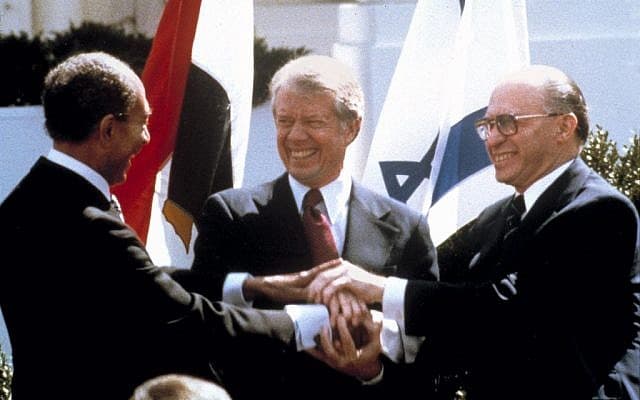
Egyptian president Anwar Sadat, US president Jimmy Carter, center, and Israeli prime minister Menachem Begin clasp hands on the north lawn of the White House as they sign the peace treaty between Egypt and Israel, March 26, 1979. (AP/Bob Daugherty)

Published: 9 October 2024

Last updated: 10 October 2024

Former President Jimmy Carter, who celebrated his 100th birthday on October 1, has something to live for.

Back in July, Carter’s son Chip asked his father if he was trying to make it to his 100th birthday. “I’m trying to make it to vote for Kamala Harris,” President Carter replied. Early voting in Georgia begins on October 15 so Carter, who has spent 18 months in hospice care, is on the cusp of attaining his goal.

But it is not his vote for Vice President Harris that will be the highlight of Carter’s public life. His greatest accomplishment was brokering, along with Israeli Prime Minister Menachim Begin and Egyptian President Anwar Sadat, the 1979 Camp David Accords, establishing peace between Israel and Egypt.

The 45-year tenure of what, at the time, would have seemed a fragile peace, is itself remarkable given the continuously roiling politics of the region. In that time, governments have been toppled in Iran and Iraq, civil wars have wracked Syria and Yemen, and the Arab Spring drove Egyptian President Hosni Mubarek, Sadat’s successor, from power.

Sadat and Begin deserve great credit for Camp David, especially Sadat who took the politically risky move of visiting Israel in 1978, but it was Carter of whom Middle East analyst Aaron David Miller, in his 2009 book Too Much Promised Land, said "no matter whom I spoke to — Americans, Egyptians, or Israelis — most everyone said the same thing: no Carter, no peace treaty."

While peace was attained through Egypt providing Israel with security guarantees in return for territory, it was only achieved by putting off resolution of the thorniest issue of all: self-determination of the Palestinian people, calling only for the establishment of a five-year transition period toward full autonomy for the Palestinians, a five-year transition that never came about.

This was a tactic that President Donald Trump took one step further in 2020 by ignoring the Palestinians entirely while forging the Abraham Accords.

This sense of a dream deferred accounts for the sympathy many African Americans feel for the Palestinian cause, a condition they identify as held in common

But Carter, unlike Trump, was surely familiar with Langston Hughes’ poem Harlem which famously asks “what happens to a dream deferred?... does it dry up like a raisin in the sun… or does it explode?”

No matter whom I spoke to — Americans, Egyptians, or Israelis — most everyone said the same thing: no Carter, no peace treaty.

Middle East analyst Aaron David Miller on the Camp David accord

Troubled by the decades-long deferral of the Palestinians’ dream of self-determination, Carter returned to the Middle East conflict in 2006 with the publication of his controversial book Palestine: Peace Not Apartheid. The bulk of the criticism was in reaction to the word ‘apartheid’ in the title. For example, Abraham H. Foxman, then national director of the Anti-Defamation League, charged that “the title is to de-legitimize Israel, because if Israel is like South Africa, it doesn’t really deserve to be a democratic state. He’s provoking, he’s outrageous, and he’s bigoted.”

The New York Times described a range of additional concerns which included “Carter’s assertions that pro-Israel lobbyists have stifled debate in the United States over the Israeli-Palestinian conflict; that Israelis are guilty of human rights abuses in Israeli-occupied Palestinian territories; and that the editorial pages of American newspapers rarely present anything but a pro-Israel viewpoint”, all topics that remain salient today.

Carter, although meeting with a group of 31 rabbis to discuss these concerns, ultimately brushed aside the criticism, returning to the topic in his 2009 book We Can Have Peace in the Holy Land. While defending his previous use of the term apartheid, he explained that “everyone who engages in Middle East peacemaking is bound to make mistakes and suffer frustrations. Everyone must overcome the presence of hatred and fanaticism, and the memories of horrible tragedies. Everyone must face painful choices and failures in negotiations. Nevertheless, I am convinced that the time is ripe for peace in the region.”

One can only imagine that, after a lifetime of peace activism as president, as private citizen, and through the Carter Center, he would today, from his hospice bed, again declare the time ripe for peace, despite a conflict seemingly more deeply entrenched than ever.

There are other, albeit less prominent, factors that establish Carter as the most significant president for the Jewish people (sorry, Donald).

In 1978, Carter established the President's Commission on the Holocaust, chaired by Elie Wiesel. Its mandate was to investigate the creation and maintenance of a memorial to victims of the Holocaust and an appropriate annual commemoration to them.

In 1980, a unanimous vote in Congress established the Holocaust Memorial Museum on its present site near the Washington Monument.

The Carter Administration authorised the erection of a Chabad sponsored nine-metre tall menorah in Lafayette Park near the White House. During the 1979 Iran hostage crisis, Carter participated in the US’ first National Menorah Lighting, a tradition that has continued annually.

His administration also created a special visa category permitting tens of thousands of Iranian Jews fleeing the Iranian Revolution to emigrate to America.

In the 2024 Presidential Greatness Survey, aggregating the view of 154 Presidential historians, Jimmy Carter ranks 22nd among the 45 presidents, smack dab in the middle. Nonetheless, it would be hard to argue that any of the other 44 were more consequential for the Jewish people.

RELATED STORIES

Democratic poll shows 71% of Jewish voters across 7 swing states favor Kamala Harris (JTA)A poll of Jewish voters in seven swing states is consistent with a recent national poll of Jewish voters.

I’m not interested in someone passive about Gaza’: how views on the war have changed dating in America (Guardian)
As Americans grapple with tensions within and beyond their communities, intimate relationships are strained: ‘Differences feel much bigger now’

You might also like
  • Israel election explainer: the main parties
    Shahar Burla
  • Sanctioning settlements is a defence of Israel, not an attack
    Elisheva Madar
  • Sanctions must influence, not just perform disapproval
    Adam Slonim
logomark.67a07ee3
We believe in the free flow of information

Republish our articles for free, online or in print, by using our Creative Commons licence

You might also like

    Ms. Foundation Women of Vision Awards: Celebrating Generations of Progress & Power
    ReflectionWorld

    My memory of Gloria Steinem

    Michael Visontay
    JDC Joint Nepal
    FeatureWorld

    ‘Your help is extremely needed’: Jewish aid group on the ground after Nepal flood

    Peter Kohn 1
    Rozana Beit Oula
    PeacebuildingOpinionIsrael

    Peacebuilding through the eyes of a sceptic

    Ron Finkel

About the author

Dan Coleman

Dan Coleman

Dan Coleman is a former member of the Carrboro, North Carolina Town Council, and a former political columnist for the Durham (NC) Morning Herald. He is the author of Ecopolitics: Building A Green Society. He lives in Melbourne.

More from the author

AnalysisWorld

Young Republicans show alarming rise in antisemitic views

FeatureWorld

Controversial frontrunner makes mayoral race a test for Jewish New Yorkers 

AnalysisWorld

Trump and MAGA turn on Israel over scale of bombing and settler attacks

AnalysisWorld

On heels of the ceasefire, Trump II era begins

Comments

No comments on this article yet. Be the first to add your thoughts.