Aa
  • Read, Watch, Listen
  • TJI Series
  • Community Action
  • Events
  • Zedi
Follow us and continue the conversation
  • LinkedIn
  • Instagram
  • FaceBook
  • X
  • YouTube
Test yourself with the TJI Quiz!

Adjust size of text

Aa

Follow us and continue the conversation

  • LinkedIn
  • Instagram
  • FaceBook
  • X
  • YouTube

Your saved articles

You haven't saved any articles

What are you looking for?

Original reporting, insightful analysis and diverse views, delivered straight to your inbox

  • LinkedIn
  • Instagram
  • FaceBook
  • X
  • YouTube
Your support fuels our mission to inform, entertain and inspire.

The Jewish Independent is bound by the Standards of Practice of the Australian Press Council. If you believe the Standards may have been breached, you may approach The Jewish Independent or make a complaint to the Australian Press Council in writing at www.presscouncil.org.au. The Council may also be contacted on 1800 025 712.

  • Our Story
  • Contact us
  • Our Team
  • Support us
  • Guidelines
  • Pitch your idea
  • Republishing us
  • Community Action
  • Our Awards
  • LinkedIn
  • Instagram
  • FaceBook
  • X
  • YouTube
Aboriginal FlagTorres Strait Islanders Flag

The Jewish Independent acknowledges Aboriginal and Torres Strait Islander peoples as the Traditional Owners and Custodians of Country throughout Australia. We pay our respects to Elders past and present, and strive to honour their rich history of storytelling in our work and mission.

© The Jewish Independent 2026All Rights Reserved
Website design and development by Your Creative, MelbourneTerms & ConditionsPrivacy Policy
HomeRead, Watch, ListenWorld
World

London Jewish museum closes its doors

Clive Lawton
Print this

Published: 15 August 2023

Last updated: 5 March 2024

Despite strong exhibitions and general goodwill, an awkward location and fewer visitors made the financial pressures insurmountable. 

The temporary closure (but for the foreseeable future) of the Jewish Museum in London came as a considerable shock to most Jews other than those who had been grappling with its finances for the past few years.

Founded before World War II, but for a long time housed in fusty and frankly unwelcoming surroundings in one of the headquarter buildings of the Jewish community in London, the Jewish Museum finally emerged into the light in the 1980s and 1990s when it secured a building in Camden Town, a trendy and rapidly gentrifying area of North London.

At that time, it merged with the less well-endowed and far less venerable but more contemporary and more informal museum of the Jewish East End which, rather than presenting many striking and special artefacts, concentrated on the ordinary life and experience of Jews in London.

With the two together, the Jewish Museum of London could offer visitors both a rich and deep insight into the history of Jewish life in London as well as casting wonderful shafts of light into all that has been beautiful in the way that Jews have celebrated our festivals, key moments and special places. But Camden Town is neither near the other main museums of London nor near the heartlands of the London Jewish community.

Geographically, it was not ideally placed and the building it secured (through the remarkable support of one philanthropist in particular) was landlocked and fairly inflexible, housed in a townhouse and prevented by local conditions from putting out any striking signage to announce its presence.

Nevertheless, by dint of outstanding and creative staff and programming, it succeeded in putting itself on the map. Many of its special exhibitions, for example on Jews and Football, on Amy Winehouse and, grasping at least one bull firmly by the horns, on Jews and Money, it attracted widespread interest, extensive accolades and enthusiastic recognition from both the wider museum community and powerbrokers in London and across the national cultural scene.
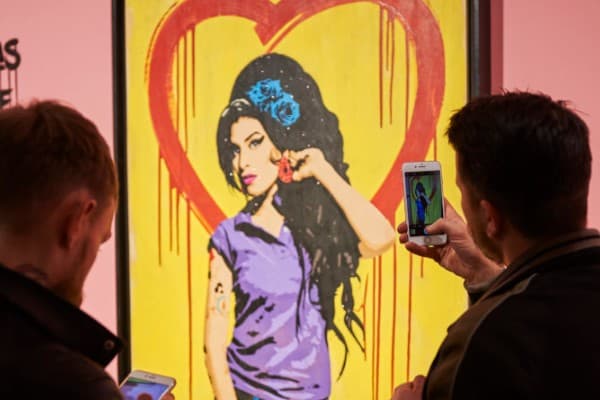
Visitors at the Amy Winehouse exhibition

However, again and again, the sums did not add up. Things had always been difficult pre-Covid but the museum had managed to keep its head above water, innovating, securing large numbers of school visits, sparkling with wonderful special exhibitions and so on. But Covid closed down everything and rebuilding numbers has apparently been an insurmountable struggle.

Finally, a few weeks back, its trustees threw in the towel. The building would have to close and last week a closing ceremony took place in the presence of the great and the good from both within and outside the Jewish community.

There is brave talk. Online programs will continue, the collection will remain accessible to researchers, a new more manageable – and affordable – building will be sought.

But it’s hard to see when, where or how a new physical museum will emerge. Although it had received various grants from government sources, both local and national, it has mostly had to wash its own face.

And being number six or 17 on almost everyone’s priority list – we all want to help but we’ve got other more pressing calls on our support – it seems hard to imagine the moment the phoenix will rise. And current talk is all about a Holocaust memorial and learning centres.

The trustees suggest five years’ time. Time will tell.

Photo: Jewish Museum of London

You might also like
  • Police eye Iran involvement as London synagogues are targeted in arson attacks
    Philissa Cramer
  • Golf club closure marks the end of an era in antisemitism
    Ashley Browne
  • The radical act of an open door
    Waseem Abu Mahadi
logomark.67a07ee3
We believe in the free flow of information

Republish our articles for free, online or in print, by using our Creative Commons licence

You might also like

    Apple & rotten core Rosh hashanah
    EditorialAustralia

    Facing a new year with the knowledge life can be better

    The Jewish Independent
    Jewish word map
    FeatureArts & Culture

    Was the barmi a shemozzle? How Australians use Jewish words 

    Caroline Hendy & Emma Breslow 1
    Netanyahu Ben Gvir Getty
    Israel Hamas WarAnalysisWorld

    Diaspora leadership must be candid about its disillusion with Netanyahu

    Colin Shindler 2

About the author

Clive Lawton

Clive Lawton

British-born Clive Lawton is co-founder of Limmud worldwide, and an internationally renowned educator in diversity issues and interfaith activity. He is currently CEO of the Commonwealth Jewish Council and was CEO of Rabbi Lord Jonathan Sacks' Jewish Continuity initiative.

More from the author

AnalysisWorld

Where can Jews feel safest? Not where you would expect

World

Britain’s moment of reckoning with the Windrush generation

Feature

Who has the right, or authority, to bestow Jewish identity on someone?