Aa
  • Read, Watch, Listen
  • TJI Series
  • Community Action
  • Events
  • Zedi
Follow us and continue the conversation
  • LinkedIn
  • Instagram
  • FaceBook
  • X
  • YouTube
Test yourself with the TJI Quiz!

Adjust size of text

Aa

Follow us and continue the conversation

  • LinkedIn
  • Instagram
  • FaceBook
  • X
  • YouTube

Your saved articles

You haven't saved any articles

What are you looking for?

Original reporting, insightful analysis and diverse views, delivered straight to your inbox

  • LinkedIn
  • Instagram
  • FaceBook
  • X
  • YouTube
Your support fuels our mission to inform, entertain and inspire.

The Jewish Independent is bound by the Standards of Practice of the Australian Press Council. If you believe the Standards may have been breached, you may approach The Jewish Independent or make a complaint to the Australian Press Council in writing at www.presscouncil.org.au. The Council may also be contacted on 1800 025 712.

  • Our Story
  • Contact us
  • Our Team
  • Support us
  • Guidelines
  • Pitch your idea
  • Republishing us
  • Community Action
  • Our Awards
  • LinkedIn
  • Instagram
  • FaceBook
  • X
  • YouTube
Aboriginal FlagTorres Strait Islanders Flag

The Jewish Independent acknowledges Aboriginal and Torres Strait Islander peoples as the Traditional Owners and Custodians of Country throughout Australia. We pay our respects to Elders past and present, and strive to honour their rich history of storytelling in our work and mission.

© The Jewish Independent 2026All Rights Reserved
Website design and development by Your Creative, MelbourneTerms & ConditionsPrivacy Policy
HomeRead, Watch, ListenWorld
AnalysisWorld

Jews, Muslims and the new Democrat-dominated Congress

The first Muslim US Senator shares much of his politics with veteran Jewish Senator Bernie Sanders - including on Israel-Palestine
Dan Coleman
Print this
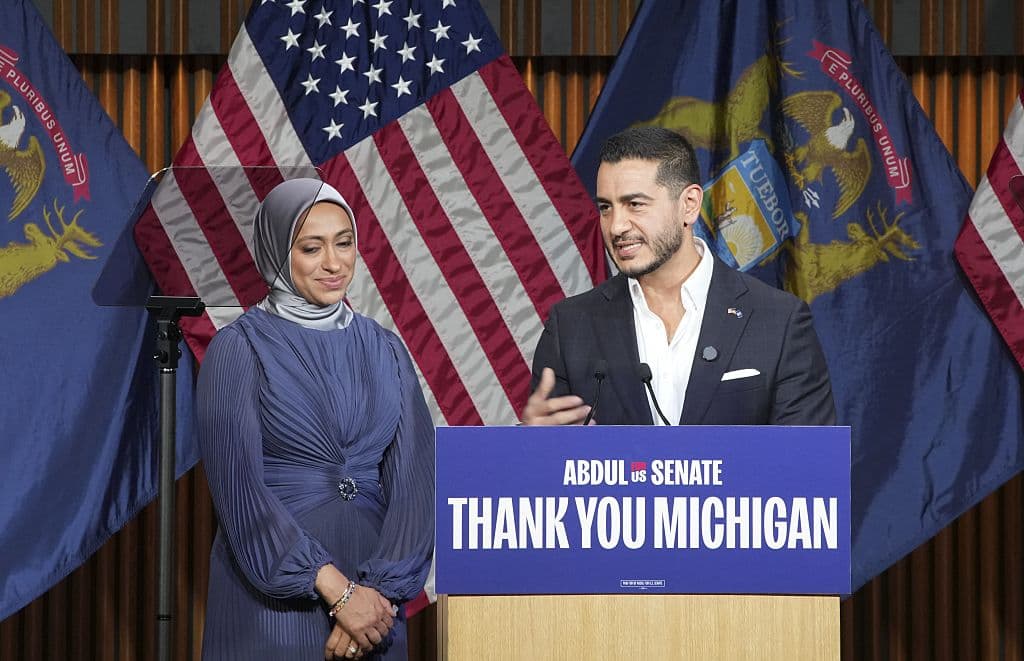
Abdul El-Sayed becomes 1st Muslim elected to US Senate in Michigan win

Democrat Abdul El-Sayed with his wife Sarah Jukaku after his election in Michigan made him the first Muslim US Senator (Katie McTiernan/Anadolu via Getty Images)

Published: 5 November 2026

Last updated: 5 November 2026

As Jewish Americans headed to the polls on Tuesday, their concerns about US relations with Israel were upended, not by any of the candidates, but by President Trump.

Trump announced that, under an agreement reached with Israeli Prime Minister Netanyahu, the bulk of US aid to Israel would be curtailed at the end of the year.

For 20 years, congressional debate on Israel has centred on the appropriate level of military aid in light of Israeli Prime Minister Benjamin Netanyahu’s flagrant violation of international law. Now, as the new Congress takes shape, Trump and Netanyahu are substantially removing the matter from the hands of Congress.

The announcement formed an unexpected cap to a campaign marked by fearmongering about the impact of a handful of far-left candidates on the US-Israel relationship.

Foremost among those targeted on the issue of Israel this campaign season has been incoming Senator Abdul El-Sayed. Sayed is a Muslim whose parents immigrated from Egypt before he was born. He has been subject to relentless Islamophobia from the most prominent Republicans, everything from racist plays on his name to suggesting, without the least foundation, that he had ties to the Muslim Brotherhood. El-Sayed is now the first Muslim to win a seat in the US Senate.

You would think that American Jews would be sympathetic to one receiving that kind of abuse, but El-Sayed has done much to hurt his cause. Jewish leaders criticised El-Sayed for his tepid response to antisemitic statements from leftist groups supportive of his campaign and for failing to rebuke antisemitic supporters.

His instincts have certainly been off. After an attack earlier this year on Michigan’s Temple Israel, he responded that “hurt people hurt people,” referring to the attacker having lost family in an Israeli airstrike in Lebanon. While there is indeed often a cyclical nature to violence, El-Sayed subsequently apologised for what was clearly an utterly insensitive comment.

Commenting on these and other matters, The New York Times columnist Bret Stephens, on election day, wrote a strident critique of El-Sayed, concluding that a vote for the Michigan candidate would be “a vote to further strengthen the forces of antisemitism in American politics.”

El-Sayed has faced full-throttle opposition from AIPAC’s political action committee. They spent some $30 million USD in support of his opponent, Republican Haley Stevens, in the primary and millions more in support of Rogers, much of it in ads targeting El-Sayed for his views and ethnicity.

While El-Sayed has been fiercely critical of Israel, in an interview with The New Yorker, he articulated a classic liberal position.

“I believe in equal rights to peace, dignity, and self-determination, for Palestinians and Jewish Israelis alike. And I believe that it is not my job as an American policymaker to decide what the ultimate peace should be. But it is my job to make sure that our resources are stewarded correctly for the people I’m responsible for: those kids going to those broken schools.”

On military aid to Israel, he said, “I don’t think we should be funding foreign militaries generally. That’s Israel. It’s also Egypt. It’s also Saudi Arabia and Qatar and UAE.” With this position, he echoes that of Senator Bernie Sanders, the most forceful critic of Israel in elected office in the US.

And, while people along a spectrum from AIPAC and Bret Stephens to the far-left Democratic Socialists of America may debate El-Sayed’s positions, they are not the matters that most voters care about. Recent polls indicate that, among all US voters, the top issues are the economy, healthcare, corruption, foreign policy (including Iran and Ukraine as well as Israel-Palestine), and immigration. Polls drilling down to Jewish or Muslim views give similar results.

El-Sayed’s emphasis on a three-pronged message: “money out of politics, money in your pocket, Medicare for all” speaks to the fundamental concerns of American voters and represents an agenda common among progressive candidates this year, including, for example, Senators Jon Ossoff (D-GA), James Talarico (D-TX), and Sherrod Brown (D-OH).

With the Democrats fully in control of both houses of Congress, we can expect initiatives on reining in inflation, reversing Trump’s cuts to Medicare, strengthening support for healthcare and education, calling out corruption, and ending the war with Iran.

In the current political climate, there will be strong critiques of Israel forthcoming. But, chief among these critics will not be junior Senator El-Sayed.

It will be veteran Senator Bernie Sanders who has been an outspoken critic of Netanyahu for years. Under the Senate’s majority system, Sanders will have increased power, matching the public prominence garnered from his two presidential runs. Bear in mind, however, that it is the President who controls foreign affairs; Congress controls only the purse strings.

El-Sayed’s victory diminishes the threat of AIPAC-funded primary challengers taking congressional seats. In 2022, for example, incumbent Jewish Democrat Andy Levin (D-MI), a supporter of Palestinian rights, was defeated by an AIPAC-funded primary opponent. This year, tens of millions in AIPAC spending did not go very far.

As for Abdul El-Sayed himself, I see no signs that he bears any animosity towards the Jewish people or anyone else. As the first Muslim senator, he joins a body that is 10 per cent Jewish. He has been working with Sanders for many years and seems to have a good relationship with soon-to-be Majority Leader Chuck Schumer. His background as public health director for Detroit, a large, diverse, and economically challenged city, reveals a caring and compassionate human being, an impression bolstered by his demeanour throughout this year’s campaign.


El-Sayed is more likely to be sharing war stories about facing discrimination with Sanders, as they strategise the most effective ways to help the Palestinian people.

You might also like
  • Traumatech Nation: How Israel became a mental health leader
    Maayan Hoffman
  • Historic step forward for Arab Israelis
    Ben Lynfield
  • Israel’s election fails to deliver a clear path to a government
    Shahar Burla
logomark.67a07ee3
We believe in the free flow of information

Republish our articles for free, online or in print, by using our Creative Commons licence

You might also like

    RAF Fairford arrests
    AnalysisWorld

    New evidence points to Iranian responsibility for Diaspora antisemitic attacks

    Colin Shindler
    Gab
    NewsWorld

    Traditional antisemitic myths dominate online antisemitism: new study

    Deborah Stone
    FRANCE-riots
    NewsWorld

    Synagogue and Jewish-owned shops damaged in French riots

    Ilan Bloom

About the author

Dan Coleman

Dan Coleman

Dan Coleman is a former member of the Carrboro, North Carolina Town Council, and a former political columnist for the Durham (NC) Morning Herald. He is the author of Ecopolitics: Building A Green Society. He lives in Melbourne.

More from the author

AnalysisWorld

Young Republicans show alarming rise in antisemitic views

FeatureWorld

Controversial frontrunner makes mayoral race a test for Jewish New Yorkers 

AnalysisWorld

Trump and MAGA turn on Israel over scale of bombing and settler attacks

AnalysisWorld

On heels of the ceasefire, Trump II era begins