Published: 25 August 2017
Last updated: 4 March 2024
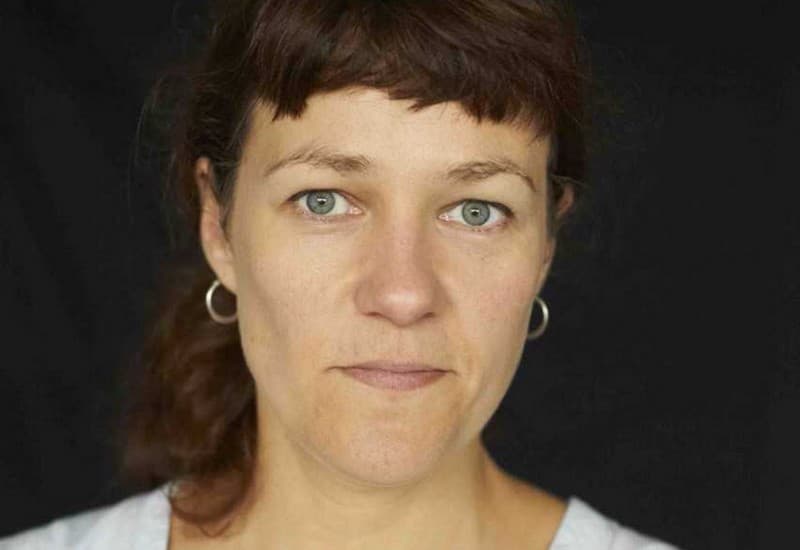
Ever since she can remember, award-winning novelist British Rachel Seiffert has known her grandparents were Nazis. Her grandfather was a doctor in the Waffen SS; her grandmother was an active party member. These facts were never hidden by Seiffert’s mother. On the contrary, they were talked about, openly.
Instead of thinking of this as a curse or a source of shame, Seiffert regarded it as a gift. It gave her the impetus and material for The Dark Room, her debut trilogy of stories about Germans and World War Two. The central story, Lore, is based on her mother’s own experience of crossing Germany as a teenager in the devastating aftermath of the Hamburg firestorm. It was made into a hauntingly powerful film by Cate Shortland in 2012.
We are talking via skype from her London home ahead of her visit to Australia as a guest of the Sydney Jewish Writers Festival this weekend. Seiffert, 46, says: “I can’t remember how old I was when she told me, but as an adult, I feel nothing but gratitude. In my mid-twenties, when I was thinking about writing, the family gave me a gift, an insight into what it was like to be on the wrong side of history. That question has preoccupied me ever since.”
As a child, there were hard moments: Seiffert was bullied and teased at school for being German. “And the only idea I had of who the Nazis were came from the way they were portrayed in pop culture.”
Now 84, her mother has never taken up British citizenship, despite living there since 1967 when she came to the UK to marry Seiffert’s father, an Australian academic teaching at Birmingham University. “I see it as a form of atonement. She feels she has to fully own what it means to be a German of her generation.”
For a decade after writing The Dark Room, Seiffert struggled to arrive at her present public candour about her heritage. “My brother had asked me to delay writing an article about it and I had to respect his privacy. But it felt very hard, especially when I was interviewed by journalists who were Jewish. I finally came out with the truth at the London Jewish Film Festival after a screening, during a Q and A. There were two seconds when I thought ‘Oh god, what have I done?’ but then I was engulfed in a huge wave of sympathy.”
[gallery columns="2" size="large" ids="13245,13246"]
There had been more shocks along the way. “After I wrote The Dark Room, when I was in my thirties, my mother mentioned that my grandfather was in the SA (Sturmabteilung: Storm Detachment, the original paramilitary wing of the Nazi party). I went completely ballistic, shouted, had a total meltdown, and my mother was really taken aback. She thought I already knew. And perhaps she had told me, and I had not paid attention or understood the difference.”
Her dual cultural heritage meant that Seiffert viewed the recent Brexit referendum result as a total shock. “I am still not able to process it. Not that I was not sympathetic to those who felt hard done by - it’s just that they are using the EU as a scapegoat for their dissatisfaction. The immigration debate was ugly and wrong, instead of being grown up and open. It’s been painful to watch Britain harden its heart to outsiders. Seventy years ago, we took in the children who arrived as refugees via kindertransport. Now, we are turning Syrian children away.”
Seiffert’s new novel A Boy in Winter, revisits World War Two and its seemingly endless source of stories that explore humanity’s moral grey areas. She had been intending to write an entirely different story about her godmother. “She was the eighth of nine children from a mixed marriage and they all survived despite the constant slow chipping away at the family by the Nazis.”
[gallery ids="13248"]
The research overwhelmed her (‘I found myself writing a history of Hamburg’) and she failed to find the incident that would provide a hook for the narrative. “When I read the Klemperer Diaries, which tells exactly that story, I thought: why write a novel?”
Meanwhile, new characters introduced themselves to her. A young girl called Yasia, who finds herself protecting two young Jewish boys in the Ukraine in 1941; an engineer called Pohl, who has been charged with building a road through territory the Nazis have occupied and is having misgivings about his labour force. “I tried them out, to see what they were willing to do of their own free will in a push-comes-to-shove situation. Yasia is an innocent, who becomes invested and implicated. Pohl is a realist, so when it comes to taking a stand, I had to force his hand,” says Seiffert, who based Pohl on a real life Haupttruppfuhrer in the Organisation Todt.
The book contains several harrowing scenes. If they are hard on the reader, what can they be like to write? “I do feel pain and emotional turmoil during the process,” acknowledges Seiffert, who completed the novel in 18 months. So how does she reward herself when the task is complete? She appears briefly stumped by the question. “Just completing the book is a reward in itself,” she offers, almost embarrassed that her reply might seem lame or unduly modest.
Even as the last survivors of the Holocaust die, real life stories continue to emerge on both sides. Asked about the recent testimony of the late 106-year-old Brunhilde Pomsel, the woman who was Joseph Goebbels' secretary and claimed to know nothing of the Final Solution, Seiffert does not hesitate: “People have the capacity to deny what’s right in front of them. We are doing it now about climate change. We make moral bargains with ourselves every day.”
A Boy in Winter, by Rachel Seiffert, is published by Virago
Caroline Baum is the author of Only: A Singular Memoir (Allen & Unwin)
Caroline Baum will be in conversation with Rachel Seiffert and Cate Shortland on August 27 at the Sydney Jewish Writers Festival. Details: www.shalom.edu.au
This The Jewish Independent article may be republished with this acknowledgement: ‘Reprinted with permission from www.thejewishindependent.com.au ’



Comments
No comments on this article yet. Be the first to add your thoughts.