Aa
  • Read, Watch, Listen
  • TJI Series
  • Community Action
  • Events
  • Zedi
Follow us and continue the conversation
  • LinkedIn
  • Instagram
  • FaceBook
  • X
  • YouTube
Test yourself with the TJI Quiz!

Adjust size of text

Aa

Follow us and continue the conversation

  • LinkedIn
  • Instagram
  • FaceBook
  • X
  • YouTube

Your saved articles

You haven't saved any articles

What are you looking for?

Original reporting, insightful analysis and diverse views, delivered straight to your inbox

  • LinkedIn
  • Instagram
  • FaceBook
  • X
  • YouTube
Your support fuels our mission to inform, entertain and inspire.

The Jewish Independent is bound by the Standards of Practice of the Australian Press Council. If you believe the Standards may have been breached, you may approach The Jewish Independent or make a complaint to the Australian Press Council in writing at www.presscouncil.org.au. The Council may also be contacted on 1800 025 712.

  • Our Story
  • Contact us
  • Our Team
  • Support us
  • Guidelines
  • Pitch your idea
  • Republishing us
  • Community Action
  • Our Awards
  • LinkedIn
  • Instagram
  • FaceBook
  • X
  • YouTube
Aboriginal FlagTorres Strait Islanders Flag

The Jewish Independent acknowledges Aboriginal and Torres Strait Islander peoples as the Traditional Owners and Custodians of Country throughout Australia. We pay our respects to Elders past and present, and strive to honour their rich history of storytelling in our work and mission.

© The Jewish Independent 2026All Rights Reserved
Website design and development by Your Creative, MelbourneTerms & ConditionsPrivacy Policy
HomeRead, Watch, ListenAustralia
OpinionAustralia

‘Australian values’ – an immigration test with no answer

A new documentary on post-war migration reminds us of the threat of letting in the wrong migrants, but recent policy proposals fail to address it fairly.
Isabelle Oderberg
Print this
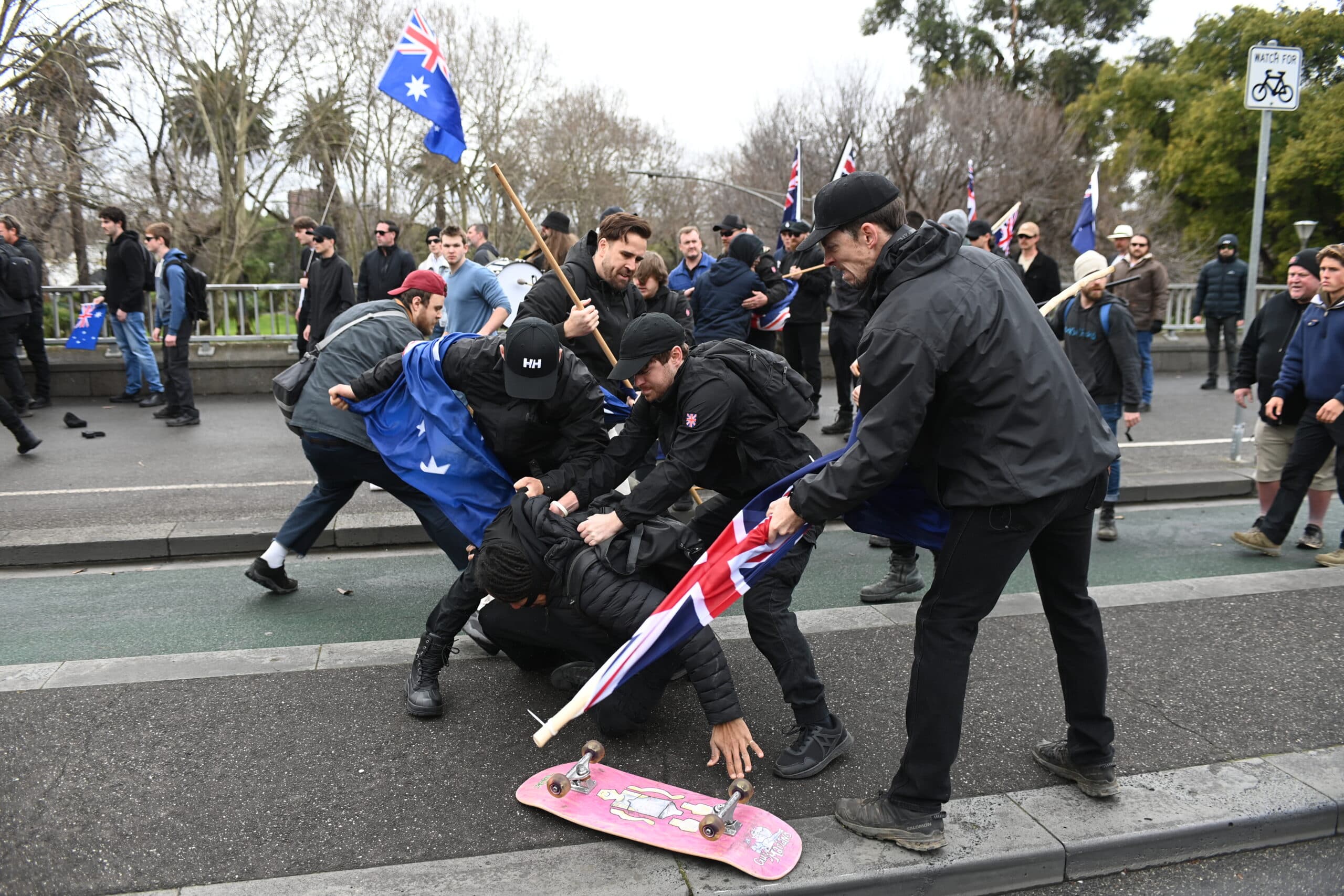
A fight at the anti-immigration protest in Melbourne on Sunday where pro-Palestinian and anti-immigration protesters clashed

A fight at the anti-immigration protest in Melbourne in September 2025 (AAP/Michael Currie).

Published: 11 May 2026

Last updated: 11 May 2026

There are a handful of topics guaranteed to get everyone’s blood boiling faster than a comments section can turn feral, but if it’s a throwdown you’re looking for, the topic of immigration is always a safe bet.

All sides of the immigration debate walk into the conversation with an overdeveloped sense of fight or flight, hypersensitive to being called a racist or being exposed to racism. Irrespective of what anyone is trying to say, the conversation usually devolves into fireworks in seconds.

A few weeks ago, I went to a preview screening of a new doco set to air on SBS this month. The Hunt For The Last Nazis – by award-winning writer, producer and director Dan Goldberg – examines Australia’s post-war immigration policy, which sought to restrict Jews while allowing thousands of Nazi war criminals to build comfortable, post-war retirements in leafy suburbs around the country and subsequent attempts to track down those criminals and bring them to justice. 

It’s an excellent, albeit harrowing, account of missed opportunities, racism and how certain aspects of immigration policy have historically, and are still, letting us down.

Any Australian knows from the waves of migration over the two centuries since the British invasion of this stolen land, despite all the fear-mongering and racist mudslinging, that immigration has brought us culture, vibrancy and community.

Beyond the beauty of it, our economy cannot and will not survive without immigration. Our birth rate is declining. We have an ageing population. We have critical skills shortages in areas including healthcare, construction and education. 
Predictably, as soon as Federal Opposition leader, Angus Taylor, unveiled his immigration plan, the conversation devolved into a slanging match. Unsurprising, given the lack of thought or genuine insight; it’s a policy with no factual or informed grounding and the clear objective of appealing to voters who are veering towards parties espousing more right-wing narratives.

Test based on 'values' is perplexing

His proposal for immigration based on "values", rather than nationality or race, involving a "values test" under the Migration Act, was perplexing at best. 

Which “values” test? Which “Australian values”? Is Taylor talking about the historically documented Australian values that sought to restrict Jewish migration after the Holocaust, discussed at length in Goldberg’s documentary? 

The Australian values that put in the place the White Australia Policy? The Australian values under which Aboriginal people are disproportionately dying in prison in record numbers? Or the value we place on the lives Aboriginal and Torres Strait Islander people, who die almost a decade before non-Aboriginal Australians?

Or are we talking about the Australian values demonstrated by Ahmed Al Ahmed, who immigrated to Australia in 2006 from Syria and voluntarily disarmed a gunman during the Bondi massacre, putting his own life in jeopardy?

Or are they the Australian values that allowed for a sponsored work visa to be given to a white, South African, neo-Nazi who appeared at a protest at NSW Parliament, central to which was a banner reading “abolish the Jewish lobby”.

How about Liam Alexander Hall, who allegedly threw a pipe bomb into an Invasion Day rally in Perth? Police claim the accused had accessed “pro-white” material online and was ideologically driven. Those values?

Surprising facts about threat assessment

Because if we’re going to talk about “Australian values”, we really do need a level of specificity.

The great shame of Taylor’s “policy” on immigration is that it took valuable airtime away from crucial conversations about immigration that we desperately need to have. 

However, those conversations are often shut down due to the sort of discomfort I explained above. It’s not dissimilar to the discomfort that materialises whenever there’s a conversation about Israel and Palestine, which too often devolves in the blink of an eye into allegations of terrorism, terrorism apologia, antisemitism or any combination of the above. 

In February 2025, ASIO’s Director General, Mike Burgess, delivered his Annual Threat Assessment. It makes for sobering reading. He talks about fracturing social cohesion, radicalisation of young Australians and the most likely sources of threats to national security.

Guess how many times the word “immigration” appears in his statement? Not once. Not a single mention. Immigration, for the man literally tasked with this country’s security, in 2025, was apparently not front of mind.

This is likely due to these things called “the internet” and “social media”. We don’t need to “import” extremism or hatred. We can access it freely at home, on the tram, in the car, any time we bloody well like, actually.

Extremist ideology ensnares people who, justifiably or unjustifiably, feel hard done by; who feel victimised or isolated. Purveyors of extremist thought engineer their nets specifically to capture targets who already self-identify as being “under attack” or “threatened”. The full descent into that world of madness is just a click away. 

Impact of lone wolves

According to Burgess, the biggest risk to Australian security and political acts of violence, is from “lone actors” with access to weapons. A prescient prediction, given what we know about the massacre at Bondi.

“The impacts of social media, mental health, the spread of misinformation and conspiracy theories, ubiquitous encryption, growing grievance and the radicalisation of minors all require whole of government, whole of community, whole of society responses,” he said.

“I remain concerned about young Australians being caught up in webs of hate, both religiously and ideologically motivated….” Burgess added.

Right now, there are two crucial conversations we need to have about immigration. The first, as raised in the documentary, is why we don’t have a policing unit in Australia tasked with investigating alleged war crimes or crimes against humanity committed overseas by Australians or people now living in Australia.

Just like Holocaust survivors who realised they were living alongside Hitler’s henchmen in leafy suburban Australia, why should survivors of genocide in Rwanda or Sudan be forced to live alongside the perpetrators of some of the worst crimes against humanity? Against their own friends and family? 

The second is around why we don’t have adequate support services for immigrants who come here to make Australia their home. Some of those immigrants come from war-torn regions, places where women aren’t educated or taught to drive; some have no English.

Assuming that at least some of what Taylor alludes to is the “fair go” we’re apparently so good at, why are we not giving those people the “Australian” welcome they deserve?

And why do we have so many people already in this country who are falling into the black endless pit of extremist thought? Why are we not putting in place the social support and interventions that we know reduces the number of people wandering down this rabbit hole? 

Burgess pointed out in his address in 2025 that: “You cannot arrest your way to social cohesion. You cannot regulate your way to fewer grievances. You cannot spy your way to less youth radicalisation. In this environment, national security is truly national security – everybody’s business.”

We need less knee-jerk politicking and political posturing and more fact-based intervention. We have the knowledge, but we need less loud people with a microphone and more “experts” leading us to evidence-based solutions that we know work. We need to focus on “de-isolating” young people and other cohorts at risk and providing intervention and support.

And moreover, what we need more than anything in the world, is less hysteria, less shouting and more constructive, fact-based conversations. Where do we import that from? 

The Hunt For The Last Nazis will air on SBS at 7.30pm on May 31 on SBS.

You might also like
  • UK Jews talk of leaving for Israel but few actually do
    Colin Shindler
  • For years, governments knew there were Nazis living in Australia and covered it up
    Dan Goldberg
  • Thousands of Indian Jews head to Israel, despite discrimination  
    Ben Lynfield
logomark.67a07ee3
We believe in the free flow of information

Republish our articles for free, online or in print, by using our Creative Commons licence

You might also like

    funding handouts
    NewsAustralia

    Who will get the money from the Cranbourne windfall?

    Gideon Cohen
    Commissioner Virginia Bell
    Royal CommissionAnalysisAustralia

    Now is the time for the Royal Commission to deliver, not be politicised

    Dean Sherr 2
    chanukah by the sea bondi
    Royal CommissionOpinionAustralia

    Safety not just security: the last word to the Royal Commission

    Yehoram Ulman 1

About the author

Isabelle Oderberg

Isabelle Oderberg

Isabelle Oderberg's journalism has appeared in The Age/SMH, Guardian, ABC, Meanjin and elsewhere. She also worked as a media and communications strategist across the not-for-profit sector. She is the author of Hard to Bear: Investigating the science and silence of miscarriage (Ultimo Press), and Chair of the Early Pregnancy Loss Coalition. Learn more at eplc.au.

More from the author

OpinionAustralia

The new McCarthyism: Anti-Zionist witch hunts

OpinionArts & Culture

Randa Abdel-Fattah is a perverse poster child for free speech

OpinionArts & Culture

I would have attended Bendigo Writers Festival… and said anything I liked

Comments1

  • Avatar of LAURANCE SPLITTER

    LAURANCE SPLITTER14 May at 07:38 am

    I strongly support the views expressed here. I would just offer an additional reason for being sceptical of the concept of “Australian values”. If such values include “fairness”, etc., then what makes them worthwhile is not that they are Australian, but that they are values which characterize all decent human beings. No need to play the nationalist card here.