Published: 25 October 2016
Last updated: 5 March 2024
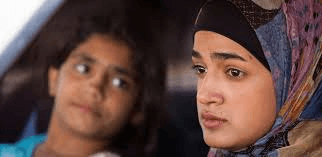
Sand Storm (2016) is an Israeli film written and directed by Elite Zexer, with attention to details and lots of love. This is her first film and, after seeing it, I am happy to wait patiently for the second. Patience will be necessary because achieving quality of this kind takes time. Time for thorough research, for writing and rewriting the script, for shooting and reshooting the takes until they are right and for going through every line and part of a scene with the actors, so that even when they are silent, they still say it all.

It took ten years from Elite’s first meeting with these Bedouin families to the release of the completed film. She became intrigued by some of the Bedouin women she met and their life stories ignited the idea for the film. Sand Storm is a family drama that takes place in a Bedouin village in the Israeli desert. It tells the story of Jalila, a 42 year-old woman, whose husband has just married a second, much younger, wife and Layla, her 18 year-old daughter, whose secret, strictly forbidden love affair, has just been unveiled. The two women have different views of the world, and each tries to deal with life changing events in her own way. Slowly they learn to work more with each other and to see the world also through each other’s eyes.
Though the film is set in Israel, and made by an Israeli, many Israelis may be prompted to turn to Google after watching the film, to get a better understanding of the behind-closed-doors culture of the Bedouin community. The Arab-Israeli actors in the film had to learn the dialect and culture of their Bedouin neighbors, just as much as the Jewish-Israeli scriptwriter and director did.
There has been extraordinary Jewish-Arab-Bedouin collaboration in the making of the film. Overcoming much inter-communal conflict and negativity, the Jewish-Arab crew worked with love and respect for each other. Their friendship and affection for each other shine through in the film, and beyond it in interviews and at events such as when collecting yet another prize for the film, including the Sundance film festival Jury prize and many more.

Director Elite Zexer and actress Lamis Ammar (Layla)
The film deals with particular Bedouin conventions as well as more general or universal messages. For example, one reason Layla is forbidden to see a Bedouin man from another tribe, found also in many traditional or religious cultures, is that women are not supposed to have any type of unsupervised contact with men from outside the family. This is believed to be essential for a woman's good name and reputation and, if she breaks this rule, she shames not only herself but her whole family, risking their status in the community and risking any sisters’ chances too of eventually finding good husbands. Operating in addition, however, and more specific to the Bedouin, is a strong preference for women to marry within the tribe. Marrying outside the tribe would mean a woman would have to leave the village, but Bedouin parents strive to keep their daughters close, to have them live nearby, and to keep them and their children as part of the extended family.
The film is made from the women's point of view, as they struggle within the limits of the traditional world surrounding them. Asked what inspired her to write and make it, Elite Zexer answered: “After years of traveling with my mother to Bedouin villages, I experienced one special encounter. My mother and I escorted a young woman during her wedding to a strange man, a man she only married to please her family, while she secretly loved another. Minutes before she met him for the first time, she turned to me and said: ‘This will never happen to my daughter.’ I looked at her and felt my stomach turn. That's the moment I knew that I had to make this movie.”
But it’s not only the women who struggle. The limitations on women, enforced by the men, harm them as well as the women. The men are portrayed as if constrained also to suppress their real wishes, which adds another layer of complexity to the characters in the film.
Sand Storm is one of those rare films capable of eventually promoting changes in real life. It may help a new generation of Bedouin to express more of their real feelings and to loosen the traditional bonds of oppressive, and expressive, silence. But whether that happens or not, the creation of Sand Storm has already built bridges between three different sections of Israeli society and drawn attention to moving and often hidden struggles for gender equality.
Sand Storm features as part of the Jewish International Film Festival, with multiple screenings in Melbourne, Sydney, Auckland, Brisbane, Canberra and Perth, commencing 26 October and running into November. See here for full programme in each location and to buy tickets.
This The Jewish Independent article may be republished if acknowledged thus: ‘Reprinted with permission from www.thejewishindependent.com.au ’

Comments
No comments on this article yet. Be the first to add your thoughts.