Aa
  • Read, Watch, Listen
  • TJI Series
  • Community Action
  • Events
  • Zedi
Follow us and continue the conversation
  • LinkedIn
  • Instagram
  • FaceBook
  • X
  • YouTube
Test yourself with the TJI Quiz!

Adjust size of text

Aa

Follow us and continue the conversation

  • LinkedIn
  • Instagram
  • FaceBook
  • X
  • YouTube

Your saved articles

You haven't saved any articles

What are you looking for?

Original reporting, insightful analysis and diverse views, delivered straight to your inbox

  • LinkedIn
  • Instagram
  • FaceBook
  • X
  • YouTube
Your support fuels our mission to inform, entertain and inspire.

The Jewish Independent is bound by the Standards of Practice of the Australian Press Council. If you believe the Standards may have been breached, you may approach The Jewish Independent or make a complaint to the Australian Press Council in writing at www.presscouncil.org.au. The Council may also be contacted on 1800 025 712.

  • Our Story
  • Contact us
  • Our Team
  • Support us
  • Guidelines
  • Pitch your idea
  • Republishing us
  • Community Action
  • Our Awards
  • LinkedIn
  • Instagram
  • FaceBook
  • X
  • YouTube
Aboriginal FlagTorres Strait Islanders Flag

The Jewish Independent acknowledges Aboriginal and Torres Strait Islander peoples as the Traditional Owners and Custodians of Country throughout Australia. We pay our respects to Elders past and present, and strive to honour their rich history of storytelling in our work and mission.

© The Jewish Independent 2026All Rights Reserved
Website design and development by Your Creative, MelbourneTerms & ConditionsPrivacy Policy
HomeRead, Watch, ListenWorld
FeatureWorld

‘Your help is extremely needed’: Jewish aid group on the ground after Nepal flood

The Joint is already on the ground distributing aid to the thousands bereaved, wounded and homeless after the flash flood in Nepal
Peter Kohn
Print this
JDC Joint Nepal

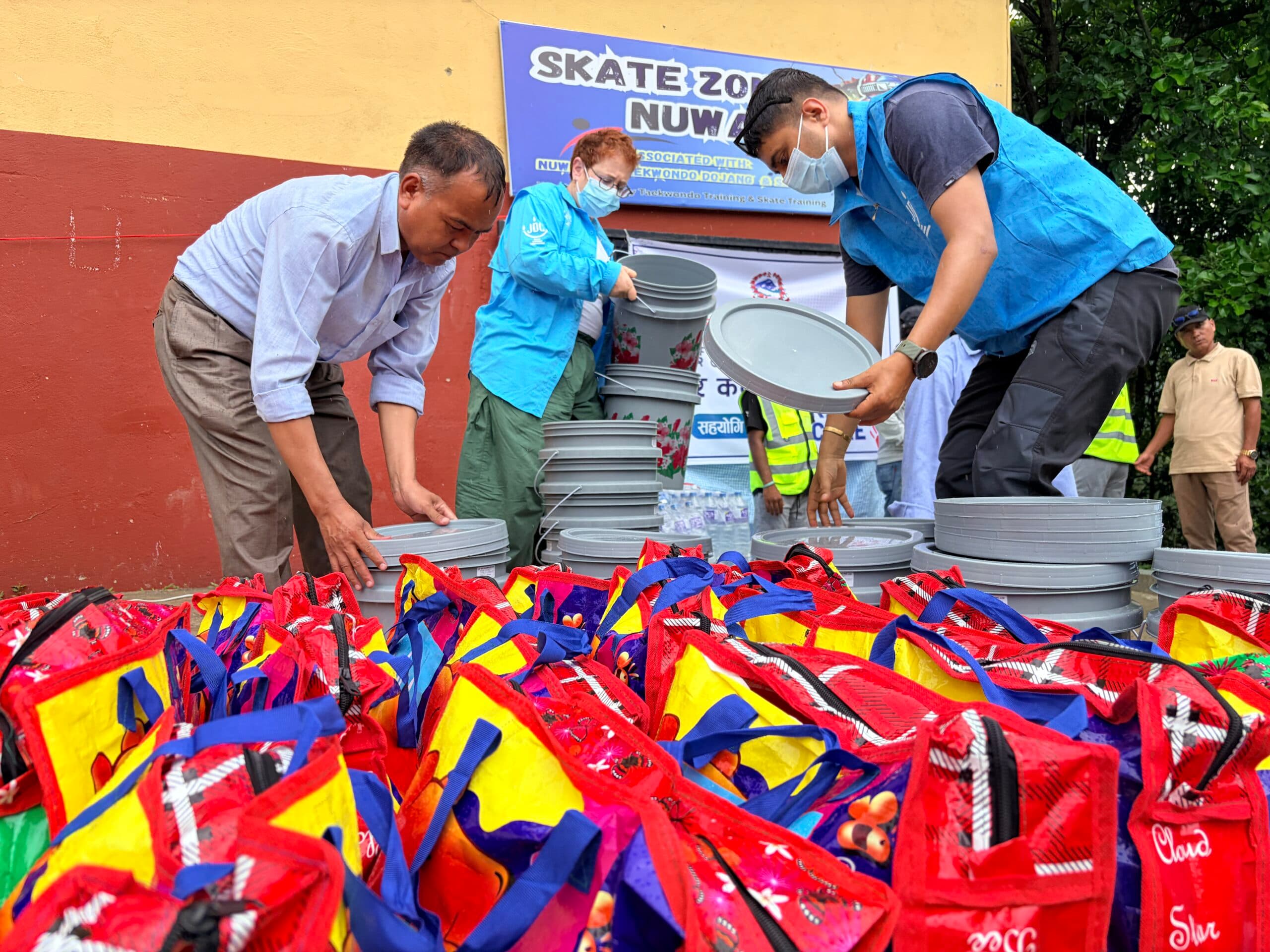
Joint workers including Avital Sandler-Loeff (middle) prepare aid for Nepal’s flood victims

Published: 9 September 2026

Last updated: 9 September 2026

In the aftermath of the catastrophic flash flood that struck the Nepal-Tibet border region on August 26, the Jewish Joint Distribution Committee (JDC or “The Joint”) has swung into action, with its aid workers providing critical relief.

Triggered by a glacial collapse, the wall of water that crashed through the remote region has so far claimed 1,342 lives, according to media reports on September 7. Some 5,000 people remain unaccounted for, among them 30 Jews, including two Israelis.

JDC Australia emphasised the major role that Jewish Australians can play in supporting the 112-year-old global Jewish aid organisation’s relief effort.

TJI was able to conduct a Zoom interview with two key Israeli JDC officials who are on the ground in Nepal.

Avital Sandler-Loeff, executive director of JDC’s humanitarian services, and Mickey Noam-Alon, JDC’s director of disaster response, arrived in Nepal’s capital, Kathmandu, on Friday, September 4, and visited the disaster zone. They will remain stationed in Nepal for several days, coordinating JDC’s relief effort.

The JDC officials are applying the organisation’s policy of operating through local aid workers who are familiar with local conditions.

“These are people who know the community from within, who have all the right networks, who are coordinated with local government. We first and foremost design the intervention in partnership with them, and help them with our perspective from working in disasters globally in the last 50 years,” said Sandler-Loeff.

“That represents value. We can work with them on the ground – they can travel, they speak Nepali, which I unfortunately don't. It's really been as local as possible and supported as internationally as needed. That's been our approach, and it's been very efficient.”
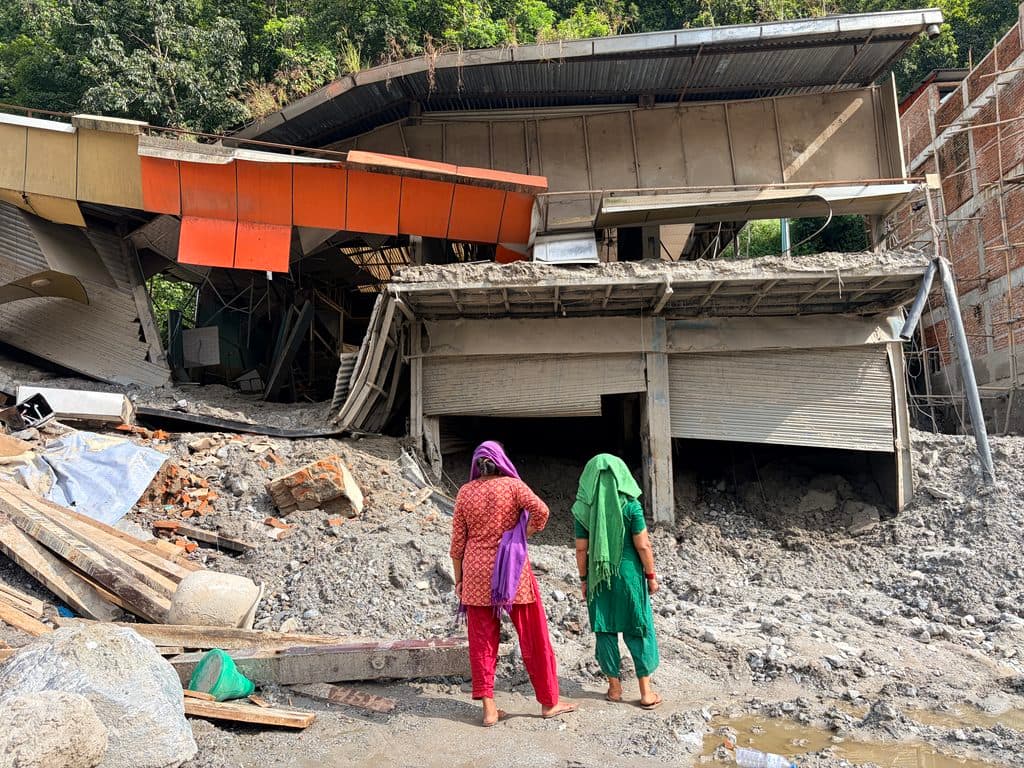
JDC has contracted a local coordinator who has worked with the former USAID. The representative is advising Sandler-Loeff and Noam-Alon on the most effective ways to help victims in Bidur (in the Nuwakot District) and in the Rasuwa District, two of the most devastated areas.

Locals survey a ruined house

“This coordinator was hired recently to be our ongoing boots on the ground and helps us coordinate our work in this disaster. He is new to JDC,” said Noam-Alon.

Sandler-Loeff said JDC’s previous experience in Nepal is of immeasurable help now, with training acquired after the 2015 quake being applied to the flooding emergency.

JDC team members worked in Nepal between 2015 and 2019 with multiple local organisations, implementing projects as part of JDC’s extensive support following the earthquake.

Prioritising the most effective ways to help the 2026 flood victims is important, she said. “Will it be water? Usually, purifying water is very much needed. Is it medical assistance? Do we need to open a mobile clinic? Who do we need to work with to make sure that we bring non-food items like blankets, sleeping bags?”

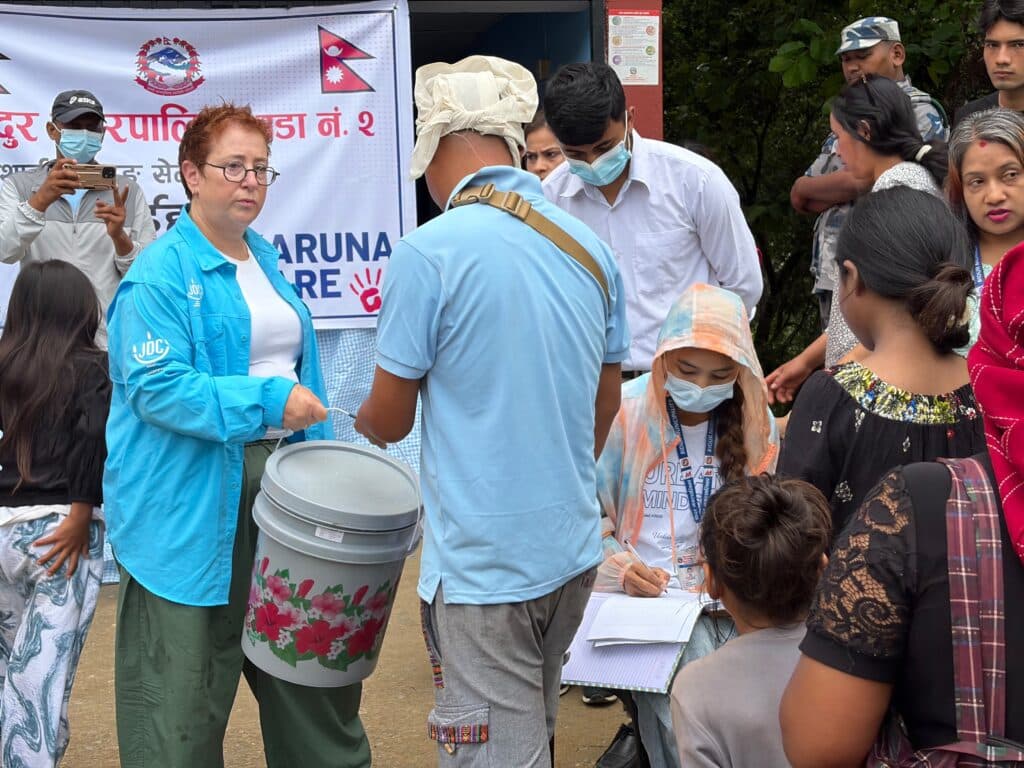
Sandler-Loeff and Noam-Alon were briefed on what was needed most. Food supply targets have broadly been met for now, but there is a crying need for kits that provide basic hygiene, for soap and other essentials that can stave off an epidemic.

“It’s really about the most basic things: purifying water, buckets to store water coming from the water tanks that are distributed through the government and the aid agencies.

“People are coming with nothing on them, so toothbrushes, towels, toothpaste, all the things that are so basic – it’s the first we bring.”

 Avital Sandler-Loeff (left) aids Nepal's flood victims (JDC)
Avital Sandler-Loeff (left) aids Nepal's flood victims (JDC)

Sandler-Loeff said the risk of an epidemic outbreak is high because there are few places for survivors to shelter, something that became clear to them quickly. Schools and other public buildings are being used to house people. “The main thing we worry about is the risk of an epidemic, the supply of water and sanitation.”

Noam-Alon said the Nepalese government is very focused on maintaining overall control of international rescue and relief efforts, after experiences with duplication of services that occurred after the 2015 earthquake. “We need, of course, to respect that,” he added.

“That’s also why we are trying to be very well coordinated. We work well within the system, and we find how we can be the most useful. Although we really want to be as helpful as we can, we want to respect how Nepalis work to help themselves,” he said, adding that people who receive assistance need to be registered to avoid duplication.

“We bring equipment to places that haven’t yet been visited or helped by any other organisation – that’s extremely important to us,” he said.

Sandler-Loeff emphasised that Australian aid workers have offered significant assistance.

The JDC humanitarian chief – who has been with JDC for many years and through many disasters, including this year’s earthquakes in Venezuela and Colombia – spoke about the white handkerchiefs worn by young Nepali men who have lost their parents in the flood disaster, a traditional Hindu symbol of bereavement. She described a seven-year-old girl waiting in an aid line who was permitted to go to the front of the queue because, local officials explained, her entire family has vanished.

For an instant during our interview, Sandler-Loeff became emotional. “We’re not vaccinated from feelings,” she explained.

Jewish Australians have begun responding strongly to a JDC donor campaign for Nepal. Joint Australia director Brett Kaye noted that JDC was on the ground in Nepal within 24 hours of the flood disaster. The organisation is working to “provide support on the ground, to deliver aid to people who need it the most”.

Kaye said Joint remained in Nepal for several years after the earthquakes in 2015. “So we know we have very strong relationships on the ground in Nepal because we were there for so many years, delivering aid. Right now, we can respond very quickly with our trusted partners that we've worked with for years.”

He said the response by Jewish Australian donors to JDC’s 2026 Nepal campaign so far has been encouraging. “There's no doubt the response to this particular request has been greater than we've seen for a long time.”

Grounded in the Jewish value of tikkun olam (repairing the world), JDC deploys immediate medical and humanitarian responses to major international crises, such as earthquakes, floods, and refugee situations, regardless of religion or nationality.

Michael Pollak, JDC’s NSW director, said Joint distinguishes itself from many other Jewish philanthropic organisations with its broad focus. “Having spent time in rural Nepal, this tragedy really hits home. I’m incredibly proud that The Joint puts our Jewish values into action, standing with people in their darkest moments, regardless of their faith or background, wherever they may be.”

Sandler-Loeff said the inspiration for her work is that Jews have a shared history of knowing what it feels like to be destitute and unaided. She is determined to see that not repeated for any people. She urged Jewish Australians to join the JDC’s massive relief effort. “Your help is extremely needed.”

To donate to the JDC Nepal relief effort, visit https://www.mycause.com.au/page/403620/help-flood-survivors-in-nepal

You might also like
  • The reasons Israelis have closed their eyes to Gaza
    Shira Efron
  • ‘Humanitarian area’ in Gaza designed to pressure civilians to leave Strip
    Ben Lynfield
  • ‘Everyone wants to work here’: Foreign workers still flock to war-torn Israel
    Hannah Moshinsky
logomark.67a07ee3
We believe in the free flow of information

Republish our articles for free, online or in print, by using our Creative Commons licence

You might also like

    Turkiye, Saudi Arabia and Pakistan sign trilateral defense pact
    AnalysisWorld

    New Saudi-Pakistan-Turkey alliance driven by failure of US to subdue Iran

    Dror Doron
    Netanyahu Ben Gvir Getty
    Israel Hamas WarAnalysisWorld

    Diaspora leadership must be candid about its disillusion with Netanyahu

    Colin Shindler 2
    interfaith war
    FeatureWorld

    The illusion of Just War: Conflict ethics in Judaism, Christianity and Islam

    Dave Moskovitz

About the author

Peter Kohn

Peter Kohn

Peter Kohn is an Australian journalist who began his career at the Herald & Weekly Times. For 43 years, he was associated with The Australian Jewish News. For the past decade, he held the title of Senior Journalist at the newspaper. He is the author of two novels. Rachel’s Chance is the story of his family’s experiences as Jewish refugees in Shanghai during World War II, and View From A Sandcastle is based on his own story, growing up in Melbourne suburbia during the 1960s and 1970s.

More from the author

NewsAustralia

Strategies for cohesion final focus of Royal Commission hearings

NewsAustralia

Evidence of declining social cohesion and the efforts to turn it around

NewsAustralia

Hate preachers, polarised debate, counter-terrorism

Comments

No comments on this article yet. Be the first to add your thoughts.