Strategies for cohesion final focus of Royal Commission hearings
The final hearings were supposed to focus on positive strategies but there were some disturbing sidelines
Peter Kohn
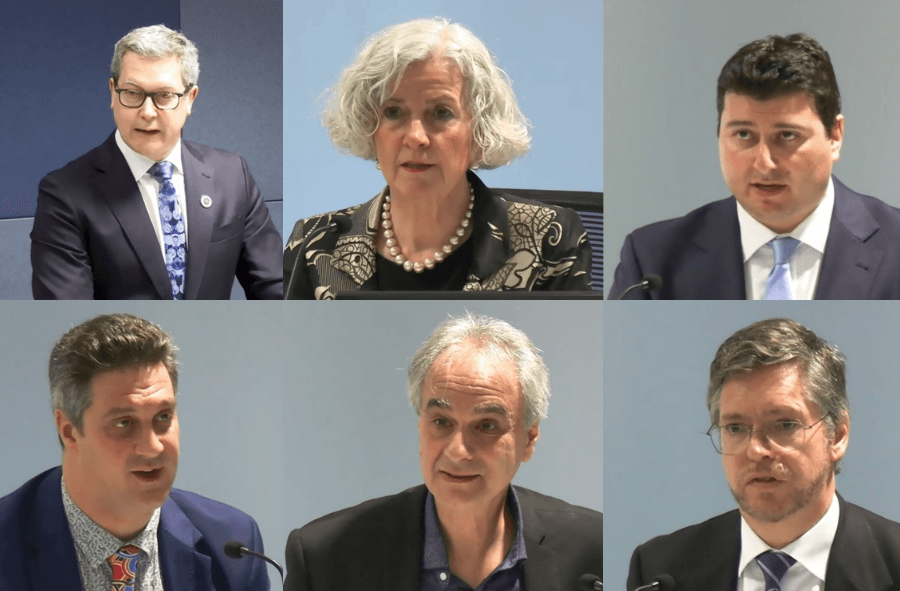
Among those who gave evidence at the Royal Commission this week were (clockwise from top middle): Stephanie Forster, Mayor Will Nemesh, Lord Mayor Nicholas Reece, Rabbi George Mordecai, Mayor Alex Makin
Published: 27 August 2026
Last updated: 28 August 2026
Social cohesion was the theme during the final hearing block of the Royal Commission (RC). Remarkably then, in one session this week, it heard a view that proponents of Zionism are quite legitimately deserving of “dehumanisation”.
It was a deeply disturbing session, particularly coming in the final hearing block of a landmark RC to which Jewish Australians and a rainbow of cultural and religious communities in this nation look for a way forward.
Launched in response to last December’s Bondi Beach terrorist attack, by a federal government initially opposed, the RC under Commissioner Virginia Bell, a retired High Court justice, has become the platform from which Australians expect direction.
There is a clamour for wisdom – about how to restore a sense of what was lost on December 14, and what has been eroding for some years before that Chanukah Sunday evening, and how to find practical ways to protect all Australian minorities, some with sharply contrasting narratives.
In its final week, the RC itself became the news, with political debate flaring up over a decision to finish it early – on Wednesday, two days ahead of schedule. Coalition leader Angus Taylor described the early finish as “a betrayal of the Jewish community”.
He was no doubt tapping into views in some parts of the Jewish community that federal government figures, including Prime Minister Anthony Albanese, Home Affairs Minister Tony Burke and Foreign Minister Penny Wong, should have been compelled to give testimony. NSW Premier Chris Minns weighed in, saying a few weeks longer, if needed, “would be money well spent”.
Addressing the RC on its final day of hearings, Richard Lancaster SC, counsel assisting, noted that over its nine thematic hearing blocks spanning 62 hearing days, the RC has heard from 346 witnesses. Additionally, it has received more than 20,000 public submissions (of which more than 14,000 were from Jewish witnesses) and has also compulsorily acquired some 550,000 pages of information.
Commissioner Bell expressed her understanding of frustrations in the Jewish community that testimony on aspects of the Chanukah attack could not be taken from witnesses publicly due to criminal proceedings underway. But she added, “After the conclusion of the criminal proceedings, I propose that substantial parts of the confidential volumes of the interim and final reports should be made public.”
Bell said she would submit her report on December 18 instead of the original deadline of December 14, because a report publicised on the solemn first anniversary of the Bondi Beach shootings “would be a distraction”.
She concluded that “the commission is well placed to document the nature and extent of the antisemitism that has flourished in Australia against a backdrop of events in the Middle East, particularly since October 7, 2023”.
‘Dehumanisation’ of Zionism supporters
The testimony from Rita Jabri Markwell, legal adviser to the Australian Muslim Advocacy Network (AMAN) – that her organisation is entitled to argue that advocates of Zionism should be fair game for those who want to treat them as less than human – was stunning. It’s fair to state that most reasonable people would agree that beliefs like that do not bode well for cohesion.
Under cross-examination, Markwell conceded that dehumanising speech is dangerous, as it primes people to perceive targets who are not subject to even fundamental considerations of humanity. But then she stated that AMAN’s “framework”, while not allowing “dehumanisation” for “protected characteristics”, does allow “dehumanisation” of people based on political beliefs they espouse.
(The controversial AMAN “framework” – of which Markwell is a principal drafter – identifies 12 distinct categories of “dehumanising” speech and conduct). That “framework” legitimises exposing supporters of Zionism to “dehumanising” conduct on the calculus that, in Markwell’s testimony, Zionism, in all its aspects, is a form of violent extremism.
Nicholas Bender SC, counsel for various Jewish organisations, took Markwell to an article in The Jewish Independent, in which Mia Klein, an RC “lived-experience” witness, had described being evicted from an Australian share house because of her Zionist beliefs. She had responded by writing a letter to other members of the share house in which she stated that, although she was a strong critic of Israeli PM Benjamin Netanyahu and supported a two-state solution, she was adamant that Zionism is not based on ethnic cleansing of Palestinians.
Markwell responded, “I haven’t yet heard a Zionist explain to me how they incorporate Palestinian human dignity and human rights into their ideological framework.”
When asked if she knew that many Jews who support a two-state solution also embrace Zionism, Markwell responded that “it’s not necessarily relevant to my analysis of Zionism as someone who studies dehumanisation”. Asked whether the AMAN “framework” would allow a supporter of Zionism to be “dehumanised” in Australian public life, she responded, “Zionism could be spoken about with disgust and fury. Yes, under that framework, it could be.”
Commissioner Bell asked Markwell whether, beyond her beliefs about Zionism, she accepted “a legitimacy to the existence of the State of Israel”, based on the 1947 UN partition resolution. Markwell said, “I don’t think I have a view, particularly on the time of that declaration. But I know that if you were to ask me now whether I think the state has legitimacy, I, as a human rights lawyer, I don’t think that any state that relies on unlawful occupation and apartheid and genocide could be said to be a legitimate state.”
In her testimony, New Israel Fund (NIF) Australia’s executive director Kate Rosenberg said NIF supports the national antisemitism framework but continues to push for distinctive measures within it, pertaining to antisemitism.
She took issue with a trend in recent years by some within the Jewish community to see antisemitism in isolation, rather than as a subset of wider racist behaviour, and to ask for it to be combated in a specific manner, which sets it apart from other forms of racism.
Rosenberg qualified that in the aftermath of the October 7 attacks on Israel and the Bondi Beach terrorism, Jewish Australians feel the need for a Royal Commission finding “which has antisemitism on every line” and agreed “that is necessary as well”.
“But unless we deal with racism in Australia in a holistic manner that tackles it systematically, the Jews won’t be any safer either,” she said.
She described competing views that antisemitism is distinct and that it is a form of racism as a false choice: both views “can be true”. While antisemitism has “unique identifying factors and therefore its own unique requirements in tackling it”, Rosenberg added that “it cannot be tackled unless all of racism is tackled”.
Rosenberg said social cohesion needs to be built around difficult subjects, but that Australian solutions often confine themselves to comfortable zones at the margins. “Oh, you like music. I like music. Oh, you also make this kind of bread in your tradition,” she said, describing a mindset that seeks shortcuts to cohesion.
“In trying to solve the problems that we are facing here in society, it can be easy to avoid the discussion of Israel and Palestine, and to focus on the other things that might bring us together across groups,” she said. “We must not shy away from the difficult conversations.”
She referenced Solutions Not Sides, a program in UK schools, which invites a Jewish Israeli and a Palestinian to give classroom presentations, developing from historical narratives to concepts of civics, discernment in media consumption and clear thinking. The British initiative “stares the beast right in the face and then extrapolates it out further to achieve the aim of social cohesion”.
The RC heard about the Australian Cohesion Forum (ACF), a recently founded not-for-profit organisation dedicated to “inter-cultural relationships”. ACF co-directors Roz Mendelle and Simonne Whine described its Living Archive project, which records testimonies of survivors from a wide array of violent, traumatic experiences.
Inspired in part by Ruptured, an anthology of 36 Australian Jewish women writing about their experiences after October 7, edited by Lee Kofman and Tamar Paluch, Living Archive began taking testimonies from diverse Australian communities a few weeks before the Bondi Beach attack. The archive includes dissidents who fled the Iran regime and South Sudanese survivors.
Whine reflected, “You can’t not have empathy when you hear a real-life, lived experience story.”
Attending an ACF forum at which he shared the podium with Jewish and Yazidi youth speakers, Devavrath Parasuram, a young Hindu student, and a co-founder of Hindus Down Under, testified about his shock at hearing the accounts of Jewish students trying to carry on a normal life at university.
The Sydney law student and economics graduate said the experiences were related by Jewish students during a panel event run by the ACF in April at which he spoke alongside Yazidi and Jewish youth representatives. One Jewish student, describing campus life, recounted being spat on by a stranger on the way to class.
Parasuram had personally felt welcome on campus, which made the Jewish students’ experiences all the more worrying to hear. “What really struck me was … the difficulties they have, the lack of confidence to even go to class without having to feel like they were in danger ... we might all be students, but some are treated differently to others.”
Recounting an interfaith event last year between Hindu and Jewish youth celebrating Chanukah and Diwali, he said, “Two different festivals, but we were able to both share the meaning over dinner and gain an understanding of each other.”
Parasuram said the long-term value of the event is that if a Jewish student might encounter anti-Hindu tropes, particularly online, they would have their personal recollection to rely on. He said the Jewish and Hindu groups are continuing to meet, and held an event at the Art Gallery of NSW recently, touring an exhibition of Hindu art.
“You wouldn’t insult someone … if you actually had met them and had that empathetic connection,” he concluded.
Journeying beyond the comfort zone
A Jewish witness identified only as “Jessica” told the RC about a trip to a mosque in Lakemba, the southwestern Sydney suburb with the country’s highest proportion of Muslim Australians. Jessica was in a volunteer group which was welcoming a Somali woman and her mother to Sydney under the Community Refugee Integration and Settlement Program.
A group member of Lebanese origin accompanied her and introduced her to a Somali cleric who made further connections for them. The visit took place after the Chanukah attacks, and both Jessica and their host took the opportunity to ask how the other was dealing with matters. For Jessica, it was December 14; for the religious leader, it was the general rise in Islamophobia.
Jessica was enriched by “getting to go to parts of the community you don’t normally go and meet people you don’t normally meet”.
Her testimony reverberated with that of Sydney’s Rabbi George Mordecai, co-founder of Coming Together, a multi-faith bridge-building venture that began after the October 7 attacks. The face-to-face group navigates ideological gulfs and the often awkward conversations that spring from them. It has survived intact, even after the Chanukah terrorism. “I felt that we should make alliances across difference, even in this most tumultuous of times,” the rabbi told the RC.
Jewish Australians have a right to feel concerned when overseas visitors who have publicly expressed antisemitic views make it through the screening process and are granted visas, a senior Department of Home Affairs official testified.
Stephanie Foster, the Department’s secretary, conceded that in some cases the person in question was only removed after their statements had been publicly revealed.
She was taken to three cases in which visa cancellation had occurred only after the individual’s arrival. Mizanur Rahman Azari, who reportedly described Jews as “the biggest terrorists of the world” – and had already been refused entry into the UK in 2021 – made it through all the filters and arrived in Australia.
His visa was only cancelled after Jewish organisations approached the Home Affairs Minister. Another preacher, Sheik Ahmadulla, had his visa cancelled in April and social media icon Sneako suffered the same fate after media reporting exposed him.
Questioned about whether Home Affairs could have acted pre-emptively in such cases, Foster emphasised that decisions were made on information available at the time.
Former Tasmanian Liberal Premier Peter Gutwein, now chair of the Australian Multicultural Council (AMC), warned that a developing national narrative of blame against migrants threatens Australia’s multicultural cohesion.
He said weaponising migration for political purposes has seen simplistic messaging blaming job losses and housing costs on new arrivals. Government has an obligation to help define the narrative, he said.
He urged federal Parliament to reaffirm its commitment to multiculturalism, as strongly recommended by the AMC, which advises the government on multicultural policy, a reaffirmation that has not properly materialised, he said.
Gutwein said business and industry groups have a particular obligation to ensure that the nation is broadly committed to what he called “living well together”.
The arts, celebrities and history
Peter Ivany, a board member and director of organisations such as the Art Gallery of NSW, NIDA and the Museum of Contemporary Art, lamented the tendency of celebrities and performers to offer their casual opinions on complex world issues. “You’ve got a whole range of influencers and actors that all of a sudden become experts on 5,000 years of warfare in the Middle East.”
He called for government arts funding to be conditioned on recipient groups not inciting divisiveness or hatred. He said senior appointees to publicly funded institutions should undergo due diligence. “Their social media hasn’t been checked. Their previous history hasn’t been checked … when you go for any job, all that has to be checked before you go in. And government jobs shouldn’t be any different.”
Almost half of Australian Jewish participants in competitive sport have experienced or witnessed antisemitism at matches and events. Those findings emerged from a survey conducted by Maccabi Australia from 669 responses to a poll the Jewish sporting organisation took of its membership totalling some 17,000 this year.
David Goldman, Maccabi Australia general manager, pointed out that fewer than a third of the respondents had reported the antisemitic incidents they witnessed.
The RC explored sport as a bridge, with Commissioner Bell asking Kevin Nafte, who played in and later coached an Israeli-Palestinian Australian Rules football team, if he believed that, based on his interactions with the Palestinian footballers, there might be some acceptance that Palestinians and Israelis could one day live next to each other in peace. Nafte responded, “I saw glimpses of that.”
A witness under the pseudonym AEB detailed Connection Camp, a two-day event held at the West Tigers Centre of Excellence at Concord Oval in Sydney’s inner west during this year’s April school holidays. Some 120 students in Years 3-6 of different faith backgrounds played football. There were 50 Jewish, 50 Muslim and 20 Christian children.
Kids of different faiths were blended into both teams, so it would not be seen as an on-field contest between religions. The event included social sessions with kosher and halal food. National Rugby League players from Western Sydney Wanderers and West Tigers attended both days.
Children who had arrived in their own groups soon began mingling, said AEB, and parental feedback has been so positive that a second camp is now planned for October.
Local government, foreign affairs
Testifying on Monday, Melbourne’s Lord Mayor Nicholas Reece urged the Department of Foreign Affairs & Trade (DFAT) to take a deeper involvement in community forums that focus on overseas issues and Australian foreign policy, questioning whether local councils are the best environment for such activities.
Reece referred to a highly controversial 2024 Melbourne City Council meeting which spent some five hours debating a motion titled “Reflecting Community Sentiment on the Humanitarian Crisis in Gaza”. Outside the Melbourne Town Hall, more than 1,000 gathered, with some protesters banging on the doors. “It’s a council meeting I will never forget,” said Reece.
While councils should not totally shut themselves off as instruments of community dialogue on world issues, Reece questioned the present situation. “Is that the best use of local government – spending five hours debating a complex geopolitical conflict on the other side of the world, where the decision that’s made in that council chamber will be of no consequence to that conflict?
“We don’t have a Department of Foreign Affairs in local government either, and so our ability to actually form a judgment and get advice on something like that is limited as well.”
He recommended establishing DFAT-run community forums based on a model the department had operated through AusAid in the past decade.
Closer to home, removing offensive graffiti has been a task that Melbourne City Council has done well, he said. In the past two years, the council has removed almost 4,000 square metres of antisemitic graffiti, including images of a Star of David with a red line through it.
Under its zero tolerance policy on offensive graffiti, the council operates a 24/7 removal service with a target of one hour between reports and removals. Reports can be made through the council’s website, its call centre or the Snap Send Resolve app to which photos can be attached.
Solidarity from local councils
Local government has a definite role to play in fostering social cohesion, argued Will Nemesh, Mayor of Waverley Council in Sydney’s eastern suburbs. His LGA includes Bondi Beach and is home to the largest Jewish population in NSW, with more than 11,000 people – 16 per cent of the LGA’s population.
After the 2023 Hamas attacks, Waverley became the first Australian municipality to formulate an antisemitism strategy, which became a national model.
In the days after last December’s Chanukah killings, more than 40 NSW mayors were brought to Bondi Beach to lay wreaths. Waverley organised Light After Darkness, a commemoration of the December 14 victims which was held on the last day of Chanukah. Since then, Waverley has hosted an interfaith and intercultural Shabbat dinner at Bondi Beach.
Beyond these acts of commemoration, Waverley has been behind the council programs Cultural Waves, a five-month immersion for 14 to 18-year-olds and Perfect Strangers, which invites diverse people to meals.
The Adass Israel Synagogue, which was firebombed in late 2024, is located in Melbourne’s Port Phillip LGA – and Mayor Alex Makin recounted three initiatives in the immediate aftermath – the mayor of the time attending on-site, a liaison officer to support the community, and a vigil on the day after.
Following the Bondi Beach attack, Port Phillip liaised with neighbouring Glen Eira Council in formulating a statement of solidarity with its Jewish citizens. The two municipalities with the highest ratios of Jewish residents in the nation helped widen it to a statement on behalf of all councils in Victoria. Its final sentences read, “To our Jewish community, we say we see you, we stand with you. This is your home, and you should not feel afraid.”
About the author
Peter Kohn is an Australian journalist who began his career at the Herald & Weekly Times. For 43 years, he was associated with The Australian Jewish News. For the past decade, he held the title of Senior Journalist at the newspaper. He is the author of two novels. Rachel’s Chance is the story of his family’s experiences as Jewish refugees in Shanghai during World War II, and View From A Sandcastle is based on his own story, growing up in Melbourne suburbia during the 1960s and 1970s.