Aa
  • Read, Watch, Listen
  • TJI Series
  • Community Action
  • Events
  • Zedi
Follow us and continue the conversation
  • LinkedIn
  • Instagram
  • FaceBook
  • X
  • YouTube
Test yourself with the TJI Quiz!

Adjust size of text

Aa

Follow us and continue the conversation

  • LinkedIn
  • Instagram
  • FaceBook
  • X
  • YouTube

Your saved articles

You haven't saved any articles

What are you looking for?

Original reporting, insightful analysis and diverse views, delivered straight to your inbox

  • LinkedIn
  • Instagram
  • FaceBook
  • X
  • YouTube
Your support fuels our mission to inform, entertain and inspire.

The Jewish Independent is bound by the Standards of Practice of the Australian Press Council. If you believe the Standards may have been breached, you may approach The Jewish Independent or make a complaint to the Australian Press Council in writing at www.presscouncil.org.au. The Council may also be contacted on 1800 025 712.

  • Our Story
  • Contact us
  • Our Team
  • Support us
  • Guidelines
  • Pitch your idea
  • Republishing us
  • Community Action
  • Our Awards
  • LinkedIn
  • Instagram
  • FaceBook
  • X
  • YouTube
Aboriginal FlagTorres Strait Islanders Flag

The Jewish Independent acknowledges Aboriginal and Torres Strait Islander peoples as the Traditional Owners and Custodians of Country throughout Australia. We pay our respects to Elders past and present, and strive to honour their rich history of storytelling in our work and mission.

© The Jewish Independent 2026All Rights Reserved
Website design and development by Your Creative, MelbourneTerms & ConditionsPrivacy Policy
HomeRead, Watch, ListenArts & Culture
InterviewArts & Culture

New films capture uniqueness of Jewish Australia

A new generation of filmmakers are turning their lenses inward, capturing the resilience and nuances of Australian Jewish life post October 7. 
Ruby Kraner-Tucci
Print this
JIFF 2025 Short Films

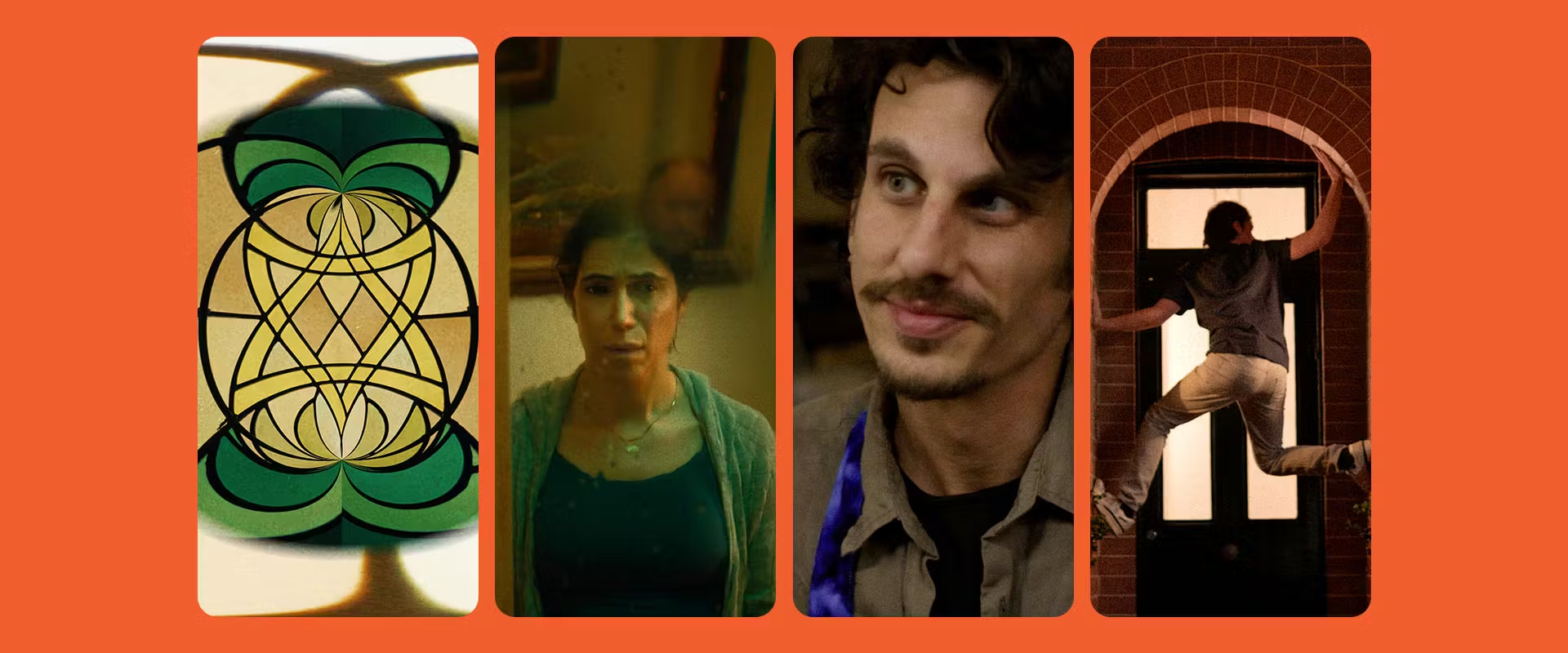
The four JIFF25 Short Film Fund productions (Image: JIFF).

Published: 23 October 2025

Last updated: 23 October 2025

Four Australian short films will premiere at this year’s Jewish International Film Festival (JIFF), each responding to the experiences of local Jewish life post October 7. 

The films are supported by the Jewish Australian Screen Fund (JASF), which partnered with JIFF to provide $30,000 to the filmmakers – the biggest grant pool to date. The newly-established fund is the brainchild of Jamie Bialkower, who aims to address the lack of Jewish narratives and creatives being financed in Australia, and to increase Jewish representation on screen.  

“The four films are unique, unexpected, and self-contained but collectively, they are in conversation with each other, offering a nuanced and thought-provoking look at this moment in time we are living through,” Bialkower told The Jewish Independent. 

“Having these films exist is an acknowledgment in itself – we've captured this, with no agenda other than to have our voices heard.” 

The four filmmakers behind this year's JIFF25 short films (clockwise from top left): Adam Dostalek, Anita Lester, Jacob Melamed and Benjamin Levitt (Image: supplied).

The Jewish Independent spoke with each of the four filmmakers about what audiences can expect from their upcoming short productions. 

Crumbs: ‘We should be practising nuance’ 

After reading Sholem Aleichem’s legendary The Railroad Stories – a series of observations following Eastern European Jews riding trains between shtetls – Anita Lester said her short film Crumbs appeared to her quickly.  
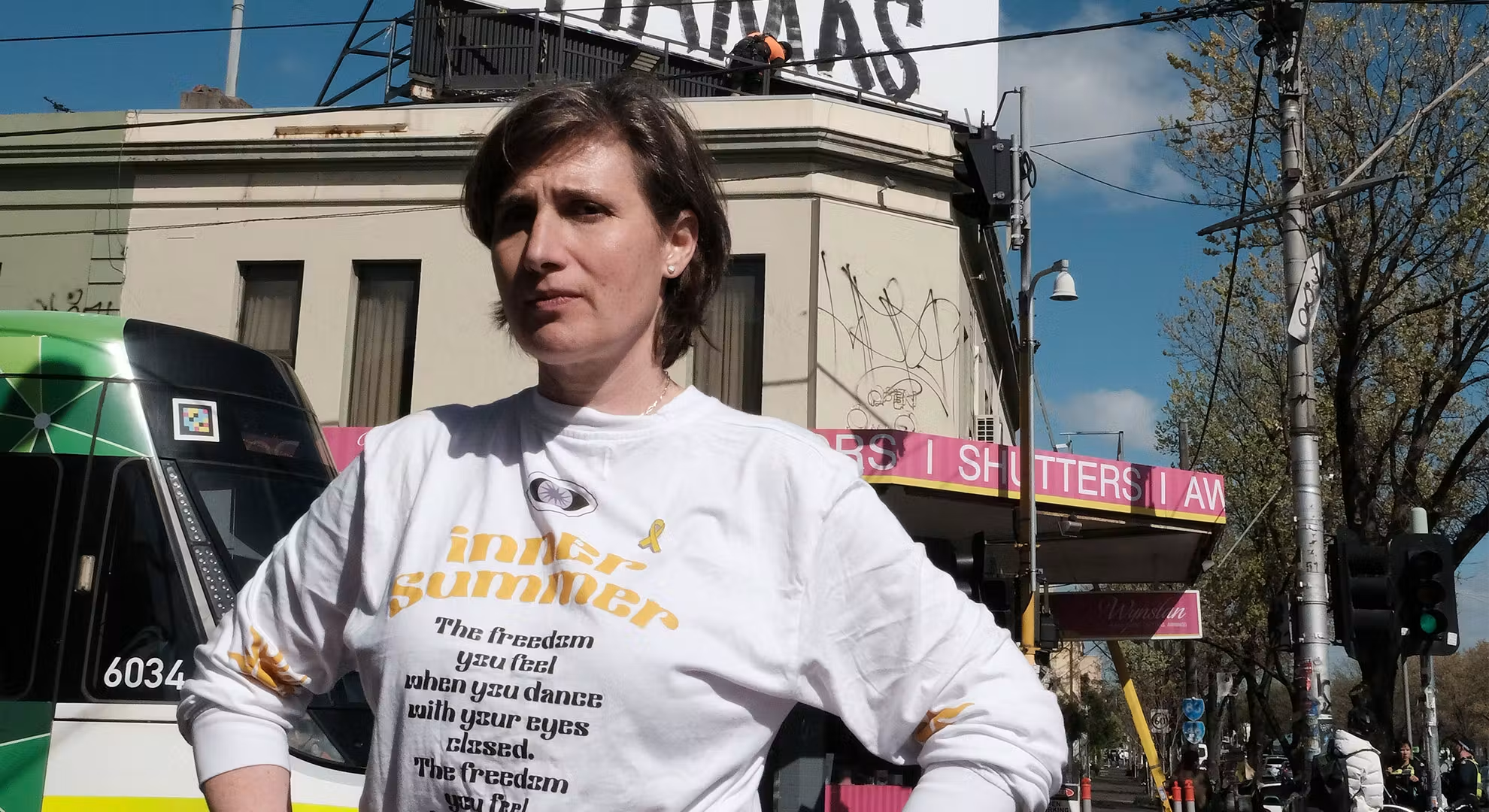
“Initially I wanted to do Railroad Stories 2025, but shooting on a train was impossible, so I came up with this idea of doing it in the equivalent home of transit in the Jewish community in Melbourne, which is just so a bakery,” Lester told TJI. 

"Australian Jews, but especially Melbourne Jews, have a very, very unique story to tell"

Crumbs tells seven “small, semi-humorous" anecdotes that encapsulate the experiences of a spectrum of Jews waiting in line at a bakery over the course of a day. Some are directly inspired by Aleichem’s stories, while others draw from Lester’s first-hand experiences, including the hours she personally spent in line at friend Maaryasha Werdiger’s infamous bakery, Zelda. 

The cinematography is intentionally voyeuristic, helping audiences feel as though they are eavesdropping, while the actors were cast with the aim of being as authentic as possible. The result is a commentary on Jewish life in Melbourne post-October 7, with scenes discussing pro-Israel rallies and anti-Zionist Jews, among others. 

“Australian Jews, but especially Melbourne Jews, have a very, very unique story to tell. The majority of us come from Holocaust survivor families and the Yiddishkeit is so strong. That I feel should be captured and supported.” 

Lester hopes that by spotlighting the diversity of the community, audiences can appreciate the importance of debate and discourse that respects our differences. 

“The Jewish community has a culture of 1,000 opinions and we should not be against each other. We should listen to each other even through those differences. If we are preaching nuance, then we should be practising nuance as well.” 

The Promised Land: ‘What have we learned since the Holocaust?’ 

Adam Dostalek agrees with Lester: “It’s okay to disagree with somebody,” he told TJI. 

The director wants his short film, The Promised Land, to empower audiences to confront the “global, universal conversation that so many people, whether you're Jewish or not, are having in today's age: how do I feel about what's going on in the Middle East?” 

Written by award-winning Australian playwright Ron Elisha, The Promised Land presents a simple, yet powerful, story. Set in one location and featuring just two characters over three distinct acts, the film follows 90-year-old Polish Holocaust survivor Godel (Linal Haft), who tries to convince his young carer Rebecca (Alexis Fishman, who also co-produced the film) that it is her duty to make aliyah.

"To have the opportunity to create a story that is so connected to my people, to my culture, to my way of life... is wonderful"

“It’s a very simply constructed story, which is something that I quite like as a director,” Dostalek continued. “What I'm interested in is what is not written on the page, what is not being said. Who are these characters? Who are these people behind the dialogue? What layers can I build? That's the process in which we took to make this film, and why I think it's really strong.” 

Dostalek says he feels “so lucky” to champion Australian Jewish stories – especially one that speaks to his own experiences.  

“The Australian film industry is hard enough, so to not only create a beautiful story, but to have the opportunity to create a story that is so connected to my people, to my culture, to my way of life, and for me to blend that into the art of filmmaking is wonderful.” 

Shpatzir: ‘A gentle confrontation on Judaism’ 

Benjamin Levitt's short film Shpatzir is also deeply personal. 

Levitt, who is not religious, would always pass a synagogue on his way to the local shops – but could never bring himself to go in. His protagonist in Shpatzir encounters the same moral dilemma.

“I’ve never, ever gone in. I don’t know if it was Jewish guilt or a genuine want, but that pushed me to make this film,” Levitt told TJI. 

Shpatzir was a small, “hands-on” affair for Levitt, who co-wrote, directed and produced the film with David McKinnar, while also acting in it and composing the score. It’s set in the synagogue closest to Levitt’s home in Kew – a suburb in Melbourne’s east that once housed a thriving Jewish community, but now runs services just monthly. 

"I think primarily I want to make people laugh or smile at the mental state we’ve all been in for two years"

The choice of a shule away from Melbourne’s bagel belt was intentional: Levitt wants Shpatzir to bridge what he sees as a "large gulf” between Jewish culture and religion. 

“I would like people to think about what their relationship is with the religious part of Judaism. I’m not religious myself, but it is a part of our culture and sometimes it can be really comforting to be in that space. 

“I think primarily I want to make people laugh or smile at the mental state we’ve all been in for two years, which isn’t easy, but I feel as though approaching life before October 7 and after in that way is quintessentially Jewish.” 

Mezuzah Man: ‘I was uncomfortable putting a mezuzah up’ 

Like Levitt, writer and director Jacob Melamed made Mezuzah Man following his own experience of leaving home post October 7 and finding himself fearful of putting up a mezuzah. 

“I didn't feel comfortable with people knowing that I was Jewish. I thought there's a story there, so I wrote about my experience,” explained Melamed. 

Mezuzah Man follows passionate protagonist Yossi, who takes it upon himself to reclaim his community’s sense of pride, after rising antisemitism has caused them to become fearful. 

"It was a beautiful affirmation that the Jewish community is helpful and just want to feel like they belong and aren’t afraid"

“I decided I'd write it from the perspective of somebody I wished I could be. I wish I was that proud Jew that could wear a Star of David, that could put a mezuzah up, that could be open without any judgement or fear. But that's not me.” 

Melamed took the film’s core message of Jewish pride literally, making Mezuzah Man “as Jewish as possible” through representation across both the cast and crew, shooting real Jewish homes across Sydney, and involving community members in the production. 

“It was a very collaborative, communal effort to get this across. It was a beautiful affirmation that the Jewish community is helpful and just want to feel like they belong and aren’t afraid. 

“I really want people to walk out of this film feeling like, if they were afraid to put a mezuzah up before, maybe they'd be less afraid now. Or if they're still afraid to put one up, at least to think, well, what's the worst that could happen?” 

The Short Film Fund Shorts will premiere at the Jewish International Film Festival 2025. Learn more and book tickets online. 

You might also like
  • Rising to take back Israel
    Peter Kohn
  • Your guide to the 2025 Jewish International Film Festival 
    Kathy Laster
  • Everything to see at JIFF 2024
    Ruby Kraner-Tucci
logomark.67a07ee3
We believe in the free flow of information

Republish our articles for free, online or in print, by using our Creative Commons licence

You might also like

    why main 4th
    PodcastArts & Culture

    Why we need to find our why now: new TJI podcast

    Ittay Flescher and Courtney Winter-Peters 1
    haredi street guitar
    Photo EssayArts & Culture

    Jerusalemites through the lens

    Sharon Gabay
    Wake main 2nd
    FeatureArts & Culture

    New ‘spoken word’ festival in Sydney offers stories directly from creators

    Miriam Hechtman

About the author

Ruby Kraner-Tucci

Ruby Kraner-Tucci

Assistant Editor

Ruby Kraner-Tucci is a journalist and TJI's assistant editor. Her writing has appeared in The Age, Australian Jewish News, Time Out and Broadsheet, among others. Ruby was awarded Multicultural NSW’s Best Report in Multicultural Media 2025 and has been named a Top 36 Under 36 Jewish Changemaker by B'nai B'rith.

More from the author

FeatureAustralia

‘True essence of being an ally’: The non-Jews choosing to work in the Jewish community

InterviewAustralia

Elliot Szafran: food that feels like a hug from Zaide

NewsAustralia

Antisemitic incidents down from peak but still triple pre-Gaza war

FeatureArts & Culture

Bringing Terezin music to life 

Comments

No comments on this article yet. Be the first to add your thoughts.