Aa
  • Read, Watch, Listen
  • TJI Series
  • Community Action
  • Events
  • Zedi
Follow us and continue the conversation
  • LinkedIn
  • Instagram
  • FaceBook
  • X
  • YouTube
Test yourself with the TJI Quiz!

Adjust size of text

Aa

Follow us and continue the conversation

  • LinkedIn
  • Instagram
  • FaceBook
  • X
  • YouTube

Your saved articles

You haven't saved any articles

What are you looking for?

Original reporting, insightful analysis and diverse views, delivered straight to your inbox

  • LinkedIn
  • Instagram
  • FaceBook
  • X
  • YouTube
Your support fuels our mission to inform, entertain and inspire.

The Jewish Independent is bound by the Standards of Practice of the Australian Press Council. If you believe the Standards may have been breached, you may approach The Jewish Independent or make a complaint to the Australian Press Council in writing at www.presscouncil.org.au. The Council may also be contacted on 1800 025 712.

  • Our Story
  • Contact us
  • Our Team
  • Support us
  • Guidelines
  • Pitch your idea
  • Republishing us
  • Community Action
  • Our Awards
  • LinkedIn
  • Instagram
  • FaceBook
  • X
  • YouTube
Aboriginal FlagTorres Strait Islanders Flag

The Jewish Independent acknowledges Aboriginal and Torres Strait Islander peoples as the Traditional Owners and Custodians of Country throughout Australia. We pay our respects to Elders past and present, and strive to honour their rich history of storytelling in our work and mission.

© The Jewish Independent 2026All Rights Reserved
Website design and development by Your Creative, MelbourneTerms & ConditionsPrivacy Policy
HomeRead, Watch, ListenAustralia
FeatureAustraliaLifestyle

‘True essence of being an ally’: The non-Jews choosing to work in the Jewish community

From navigating intense public discourse to losing friendships, non-Jewish professionals working in and for the community face unique challenges. So what makes them want to stay – and at what cost?
Ruby Kraner-Tucci
Print this
non Jewish allies copy

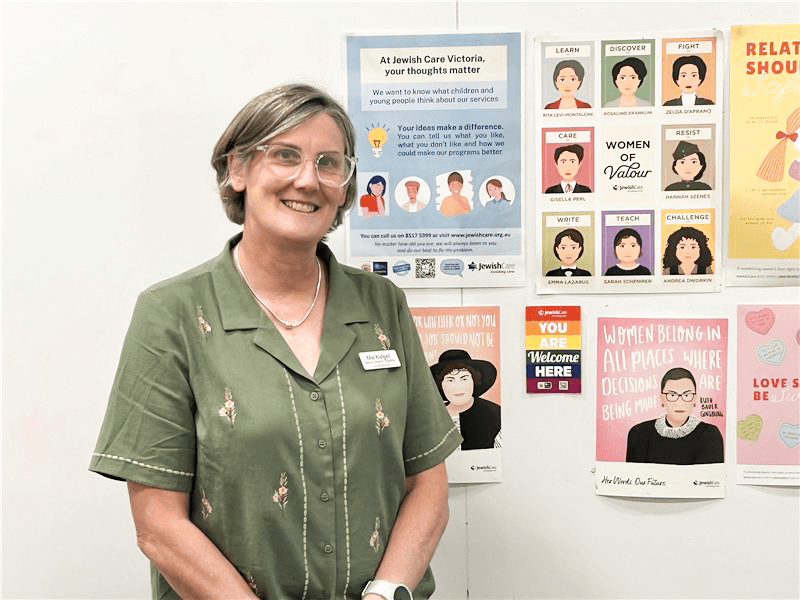
From left: Melinda Kidgell, Matthew Sortino, Bren Carllil: all non-Jews who work in Jewish organisations (Images supplied)

Published: 16 February 2026

Last updated: 26 February 2026

From the October 7 Hamas attacks to the horrific Bondi massacre, the past two years have created an unprecedented pressure cooker for everyone in Jewish spaces.

While the immediate focus has been – rightly – on the trauma of Jews themselves, non-Jewish professionals choosing to work in and for the Jewish community have faced their own unique challenges.

From navigating intense public discourse, to losing friends who don’t understand their commitment to the Jewish community, and confronting historical and contemporary stigmas in their circles – three workers speak to The Jewish Independent about the reality of being an ally on the inside.

‘I love that I am involved in the Jewish community’ – Matthew Sortino, 36 
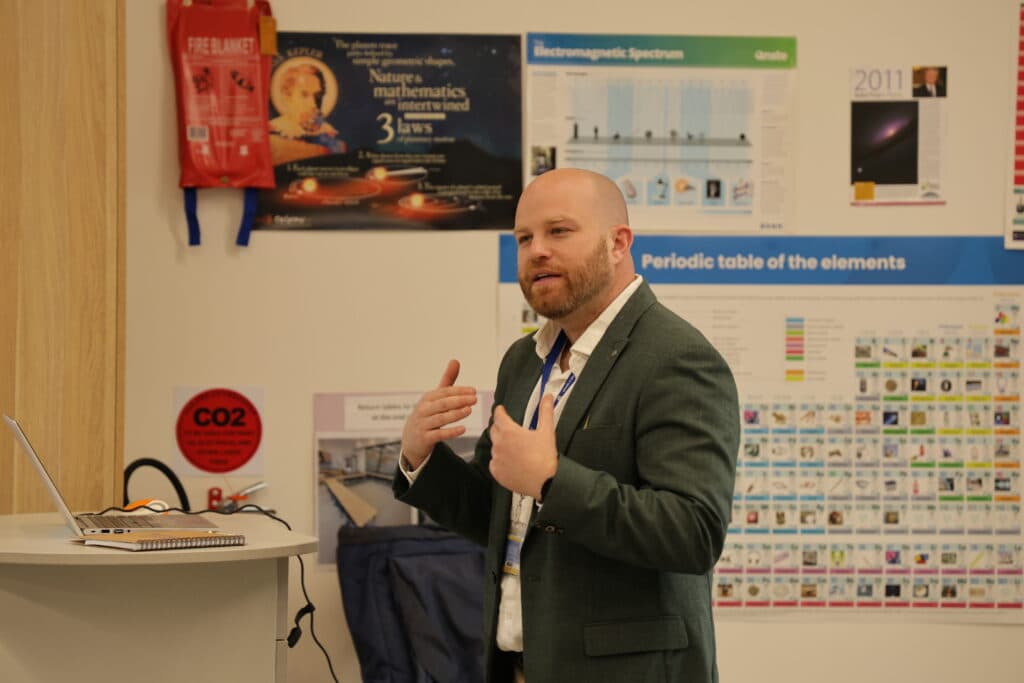
Sortino is Head of Humanities at Bialik College in Melbourne (Image: supplied).

I’m the son of migrants – my dad and my mum’s parents all came from Sicily in Italy. I was born in Melbourne and brought up Catholic, but I stopped being religious in high school. Today, I identify very much as being culturally Italian-Australian, my wife is Italian too and we are raising our kids to celebrate Christmas and Easter – although for us, it’s more about food and family than it is about religion. 

I started my teaching career in a Catholic primary school before I moved up through middle and then high school in the public system. I was offered the role of Head of Humanities at Bialik College out of the blue. I wasn’t sure about moving into private education, but I was sold in the first 10 minutes of meeting them. I really loved their approach to education and understanding of the importance of family.  
I feel like I’ve become a spokesperson for the Jewish community, because I’m often the only connection people in my circles outside of school have to Judaism.

Living in Melbourne’s northern suburbs, I’ve never been enmeshed in Jewish culture. I remember thinking during COVID that fringe conspiracies surrounding Jews became mainstream, and this only got worse after October 7. When I was leaving my old school to come to Bialik, a colleague said to me, ‘How can you do that? Aren't they all war criminals?’. I was blown away by that reaction, and it made me want to move to Bialik even more.

The measures to protect Jewish students were new to me. I hadn’t seen security guards at a school or experienced students needing to wear casual clothes on excursions. Initially, I thought it was a bit of paranoia. But after October 7, I decided to go on a learning deep dive on Israel-Palestine. I listened to Israeli news in English, I read countless books from different perspectives, and I found myself in very strong alignment with Bialik through my own pathway. I concluded that you can be an avid Zionist while believing in the dignity of the Palestinian people and wanting them to have a state to call their own. 

I'm seeing firsthand, from what is supposedly the most Zionist school in the country, a real advocacy for peace and hope for the future.

Bialik is an open space. It's a caring space. It’s a space that embraces different perspectives. I'm seeing firsthand, from what is supposedly the most Zionist school in the country, a real advocacy for peace and hope for the future. I feel like I’ve become a spokesperson for the Jewish community, because I’m often the only connection people in my circles outside of school have to Judaism. At Bialik, I feel I am also in the privileged position to be a sounding board, where I can sometimes offer a slightly different perspective.

I’m not Jewish so I can easily walk away from this if I wanted to, but I love that I am involved in the Jewish community. I drive 45 minutes each way every day because I enjoy my job. I’m not wanting to leave – if anything, I’m looking for ways to step forward, not back, with the aim of trying to illuminate the nuance and hopefully help build peace between people who may have hatred in their hearts. 

‘I know what it’s like when people make assumptions’ – Melinda Kidgell, 54

Kidgell is Deputy Director of Disability and Social Services at Jewish Care Victoria (Image: supplied).

I'm not Jewish, my background is Australian all the way back to the First Fleet, but I have worked in the Jewish community for about 10 years. I always wanted to work in social welfare because I identify as being part of a minority community myself.

My interest is in working with harder to reach groups, delivering services that aren’t mainstream or easy, and that deal with complex needs. I’ve worked with the Chinese community, with refugees and asylum seekers, and in a public housing program with The Salvation Army. 

Being part of Jewish Care as a non-Jewish person, I am aware that I am the other, and it’s on me to acknowledge that, step back and listen.

When I was offered a role at Jewish Care Victoria through a former colleague, I very quickly realised that there is a particular way people respond to and feel about the Jewish community. Nobody in my circle offered their congratulations or support. Instead, they said, ‘why would you want to work there?’ and even ‘why don’t they just get over the Holocaust?’. If anything, those comments made me double down because even though Judaism is not my cultural or religious identity, I know what it’s like when people make assumptions – for me personally, that’s always been about my gender expression and sexual identity. 

Being part of Jewish Care as a non-Jewish person, I am aware that I am the other, and it’s on me to acknowledge that, step back and listen. I think that’s the true essence of being an ally – to use your voice where your voice has the most impact, and to preference the voice of others in the environments where those voices are most relevant. 

Whenever I introduce myself as someone who works at Jewish Care, there is always a slight pause. Usually, I take no issue with that, but since October 7, I’ve found myself exhausted. The trauma has been consistent. My circles outside of work responded with mass silence, my relationships shifted, and I even had someone ask me if I was ashamed to work at Jewish Care. I was really upset by that, but I’ve never thought about leaving my job. 

I’m currently Deputy Director of Disability and Social Services, where I manage services that are by and for the Jewish community: housing and homelessness, financial support, family violence, parenting, mental health, youth programs, disability support. I’ve found Jewish Care to be an incredibly impactful place to work – positive, hopeful and filled with a real aspiration and solution-focused way of being. 

‘Now is the time when Israel needs its advocates’ – Bren Carlill, 48

Carlill is a Middle East analyst who works at AIJAC (Image: supplied).

I grew up in Darwin, where there were few Jews, in what's now called a Christian Zionist household. My parents are very strong Christians. When I was 14, we travelled to Israel for about two months and I loved it. When I turned 20, I went back and lived on a kibbutz for two and a half years. That was my first exposure to a Jewish community. I definitely consider myself a Zionist. 

I started working with AIJAC [Australia/Israel & Jewish Affairs Council] in 2006 and found my way back there last year after stints in public service, politics and with the Zionist Federation of Australia.  Today, I’m AIJAC’s Director of Special Projects, where I do long-form research projects, media interviews, opinion pieces, press releases, and so on.

Most people presume I’m Jewish. I’ve never tried to be part of the community, but I don’t find it weird to work in a Jewish organisation or for Israel advocacy.

When it comes to the Israeli-Palestinian conflict, I think most people are well-meaning but ignorant. They don’t have time to dig into the details and so they interpret it according to their worldview, which tends to be far more simplified than reality. My mission is not to whack people over their head with Israel, but to make them realise that it's a complicated conflict and therefore to approach it with the understanding that both sides have legitimate claims and legitimate grievances.  

Most people presume I’m Jewish. I’ve never tried to be part of the community, but I don’t find it weird to work in a Jewish organisation or for Israel advocacy. It’s something I’m good at and interested in. When I say what I do, most people are either genuinely interested or don’t care. Sometimes there is hate, but for me, I don’t have to walk my kids past armed guards when they go to school or when I go to my place of worship. Any ramifications of October 7 that I may have faced, which are relatively few, Australian Jews have faced far, far worse.  

My entire life, I have put my hand up to be an Israel advocate and now is the time when Israel needs its advocates – especially those who can explain this dispute in the context of the wider Middle East history with consideration and care.

You might also like
  • Tame apologises – but with little grace
    Deborah Stone
  • Confronting Richard Flanagan and the myth of the Israel lobby
    Mary Garden
  • Facing a new year with the knowledge life can be better
    The Jewish Independent
logomark.67a07ee3
We believe in the free flow of information

Republish our articles for free, online or in print, by using our Creative Commons licence

You might also like

    Rosh Hashanah Customs
    FeatureLifestyle

    10 little-known Rosh Hashanah customs from around the world

    Menachem Posner
    Neurodivergence panel
    VideoLifestyle

    Neurodivergence and inclusion in the Jcom

    The Jewish Independent
    Generation Change: Rachel Moshel
    Generation ChangeInterviewArts & Culture

    Rachel Moshel: Creating a space for Jewish art and joy

    Gideon Cohen

About the author

Ruby Kraner-Tucci

Ruby Kraner-Tucci

Assistant Editor

Ruby Kraner-Tucci is a journalist and TJI's assistant editor. Her writing has appeared in The Age, Australian Jewish News, Time Out and Broadsheet, among others. Ruby was awarded Multicultural NSW’s Best Report in Multicultural Media 2025 and has been named a Top 36 Under 36 Jewish Changemaker by B'nai B'rith.

More from the author

InterviewAustralia

Elliot Szafran: food that feels like a hug from Zaide

NewsAustralia

Antisemitic incidents down from peak but still triple pre-Gaza war

FeatureArts & Culture

Bringing Terezin music to life 

Comments2

  • Avatar of Jack

    Jack27 February at 06:03 am

    Thanks for a really interesting article, with different perspectives. While the sample size is only three, what does it say that two of the three were met with horrific responses from their own circles when they told them they were working for a Jewish school and Jewish Care?

  • Avatar of Emanuella

    Emanuella16 February at 07:45 am

    Thank you so much for highlighting these heroes Ruby, we need these people more than ever now.