Aa
  • Read, Watch, Listen
  • TJI Series
  • Community Action
  • Events
  • Zedi
Follow us and continue the conversation
  • LinkedIn
  • Instagram
  • FaceBook
  • X
  • YouTube
Test yourself with the TJI Quiz!

Adjust size of text

Aa

Follow us and continue the conversation

  • LinkedIn
  • Instagram
  • FaceBook
  • X
  • YouTube

Your saved articles

You haven't saved any articles

What are you looking for?

Original reporting, insightful analysis and diverse views, delivered straight to your inbox

  • LinkedIn
  • Instagram
  • FaceBook
  • X
  • YouTube
Your support fuels our mission to inform, entertain and inspire.

The Jewish Independent is bound by the Standards of Practice of the Australian Press Council. If you believe the Standards may have been breached, you may approach The Jewish Independent or make a complaint to the Australian Press Council in writing at www.presscouncil.org.au. The Council may also be contacted on 1800 025 712.

  • Our Story
  • Contact us
  • Our Team
  • Support us
  • Guidelines
  • Pitch your idea
  • Republishing us
  • Community Action
  • Our Awards
  • LinkedIn
  • Instagram
  • FaceBook
  • X
  • YouTube
Aboriginal FlagTorres Strait Islanders Flag

The Jewish Independent acknowledges Aboriginal and Torres Strait Islander peoples as the Traditional Owners and Custodians of Country throughout Australia. We pay our respects to Elders past and present, and strive to honour their rich history of storytelling in our work and mission.

© The Jewish Independent 2026All Rights Reserved
Website design and development by Your Creative, MelbourneTerms & ConditionsPrivacy Policy
HomeRead, Watch, ListenAustralia
FeatureAustralia

The extraordinary life of hotelier Hannah Maclurcan

She was probably a bigamist, founded one of Australia’s grand hotels and was the first female director of an Australian public company. But Hannah Maclurcan’s first love was cookery.
Steve Meacham
Print this
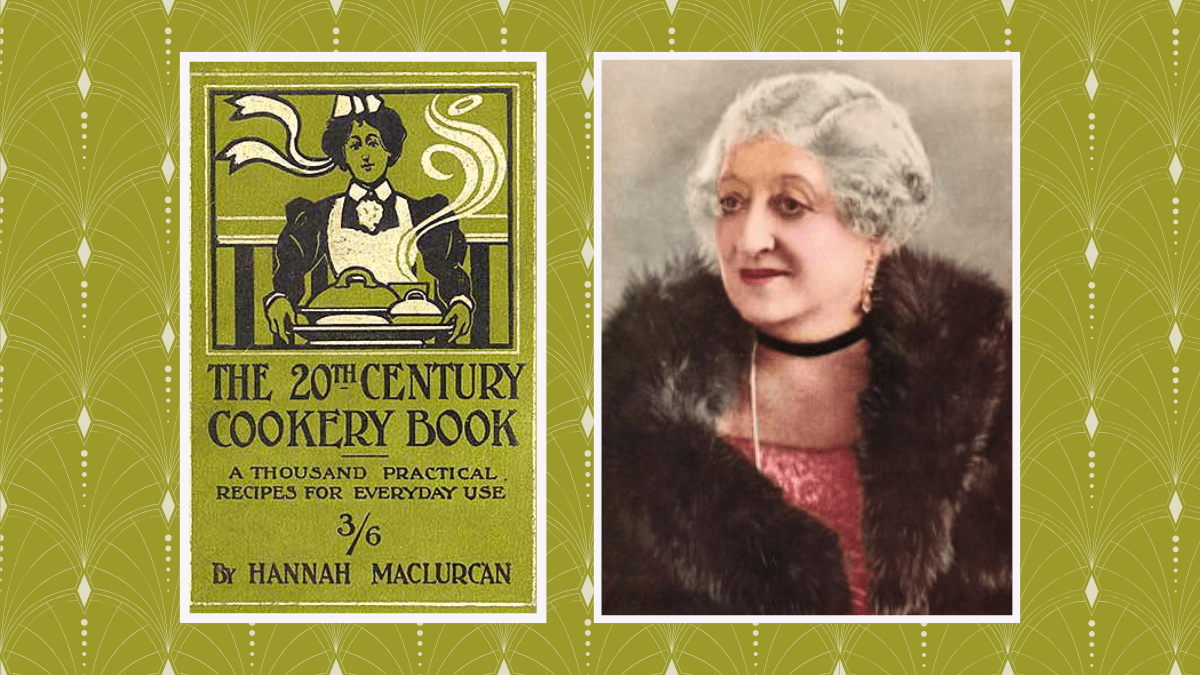
Hannah Maclurcan cookbook

Published: 5 August 2022

Last updated: 5 May 2026

Frimsel soup was a popular Jewish dish in the 19th century. It was a broth made of cheap vegetables and frimsels, “a kind of egg noodle, similar to vermicelli or egg-noodle,” explains Jacqui Newling, author of Eat Your History: Stories and Recipes from Australian Kitchens and “resident gastronomer” at Sydney Living Museums.

We’re discussing some of the Jewish recipes that Hannah Maclurcan, ground-breaking self-taught cook, company director, entrepreneur, socialite and owner of Sydney’s late-lamented Wentworth Hotel, produced for what many consider the first authentic, best-selling, Australian cookbook, which was published in 1898. A copy of the book was delivered to the ailing Queen Victoria.

Newling doesn’t have a first edition of Mrs Maclurcan’s Cookery Book: A Collection of Practical Recipes Suitable for Australia.  But she has a 1905 reprint with almost a dozen of Maclurcan’s recipes identified as Jewish, including frimsels, kleis and matzo. Many involve dumplings or noodles to fill empty stomachs on a small budget.

Newling's favourites include “Brown Stewed Fish” with dark treacle, Guinness-style porter, lemon juice, ginger, nutmeg and cloves. There is a cheaper variation, made with gingerbread, treacle and vinegar for those without the necessary spices or wanting a non-alcoholic version.

The combination of Jewish and Australian recipes is innovative, ranging from an Asian-influenced soup recipe for beche-de-mer (sea cucumbers), which she came across while managing hotels in Far North Queensland, to classic fried fish ("Jewish people seldom use breadcrumbs and always the best olive oil").

The review in London’s Jewish Chronicle, on December 21, 1900, was mainly complimentary, though it contained warnings about obscure Australian fruits and Maclurcan's lack of adherence to kashrut. “The book is a thoroughly practical compendium of good cooking (but) being intended for general up-to-date use, great care and discrimination must be exercised in its use in Jewish households.”
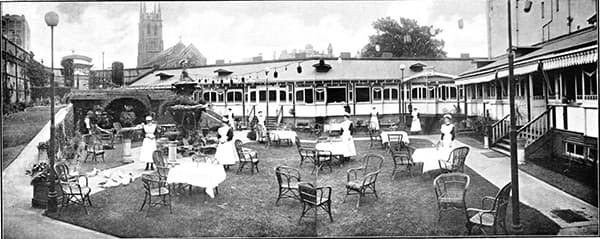
The Wentworth was little more than a boarding house. Maclurcan transformed it to one of the finest hotels in the southern hemisphere. 

So, who was Hannah Maclurcan? And why celebrate her a century after her heyday?

We know about Maclurcan mainly through the passion of two people; John Maclurcan (her great grandson whose extensive research can be found in the State Library of NSW), and Karen Bates (who has written an unpublished biography, inspired by Maclurcan's unique contribution to Australian cuisine).

She was born a goldfield baby in NSW’s Hill End in 1860, the fourth child of Susan Moses and husband Jacob Phillips.

Jacob Aaron Phillips - son of Barnard Aaron Phillips, a Jewish immigrant from London who purchased The Star of Earth hotel near Sydney’s Circular Quay in 1843 - was a prosperous storekeeper and publican when he married Scots-born Susan Moses in Mudgee in 1854.

This was a tumultuous time in the NSW goldfields. Most Australians know of the 1854 Eureka stockade rebellion in Victoria. But NSW had recorded its own miners’ rebellion the previous year when troopers from the 11th regiment marched into the Turon goldfields of Bathurst, Sofala and Hill End to enforce a new law: the Goldfields Management Bill. The miners burned an effigy of the politician who had presided over a law which required them to pay 30 shillings a month (about $700 today) for a 3.6 metre square claim, whether they struck gold or not.

The legislator’s name? Wentworth.

“On May 26, 1859, Jacob was robbed of 150 pounds in bank notes by three bushrangers. He gave detailed descriptions of all three. Hannah was born the next year. Lots of Jews were leaving NSW at that time. Jacob and Sarah decided to move north to the newly created state of Queensland,” said Bates.

Wentworth Tea Gardens, created by Maclurcan

But the move was bittersweet. Maclurcan’s mother died of septicaemia in 1866 after giving birth. She was  31. With the help of a nanny who Sarah had chosen (“needlework an advantage”), Jacob raised their six children.

By the time she was 15, young Hannah was managing her father’s hotel in Sandgate, north of Brisbane.

Let’s pass over her first marriage in 1880, to a dissolute English conman who left her a single mum with two young daughters.
She certainly passed over it. Maclurcan was probably a bigamist, having no idea if her first husband was dead or alive when she married an ancient mariner called Donald Maclurcan seven years later. The couple had two children together and Donald allowed his name to be displayed over the licensed premises, and left Maclurcan to run their businesses.

By the time Donald died, in 1903, Maclurcan was already a celebrity. Not only because of her cookbook (of which there were 18 editions over 30 years), but also because she was transforming Sydney’s Wentworth Hotel. When the couple leased it in 1901, the Wentworth was little more than a boarding house close to Circular Quay. 

By 1912, when Maclurcan became the first female managing director of an Australian limited company, the Wentworth had become one of the finest and most innovative hotels in the southern hemisphere. She introduced the a la carte menu to Australian hotels, allowing guests to eat their choices, cooked to order between 11am and 11pm, rather than be dictated by formal sittings with set menus.

She also added extra storeys to the Wentworth, with Sydney’s first lifts (a novelty so technologically advanced the Sydney Morning Herald covered the first ascent). She opened Sydney’s first inner-city tea garden, where women could be photographed in all their finery and make a splash in the social pages.

Maclurcan courted publicity, launching the Wentworth Magazine, perhaps the first hotel women’s magazine in Australia, and cannily focusing on bridal fashions, theatre reviews and interviews with artists and authors best explored with an overnight stay at her hotel.

John Maclurcan believes her greatest claim to fame isn’t her eight-course menus for governors-general and royalty, nor her mastery of Australian ingredients in her cookbooks (fricassee of sheep’s brains, anyone?).

“Two years before World War I, my great-grandmother floated the Wentworth Hotel on the stock market,” he says. “She was its managing director, the first in Australia, and just ten years since Australia became the first country after New Zealand to give women the vote.”

You might also like
  • I’m a Jewess and I’m owning the term 
    Leila Segal
  • US and Israel are more ‘The Handmaid’s Tale’ than ‘The Testaments’
    Leslie Cannold
  • Women disadvantaged by new powers for Israel’s religious courts
    Eetta Prince-Gibson
logomark.67a07ee3
We believe in the free flow of information

Republish our articles for free, online or in print, by using our Creative Commons licence

You might also like

    Apple & rotten core Rosh hashanah
    EditorialAustralia

    Facing a new year with the knowledge life can be better

    The Jewish Independent
    neo-nazis white supremacists corowaTEST
    Royal CommissionOpinionAustralia

    Antisemitism, homophobia and a radical response to both

    Dennis Altman
    Woman with land and houses behind her
    NewsAustralia

    Australia to increase sanctions against West Bank settlements

    Deborah Stone 2

About the author

Steve Meacham

Steve Meacham

Steve Meacham is a senior features writer whose work has appeared in many Australian and British publications. He has also written several authorised biographies.

More from the author

Australia

‘Never seen anything like this’: Aussies watched war from their balcony

Arts & Culture

Is this show still funny after so many years? Well, it helps if you’re Jewish

FeatureAustralia

Living – and dying – with motor neurone disease: one family’s story

FeatureArts & Culture

A musical about lynching a Jew is striking a new chord